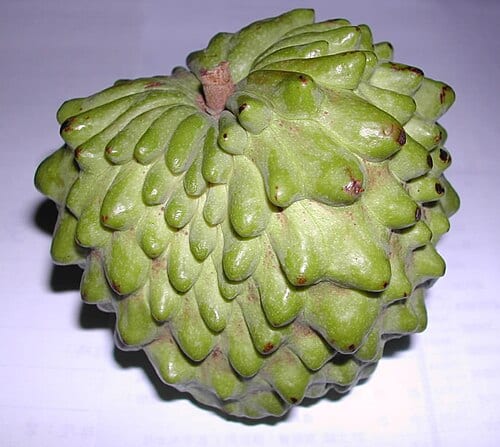
Atemoya is an artificially selected hybrid fruit variety within the Annona genus, with over 90 percent of Taiwan's production concentrated in Taitung County. Swap out the chalky sweetness of a sugar apple for something delicately juicy, and replace the mouthful of seeds with almost none at all — that is what decades of production-technique and cultivation work by the Taitung Agricultural Improvement Station have achieved. The atemoya (formal name: pineapple annona) descends from a hybrid line introduced from Israel, and it can only be tasted during October to December each year.
The atemoya's underlying cultivar traces to the Gefner hybrid variety of Annona introduced from Israel in 1965 — it is not a variety bred from scratch by the Taitung Agricultural Improvement Station. The station's key contribution was developing pruning and off-season production techniques that made winter-crop fruit (roughly November to March) commercially viable and avoided the fruit-splitting problem of the summer crop; the industry only took off around 1997. According to 114/115-period data, Taitung County accounts for 99% of Taiwan's 2,454 hectares of atemoya harvest area, producing about 12,761 metric tons annually — a near-total share of Taiwan's production, not global production.
What is Atemoya
The atemoya is an artificially bred cultivar resulting from a cross between the sugar apple (Annona squamosa) and the cherimoya (Annona cherimola), successfully selected by the Taitung Agricultural Improvement Station. The fruit is larger than a conventional sugar apple, with deeper, darker-green scales on the skin. The flesh inside is creamy white, soft, and delicate, with high sugar content (Brix 18 to 22 degrees) and few or no seeds. In flavor it carries the milky fragrance of the sugar apple with a subtle pineapple tartness, and in texture it is far juicier and less powdery than a traditional sugar apple.
Taitung County is the sole major production area for atemoya. Large-scale cultivation exists in Beinan Township, Luye Township, Taimali Township, and elsewhere, with the Beinan Township Farmers' Association serving as one of the most important production and marketing support organizations. The peak season runs from October to December, with some late-ripening varieties extending into January. Because the cultivation technology is demanding and varietal licensing is tightly controlled, virtually no other region can replicate the same quality at scale outside Taitung, creating a strong geographical-indication effect for this local agricultural product. Both the Council of Agriculture's Grain Management Office under the Executive Yuan and the Taitung Agricultural Improvement Station have published complete records of the variety's development history and production area.
How to eat it like a local
Local knowledge
Objective endorsements
- The Council of Agriculture's Grain Management Office records the atemoya variety development process and confirms it was bred by the Taitung Agricultural Improvement Station.
- The Taitung County Government Agriculture Department's dedicated "Atemoya" page explains the production area distribution and variety characteristics.
- Over 90% of global atemoya production comes from Taitung County, giving it a near-exclusive geographic origin.
Visiting tips
- Atemoya does not travel well over long distances. Buying it in Taipei means accepting some quality degradation; the best experience is still purchasing at Taitung's production sites or local farmers' associations.
- Typhoon or heavy-rain years can reduce that year's output and lower quality. Keep an eye on agricultural weather news during the season before making a purchase trip.
Sources: Council of Agriculture Grain Management Office variety introduction, Taitung County Government Agriculture Department "Atemoya" page, Taitung Agricultural Improvement Station breeding records.
Frequently Asked Questions
Is atemoya a Taitung-native variety?
No — the variety originates from the Gefner cultivar of Annona introduced from Israel in 1965. The Taitung Agricultural Improvement Station's contribution was developing off-season production techniques, not breeding a new species.
What share of Taiwan's atemoya production comes from Taitung?
According to 114/115-period data, Taitung County accounts for 99% of Taiwan's 2,454 hectares of harvest area, producing about 12,761 metric tons a year.
When is atemoya season?
The main season runs October through December, with some late varieties extending into January; winter-crop cultivation techniques were the key to turning it into a real industry.
Sources
- 鳳梨釋迦竟非台灣原品種!台東產量佔99% 這時才形成產業 — 壹蘋新聞網報導,載明品種來源與台東縣佔全台99%產量
- 台東非鳳梨釋迦發源地 60年前從以色列引進 — 報導確認品種於54年自以色列引進