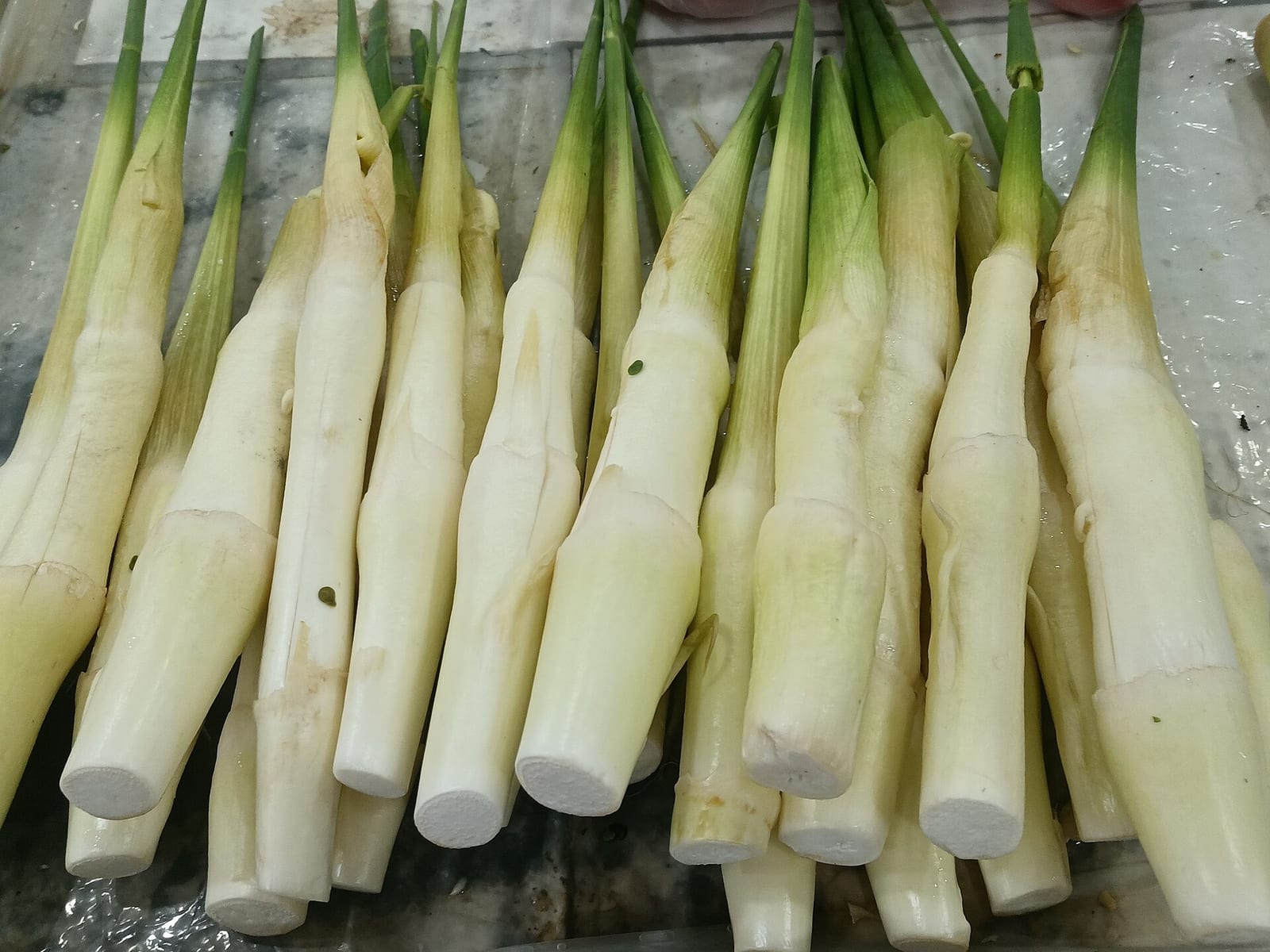
Water bamboo is a summer aquatic vegetable grown across Taiwan, its stem swelling into a plump, pale white shoot after infection by the fungus Ustilago esculenta — a shape that has earned it the nickname "beauty's legs." Puli in Nantou is Taiwan's largest production area: walk into its paddies and beneath rows of tall green leaves you'll find these pale, sweet shoots, which travel fresh from the basin to tables nationwide each summer.
According to Taiwan's Ministry of Agriculture, Puli's water bamboo cultivation accounts for more than 80% of Taiwan's total planted area and over 90% of national output; Taiwan Panorama magazine reports the area at roughly 1,800 hectares, about 85% of the national total, with production exceeding 92%. The nickname "beauty's legs" comes from the pale, elongated shape of the peeled stem, and the Puli Township Farmers' Association has held a "Beauty's Legs Princess" pageant since 2007 to promote the local industry.
What is water bamboo?
Water bamboo is the swollen tender stem of the aquatic plant Zizania latifolia, enlarged by infection with the fungus Ustilago esculenta, forming the plump, pale flesh inside. The texture is crisp and clean-sweet. Puli is Taiwan's largest water bamboo production area — according to Council of Agriculture data, its cultivated area accounts for more than 80% of the national total, and its output exceeds 90%.
The Puli basin has clean water and a large day-to-night temperature difference, producing shoots whose flesh is white and shaped like a calf — hence the nickname "beauty's legs" (meirenti). The Puli Township Farmers' Association has held the Beauty's Legs Festival since 2007, bringing this local pride to a national audience.
How to eat it the authentic way
Local knowledge
Verified facts (sponsored content excluded)
- According to Council of Agriculture data, Puli's water bamboo cultivation area accounts for more than 80% of the national total and its output exceeds 90% — it is genuinely Taiwan's largest production area in every sense.
- The nickname "beauty's legs" comes from the flesh being pale white and shaped like a calf — it has become the standard name for Puli water bamboo.
- The Puli Township Farmers' Association has held the Beauty's Legs Festival since 2007 and is the official channel for information on the growing season and production area.
Visitor tips
- Peak season runs from summer through autumn. Choose shoots with full, plump bodies, tips that haven't turned green, and a firm feel when pressed — these will be the sweetest.
- Store unpeeled shoots in the refrigerator for better freshness. Peel just before eating to prevent moisture loss and softening.
- For direct farm produce, contact the Puli Township Farmers' Association. For in-season availability, check the Farmers' Association's announcements.
Information compiled from the Nantou County Government tourism resources and local township farmers' associations. Sponsored content has been excluded.
Frequently Asked Questions
What is water bamboo?
Water bamboo is the swollen tender stem of the aquatic plant Zizania latifolia, enlarged by infection with the fungus Ustilago esculenta, giving it a crisp, sweet texture.
Why is water bamboo nicknamed "beauty's legs"?
Because the peeled stem is pale white and shaped like a slender calf, earning it the nickname "beauty's legs."
When is the peak season for Puli water bamboo?
Peak season runs from summer through autumn, when the sweetest shoots are available.
What share of Taiwan's water bamboo comes from Puli?
According to the Ministry of Agriculture, Puli accounts for over 80% of Taiwan's cultivated area and over 90% of national output, making it the largest producer.
Sources
- 農業部全球資訊網《挺直又白皙的美人腿-茭白筍》 — 栽培面積占全台8成以上、產量占9成以上
- 台灣光華雜誌《照亮美人腿——埔里茭白筍傳奇》 — 栽培面積約1,800公頃、占全國85%,產量占92%以上
- 國家文化記憶庫《美人腿節》 — 埔里鎮農會自2007年起辦理美人腿公主選拔