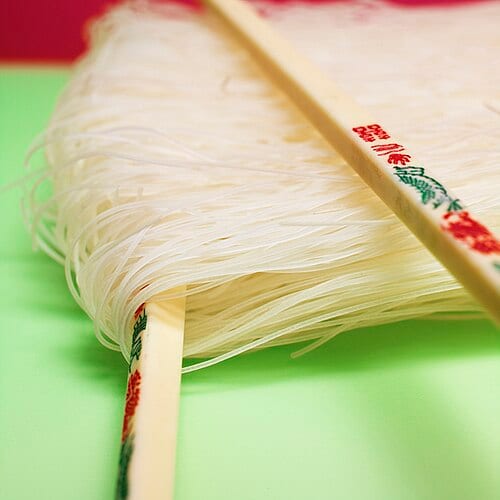
Puli rice noodles are a water-boiled style of rice noodle made in Puli, Nantou, known locally as "water noodles" because the rice paste is extruded straight into boiling water rather than steamed — a method distinct from Hsinchu's steamed-style noodles. Inside an old shop across from the Puli Winery, bundles of rice noodles are made in-house and sun-dried, then dropped into broth; pick up a strand and it's thicker than expected, moist, sliding smoothly yet holding its shape — the unmistakable taste of this mountain town.
Taiwan's rice noodles fall into two schools: Hsinchu's steamed-style ("chuifen") is thin and dry, while Puli's water-boiled style ("shuifen") is thicker and moister — Puli and Hsinchu are recognized as Taiwan's two major rice noodle production centres. The local shop Zhen Song Ji Rice Noodles, located directly across from the Puli Winery, has made water-style noodles in-house for three generations and over 70 years, making it a representative producer of the water-noodle method.
What are Puli Rice Noodles?
Puli rice noodles are "water noodles" (shuifen) — the rice paste is extruded directly into boiling water rather than steamed. The result is a thicker strand with higher moisture content and a smoother texture. This is the key distinction from Hsinchu's "steamed noodles" (chuifen), which are made by steaming and come out thin and dry. Puli is one of Taiwan's two major rice noodle production centres, and with its local water quality and noodle-making craft, it has developed a water-style flavour entirely its own — the representative noodle dish of Puli Township.
Taiwan's rice noodles fall into two broad camps: Hsinchu's steamed noodles are thin, dry, and made by steaming; Puli's water-boiled noodles are extruded into hot water, coming out thicker and moister, with a smooth yet slightly chewy texture that suits being cooked in broth or stir-fried until well-seasoned. Puli earned its place as one of the two major production centres through the purity of its water and the craft passed down through generations of noodle makers — making water-style rice noodles the natural centrepiece of this mountain town's table.
How to eat it the authentic way
Local knowledge
Verified facts (sponsored content excluded)
- Puli is one of Taiwan's two major rice noodle production centres. The local noodles are water-style (shuifen) — extruded into boiling water, thicker, high in moisture, smooth in texture — distinct from Hsinchu's steamed-style (chuifen).
- The anchor vendor, Zhen Song Ji Rice Noodles, has produced water-style rice noodles in-house across three generations, located directly across from the Puli Winery.
- This guide is organized by dish. The anchor shop is noted only for location reference and future on-site photography — it is not a restaurant ranking.
Visitor tips
- The anchor location is in Puli Township, directly across from the Puli Winery — easy to locate and convenient to combine with a winery visit.
- This is a local noodle shop. Visit during meal hours for freshly cooked noodles at their best.
- Coordinates are approximate field-survey values. Actual address and operating hours should be confirmed on-site.
Information compiled from the Nantou County Government tourism resources and local township farmers' associations. Sponsored content has been excluded.
Frequently Asked Questions
What are Puli rice noodles?
Puli rice noodles are "water noodles," made by extruding rice paste directly into boiling water, resulting in a thicker, moister, smoother strand.
How do Puli and Hsinchu rice noodles differ?
Hsinchu's "steamed noodles" are thin and dry; Puli's "water noodles" are thicker and moister, since the cooking methods differ.
Where is the most authentic place to eat Puli rice noodles?
Old in-house producers like Zhen Song Ji Rice Noodles, across from the Puli Winery, let you see the water-noodle making process.
How are Puli rice noodles best cooked?
Water noodles absorb broth well and hold up to stir-frying — both a noodle soup and a stir-fry let the rice fragrance shine through.
Sources
- 自由時報《食譜自由配》米粉到底有沒有米?水粉、炊粉差在哪? — 水粉與炊粉製程差異
- 食力foodNext《新竹和埔里米粉哪裡不一樣?》 — 埔里與新竹並列台灣兩大米粉產地
- 振松記米粉店家報導(豬爸一家) — 位於埔里酒廠對面、傳承三代逾70年