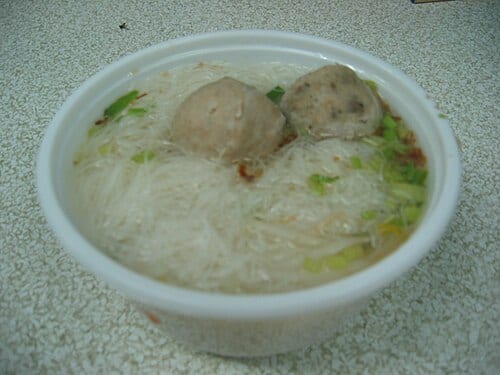
Hsinchu Rice Vermicelli is a traditional rice noodle made from indica rice, steamed and then wind-dried by the seasonal northeast monsoon known locally as the Nine Descending Winds, prized for its fine yet springy texture and famous across Taiwan. Enter Hsinchu in autumn and the air carries a scent of rice mingled with wind: along the Keya River, the vermicelli-drying yards of Nanshili hang row after row of white strands like curtains in October's gusts — Hsinchu's most aromatic season of the year. It owes its springiness to the monsoon that blows from around September for three or four months each year. Hsinchu City was included in the MICHELIN Guide Taiwan for the first time in 2025, and a rice vermicelli stall in East Gate Market was among the seven local eateries selected for the Bib Gourmand that year.
Under Taiwan's national standard CNS 11172, 'pure rice vermicelli' must be made from rice alone with at least 5.0% crude protein, while 'blended rice vermicelli' needs only over 50% rice content and can include corn starch or other starches, with a lower 2.5% crude protein threshold. The Nanshili vermicelli-drying settlement traces back to Hui'an (Fujian) immigrants surnamed Guo who settled along the Keya River after finding its terrain and wind conditions ideal for drying vermicelli. Hsinchu City was included in the MICHELIN Guide Taiwan for the first time in 2025, and the East Gate Market rice vermicelli stall was one of the seven local eateries selected for that year's Bib Gourmand.
What Is Hsinchu Rice Vermicelli
Hsinchu rice vermicelli uses indica rice as its base. The rice is ground into a slurry, pressed, kneaded into a dough, and extruded into fine strands, then steamed and wind-dried. Traditionally there are two types: "steamed vermicelli" (炊粉), which comes out thin and springy and holds up in soup or stir-fry without turning mushy; and "water vermicelli" (水粉), which is slightly thicker and softer, commonly found in rice noodle soup. What Hsinchu is truly renowned for throughout Taiwan is the steamed variety — strands as fine as hair that remain firm even after prolonged soaking, a feat that vermicelli made elsewhere cannot replicate.
Why Hsinchu? The answer is wind. Each year from September through January, the northeast monsoon funnels through the Taiwan Strait and encounters the river valleys of the Touqian and Keya rivers, generating the driest and strongest winds in all of Taiwan — known locally as the "Nine Descending Winds" (九降風). Rice vermicelli requires low temperatures, low humidity, and strong air circulation to dry properly, and Hsinchu's climate offers conditions found nowhere else in Taiwan. In 2025, a rice vermicelli stall in the East Gate Market area was selected for the Michelin Bib Gourmand — Hsinchu's first-ever inclusion in the Michelin Guide — raising the profile of this century-old industry yet another notch.
How to Eat It the Local Way
Local Knowledge
Verified endorsements (advertiser-filtered)
- An East Gate Market rice vermicelli stall was selected for the 2025 Michelin Bib Gourmand — Hsinchu's first-ever inclusion in the Michelin Guide — representing the district's long-established old-timers.
- The Nanshili rice vermicelli-making village is registered as an industrial landscape in the National Cultural Memory Bank; century-old vermicelli workshops are clustered here.
- Pure rice vermicelli and blended vermicelli (rice + corn starch) carry different CNS labeling; check the rice-content percentage on the packaging when purchasing.
Tips for Visiting
- East Gate Market is busiest before 10 a.m.; many stalls close after noon, so arrive early if there's a queue.
- The drying yards are private family workshops — please stay on the outer walkways and do not enter the drying areas, to avoid disrupting production.
- For wetter-style stir-fried vermicelli, look for old stalls in the city center; for drier versions, try Hakka villages, where the style differs slightly.
Information compiled from the Michelin Guide, Hsinchu City Government Tourism Bureau, Hsinchu County Government Tourism and Travel Division, and a large volume of public reviews, with sponsored content filtered out.
Frequently Asked Questions
What are the two types of Hsinchu rice vermicelli?
Hsinchu rice vermicelli traditionally comes in two types: steamed vermicelli, which is thin, springy, and holds up in long cooking, and water vermicelli, which is thicker and softer, commonly used in rice noodle soup.
Why is Hsinchu rice vermicelli especially famous?
The key is the Nine Descending Winds — the northeast monsoon that blows for three or four months starting each September creates Hsinchu's uniquely cold, dry, and windy drying conditions, a climate advantage hard to replicate elsewhere.
How can you tell if you're buying real rice vermicelli?
Under the CNS 11172 standard, pure rice vermicelli must be made from rice alone, while blended vermicelli may contain corn starch; check the packaging for rice content and crude protein labeling.
Has the East Gate Market vermicelli stall won any recognition?
The East Gate Market rice vermicelli stall was one of the seven Hsinchu City eateries selected for the Bib Gourmand when Hsinchu was first included in the MICHELIN Guide Taiwan in 2025.
Sources
- 農業知識入口網:純米米粉好處多,如何辨別有撇步 — CNS 11172純米/調合米粉標準
- 國家文化記憶庫:米粉寮 — 南勢里米粉寮聚落起源、福建惠安郭姓移民
- 新竹市政府市政新聞:竹市首度入選《臺灣米其林指南2025》必比登名單 — 新竹市2025年首度納入米其林評選
- NOWnews:2025新竹市必比登名單/7間入選 — 東門米粉攤為7家入選店家之一