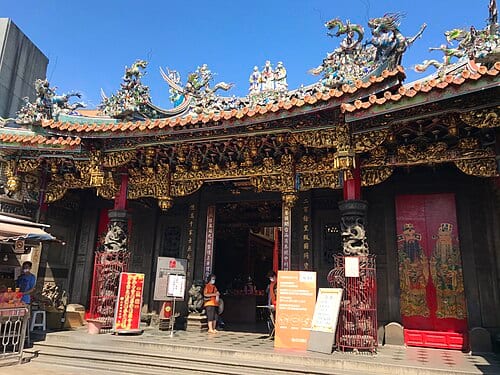
Hsinchu City God Temple is a temple founded in 1748, the 13th year of the Qing Qianlong reign, built through funds raised by local gentry at the request of Tamsui sub-prefect Zeng Riying. Its present main structure dates from a 1924 renovation designed by renowned Quanzhou master carpenter Wang Yishun, and the temple was designated a Hsinchu municipal historic site on August 19, 1985 — it is Taiwan's only temple honored with the title 'Du Chenghuang' (Metropolitan City God).
According to the National Cultural Heritage Database and Wikipedia, Hsinchu City God Temple was founded in 1748 (the 13th year of the Qianlong reign), built with funds raised by local gentry — including land donated by Wang Shijie — at the request of Tamsui sub-prefect Zeng Riying. The current main building dates from a 1924 renovation designed by renowned Quanzhou master carpenter Wang Yishun. The temple was officially designated a Hsinchu municipal historic site — not a national one, as some sources incorrectly state — on August 19, 1985.
What to see at Hsinchu City God Temple
The temple follows the traditional Hokkien san-chuan-dian (triple-hall) layout. The upswept swallow-tail ridge, cut-and-paste mosaic work, and jiaozhi pottery decorations are the main visual highlights, while the painted woodcarvings on the pillars and beams of each hall remain relatively well preserved. The temple has undergone multiple restorations from the Qing dynasty to the present, balancing heritage conservation with active religious use. The honorific 'Du' (都) in its name denotes the highest rank among City God temples — a designation unique in Taiwan that was officially granted by the Qing court when the temple was built.
The plaza in front of the temple and the surrounding lanes form a renowned street food hub. Traditional stalls selling rice noodle soup, pork ball soup, spring rolls, and fish ball dishes create a dense culinary ecosystem that draws crowds on both weekdays and weekends. The temple is an active place of worship; visitors interested in City God traditions can observe temple ceremonies and the arrangement of deities.
Tips for getting the most out of your visit
Practical information
Getting there and timing
- About a 10-minute walk from TRA Hsinchu Station. From HSR Hsinchu Station (Liujia), take a bus into the city center — check the latest Hsinchu Bus routes before you go.
- The temple is open year-round with no admission fee. Food stall hours vary; some open at dawn and close when sold out.
Nearby connections
- Zhuqian City Yingxi Gate is about a 5-minute walk away — pair it with a stroll through the moat park.
- The Glass Art Museum and Hsinchu Park are about 10 minutes by bike, making a full-day city itinerary easy to plan.
Sources: National Historic Site records from the Cultural Heritage Bureau, Ministry of Culture, and the Wikipedia entry for Hsinchu City God Temple.
Frequently Asked Questions
When was Hsinchu City God Temple founded?
It was founded in 1748, the 13th year of the Qing Qianlong reign, funded by local gentry at the request of Tamsui sub-prefect Zeng Riying.
Is Hsinchu City God Temple a National Historic Site?
No — it was designated a Hsinchu municipal historic site on August 19, 1985, not a national one.
When was the current temple building renovated?
The present main structure dates from a 1924 renovation designed by renowned Quanzhou master carpenter Wang Yishun.
Sources
- 新竹都城隍廟 - 國家文化資產網 — 古蹟等級(市定,非國定)、指定日期1985-08-19
- 新竹都城隍廟 - 維基百科 — 建廟沿革、1924年重修、王益順