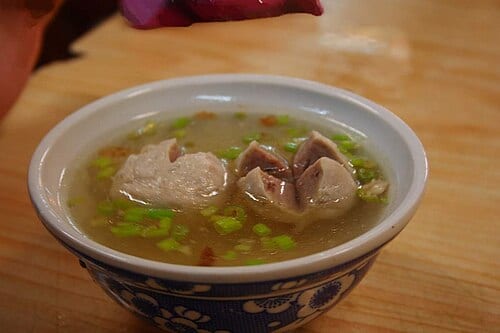
Hsinchu Pork Meatballs are a Hakka-style meatball made by pounding fresh pork leg into a paste with a wooden mallet and then boiling it into a springy, juice-bursting ball — one of Hsinchu's signature specialties. Step into the area around Ximen Street and the City God Temple and the air carries the distinctive scent of a mallet striking pork. Hai Rui Gongwan's founder Huang Hairui started as a street vendor at Hsinchu's South Gate Market in 1948, then around 1960 switched from hand-pounding to mechanical pounding, sharply boosting output and helping the Hsinchu gongwan industry take shape. Jin Yi Gongwan was founded in 1938 in front of the City God Temple and is one of the oldest surviving meatball factories in the Hsinchu-Miaoli region; it opened the Jin Yi Gongwan Culture Hall for visitors in 2002.
Hai Rui Gongwan's founder Huang Hairui began as a street vendor at Hsinchu's South Gate Market in 1948, and around 1960 he switched from hand-pounding to mechanical pounding, sharply increasing output and helping shape the Hsinchu gongwan industry; frozen home-delivery sales only developed gradually after 2000 under the third generation of leadership. Jin Yi Gongwan was founded in 1938 in front of the City God Temple, moved into the Central Market in 1943, opened an automated factory in Zhubei in 1990, and established the Jin Yi Gongwan Culture Hall in 2002 offering guided tours and DIY experiences; it has received the Council of Agriculture's Food Excellence Gold Award (1996) and the Ministry of Economic Affairs' Creative Life Industry certification (2003).
What Are Hsinchu Pork Meatballs
The character "gong" (貢) in Taiwanese means "kong" (摃) — to pound hard. The traditional method for Hsinchu pork meatballs involves cutting freshly slaughtered pork hind leg into chunks and pounding them with a wooden mallet for several hours, fully releasing the muscle fibers and proteins into gelatin. A small amount of salt, sugar, white pepper, and ice is added for seasoning, then the mixture is shaped into balls and boiled. Each ball is firm and compact, springs back when bitten, and bursts with sweet, clear meat juices.
Hsinchu's status as a synonym for gongwan traces back to several well-established names. In the 1960s, Hai Rui Gongwan's founder Huang Hairui pioneered frozen home delivery, taking gongwan from a street-food stall in front of Hsinchu's City God Temple to a specialty available throughout Taiwan. Jin Yi Gongwan, founded in 1938, is one of the oldest meatball factories in the Hsinchu-Miaoli region; other brands such as Fuyuan and Wang Ji each have their own slightly different recipes. Hsinchu's cool, dry climate is well-suited for curing and preserving meat, and the century-long draw of the City God Temple Night Market allowed gongwan culture to flourish here.
How to Eat Them the Local Way
Local Knowledge
Verified endorsements (advertiser-filtered)
- Established brands such as Hai Rui, Jin Yi, Fuyuan, and Wang Ji stand side by side in Hsinchu's gongwan world, each with its own recipe and flavor profile.
- Jin Yi Gongwan was founded in 1938 and is one of the oldest surviving meatball factories in the Hsinchu-Miaoli area; it operates a factory tourism facility open to visitors.
- Traditional methods emphasize warm freshly slaughtered pork and low-temperature pounding; modern producers mostly use low-temperature mechanical mixing instead of pure hand-pounding, but the recipe remains the key differentiator.
Tips for Visiting
- A bowl of gongwan soup typically costs NT$50–70; temple-front stalls cook to order, and the broth should be mild to let the meatballs shine.
- Frozen gongwan keeps for about 3 months; thawing at room temperature slightly reduces texture, so cook directly from frozen in hot water.
- The Hsinchu Gongwan Festival is usually held in autumn or winter, when nearby old shops offer limited combination sets — a good opportunity to compare several brands at once.
Information compiled from the Michelin Guide, Hsinchu City Government Tourism Bureau, Hsinchu County Government Tourism and Travel Division, and a large volume of public reviews, with sponsored content filtered out.
Frequently Asked Questions
What does the character 'gong' in Hsinchu gongwan mean?
'Gong' (貢) is Taiwanese for 'kong' (摃), meaning to pound hard — referring to the traditional process of repeatedly pounding pork into a paste with a wooden mallet.
When was Hai Rui Gongwan founded, and how did it scale up?
Hai Rui Gongwan's founder Huang Hairui started as a street vendor at Hsinchu's South Gate Market in 1948, then switched to mechanical pounding around 1960 to boost output, helping gongwan spread across Taiwan.
How old is Jin Yi Gongwan, and can visitors tour it?
Jin Yi Gongwan was founded in 1938 and is one of the oldest surviving meatball factories in the Hsinchu-Miaoli area; its Jin Yi Gongwan Culture Hall, opened in 2002, offers guided tours and DIY meatball-making.
How does traditional hand-pounded gongwan differ from modern production?
Traditional methods emphasize fresh, warm pork and hand pounding, while modern producers mostly use low-temperature mechanical mixing, though each shop's recipe ratio remains the key to flavor differences.
Sources
- WalkerLand:海瑞摃丸在1960年讓貢丸變成新竹特產 — 海瑞摃丸歷史沿革、第三代接手時間
- 天下雜誌:打造「貢丸大平台」海瑞第三代研發不收費 — 海瑞摃丸1948年南門市場創立、第三代黃世凱2000年調整銷售通路
- 進吉食品:品牌故事 — 進益貢丸1938年創立沿革
- 商業周刊alive:1938年老店「新竹進益摃丸」 — 進益摃丸歷史與獎項