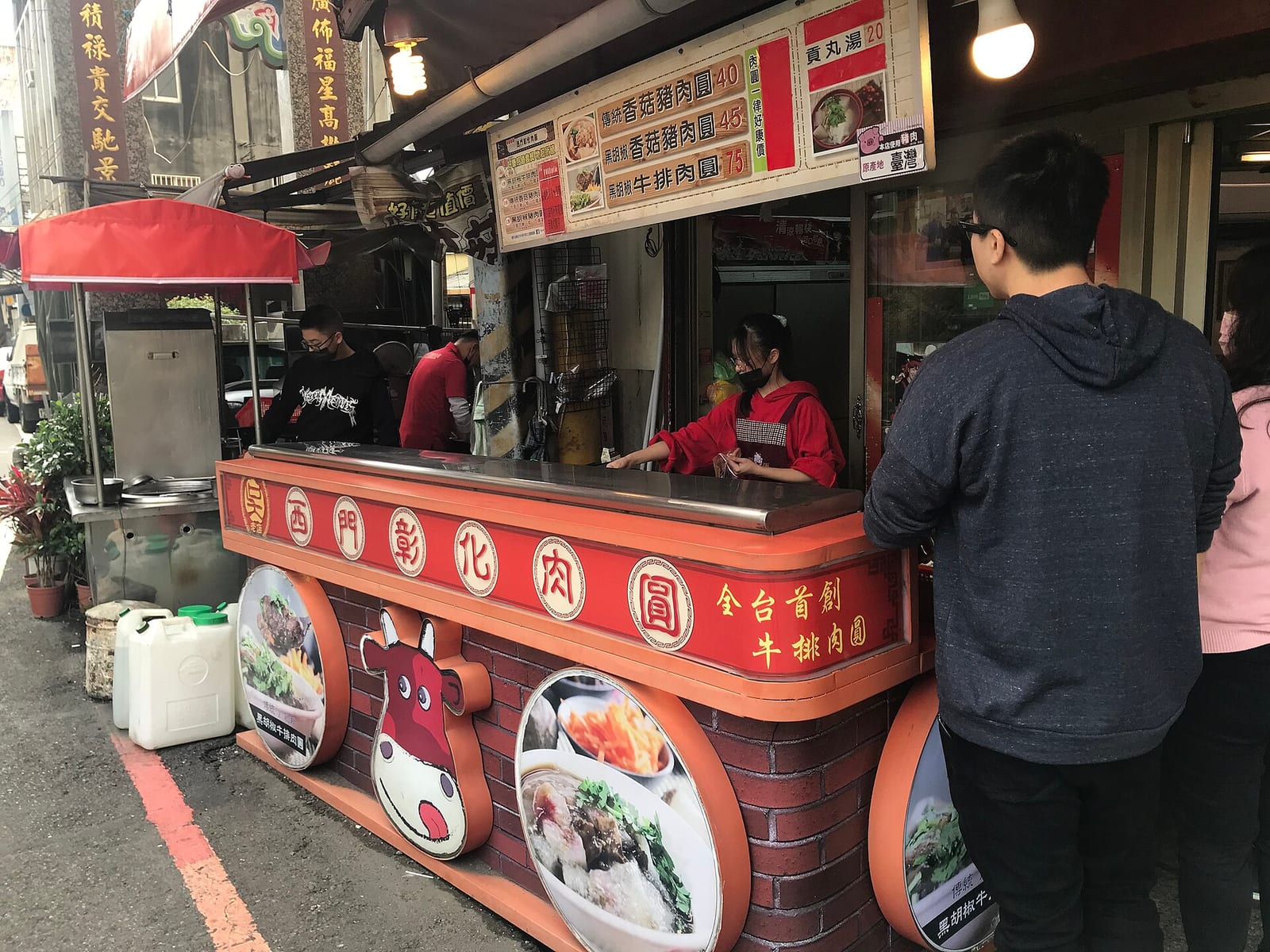
Changhua Ba-wan is a Taiwanese meatball with a sweet potato starch and rice batter skin wrapped around pork leg and bamboo shoots, oil-poached at low temperature until lightly crisp — the dish placed first among the "Three Treasures of Changhua" on the Changhua County Government Tourism website. As dusk falls on Chang'an Street, ba-wan stalls light up; in a large vat the dumplings bob gently in low-temperature oil, and the vendor lifts one out, snips it open, and drizzles on red-and-white sauce and garlic paste — the city's edible symbol, eaten here since childhood.
The Changhua County Government Tourism website lists ba-wan first among the "Three Treasures of Changhua," the official city-signature snack; on Chang'an Street, Lao Dan A-Zhang Ba-wan was founded in 1948 and continues to use Shanhua sweet potato starch for its skin, making it one of the street's representative long-standing shops (source: Changhua County Government Tourism website).
What is Changhua Ba-wan
Changhua Ba-wan belongs to the "oil-poached" school: a wrapper of sweet potato starch and rice flour encases pork leg and bamboo shoots, then slow-poaches in low-temperature oil until the outside is just crisp and the inside springy. Once removed, it is snipped open and topped with sweet-spicy red sauce, rice-flour white sauce, and garlic paste. One serving is typically one piece, often accompanied by clear broth or four-herb soup. The thickness of the skin, the savory depth of the filling, and the sweet-salty balance of the sauces are the three benchmarks by which a ba-wan stall is judged.
The Changhua County Government Tourism website lists ba-wan, braised pork belly rice, and cat-mouse noodles as the "Three Treasures of Changhua," with ba-wan placed first as the city's signature street food. Chang'an Street, Chenglong Road, and Minsheng Road form the densest cluster of ba-wan shops — stalls and storefronts operating from early morning to late night sustain the Changhua daily ritual of "ba-wan with broth." This guide is organized by dish; the shops mentioned below are illustrative of the category, not single-store recommendations.
How to eat it the local way
Local knowledge
Objective endorsements (ad-free)
- The Changhua County Government Tourism website lists ba-wan as the first of the "Three Treasures of Changhua" — the official city signature street food.
- Zhang A-zhang Ba-wan on Chang'an Street in Changhua City is a 70-year-old establishment that has appeared on state banquet menus; with over ten thousand Google reviews, it serves as an objective reference point for the category.
- This guide is organized by dish. Chang'an Street and Chenglong Road form the ba-wan cluster; A-san, Beimen Kou, and Changhua Ba-wan are presented as peers within the same category — no single-store ranking is made.
Practical tips
- Most long-standing shops operate only from the afternoon through late night; there is a high chance of finding them closed before noon — check the day's hours before you go.
- The area around Chang'an Street is a pedestrian zone; you can pair a ba-wan stop with a half-day itinerary covering the Changhua Roundhouse, Bagua Mountain Giant Buddha, and Confucius Temple.
- Coordinates are approximate field-research values. Actual stall locations may shift slightly due to renovations or relocations — rely on the in-person signage.
Data compiled from the Changhua County Government Tourism website, Lukang Township Office, and a large volume of public reviews; promotional listings have been filtered out.
Frequently Asked Questions
What are the "Three Treasures of Changhua"?
They are ba-wan, braised pork belly rice, and cat-mouse noodles — three city-signature snacks named on the Changhua County Government Tourism website, with ba-wan listed first.
Should Changhua ba-wan be bitten or snipped open?
Vendors snip it into quarters with scissors so the sauce seeps into the filling, then it's eaten with a spoon; biting directly into it doesn't let the sauce coat the filling evenly.
What's typically ordered alongside Changhua ba-wan?
It's usually ordered alone without rice, paired with a bowl of clear broth, four-herb soup, or meatball soup to cut the richness — the local combination.
Sources
- 老担阿璋肉圓-美食購物 - 彰化旅遊資訊網 — 彰化縣政府觀光資訊網(官方),阿璋肉圓創立年份與彰化三寶介紹