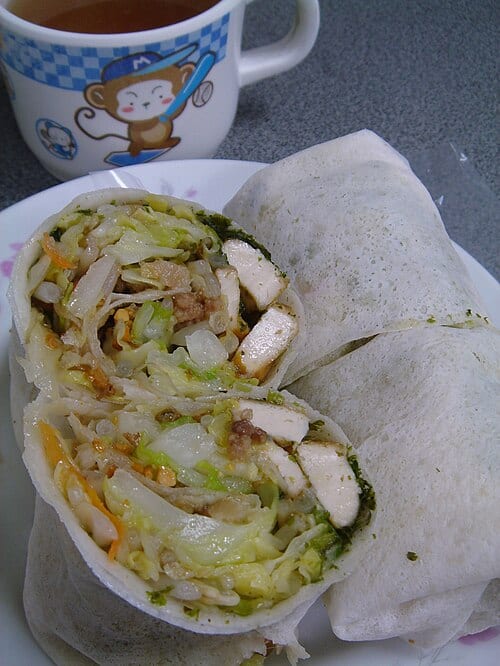
Hsinchu Popiah is a made-to-order thin-skin spring roll served in front of the City God Temple, filled with cabbage, egg crumble, and braised pork, then dusted with peanut powder and sugar for a sweet-and-savory profile found nowhere else in Taiwan. Popiah was historically known as 'spring pancake' and originated as a Qingming Cold Food Festival custom before becoming an everyday snack. Guo Jia Yuanzu Popiah, in front of the City God Temple, is a century-old shop now in its fifth generation or beyond, while A-Ying Popiah is known for its generous fillings and constant queues; both wrap each roll to order.
Guo Jia Yuanzu Popiah is a century-old shop now in its fifth generation or beyond, located on Zhongshan Road in Hsinchu's North District, known for a family-recipe braised egg brushed with a signature pink sweet chili sauce alongside generous cabbage and bean sprouts; A-Ying Popiah, also near Zhongshan Road, is known for its generous fillings and constant queues, often regarded locally as the most popular shop in the City God Temple popiah cluster.
What Is Hsinchu Popiah
Popiah was historically called "spring pancake" (春餅) and originated as a Cold Food Festival custom at Qingming, later evolving into an everyday snack. Hsinchu popiah has three distinguishing features: first, the skin is extremely thin — sometimes two sheets are layered to hold the filling; second, the filling is substantial, centered on cabbage, bean sprouts, egg crumble, braised pork, sausage, and braised tofu; third, peanut powder and sugar powder are standard, and some old shops even add a touch of sweet chili sauce, making the sweet-savory-spicy layering more pronounced than in central or southern Taiwan versions.
The old popiah shops in front of the City God Temple — Guo Jia Yuanzu, A-Ying, Wang Ji, and others — are mostly run by families now in their third generation or beyond. Hsinchu popiah's sweet-and-savory character is connected to the blending of Hokkien and Hakka culinary traditions: Hsinchu sits on the Hokkien-Hakka border, and Hakka villages customarily use peanut powder and sugar in savory preparations, a habit that carried over into the city's popiah. The temple-front popiah stalls have built up their identity over a hundred years, becoming one of the must-queue items at the forecourt, with waits of thirty minutes or more being normal.
How to Eat It the Local Way
Local Knowledge
Verified endorsements (advertiser-filtered)
- Old popiah shops including Guo Jia Yuanzu, A-Ying, and Wang Ji stand side by side in front of the City God Temple, all run by families now in their third generation or beyond.
- The period around Qingming (Tomb Sweeping Day) is the traditional peak season for popiah; some old shops offer limited combination sets or extended hours.
- Hsinchu popiah's sweet-and-savory profile is rooted in the area's blended Hokkien-Hakka geographic culture and is a recognized local characteristic.
Tips for Visiting
- Made to order is essential; the wrapper stiffens within 30 minutes, so eat in or consume nearby right away.
- On weekends, temple-front popiah shops queue for 30 minutes or more; weekday afternoons from 2–4 p.m. are far more manageable.
- Each roll costs around NT$50–80; two rolls add up to close to a full meal, so don't order more than you can handle.
Information compiled from the Michelin Guide, Hsinchu City Government Tourism Bureau, Hsinchu County Government Tourism and Travel Division, and a large volume of public reviews, with sponsored content filtered out.
Frequently Asked Questions
What sets Hsinchu popiah apart from popiah elsewhere in Taiwan?
Hsinchu popiah's defining trait is a dusting of peanut powder and sugar, giving it a more pronounced sweet-and-savory layering than versions from central or southern Taiwan.
How long has Guo Jia Yuanzu Popiah been in business?
Guo Jia Yuanzu Popiah is a century-old shop now in its fifth generation or beyond, known for its family-recipe braised egg and signature pink sweet chili sauce.
Why do City God Temple popiah shops often have long lines?
Both Guo Jia Yuanzu and A-Ying wrap each roll to order and are highly popular, so weekend waits of 30 minutes or more are common.
Should popiah be eaten right after buying it?
Yes — the wrapper stiffens quickly, and taking more than 30 minutes to eat it noticeably worsens the texture, so eating in or nearby right away is recommended.