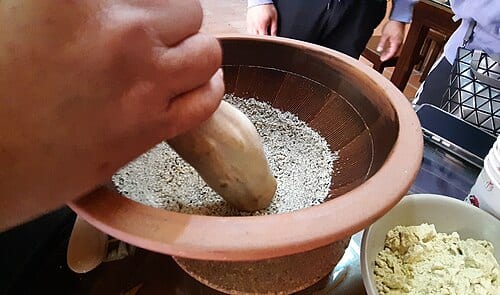
Beipu Lei Cha is a traditional Hakka beverage from Beipu, Hsinchu, made by grinding tea leaves, sesame, peanuts, and other grains in a clay mortar, developed since 1998 on Beipu Old Street into a hands-on DIY visitor experience. Walk down Beipu Old Street and the air carries the toasty scent of roasted grains; sitting at a wooden table, cradling a rough-clay mortar, and grinding with a pestle is the area's signature activity. Beipu was settled by the Jiang Xiuluan family around 1835, the 15th year of the Daoguang reign; Jinguangfu Public Hall and Tianshui Hall are both national-level heritage sites, while the Jiang A-Xin mansion is a Hsinchu County-level heritage site — an unusually dense cluster of historic buildings for a Hakka settlement.
The Beipu lei cha DIY experience traces to 1998, when then-Beipu Farmers' Association general secretary Chen Zhongguang proposed it and Beipu Township Representative Council chair Tu Chunhai arranged training in Zhudong; the experience was formally launched at the Ci Tian Temple forecourt in March 1999, and Beipu Old Street has since grown to more than 60 lei cha shops. Jinguangfu Public Hall and Tianshui Hall are both national-level heritage sites — Tianshui Hall being the residence built by the Jiang Xiuluan family after they settled Beipu around 1835 — while the Jiang A-Xin mansion, built by tea merchant Jiang A-Xin between 1946 and 1949, was designated a Hsinchu County-level heritage site in 2006.
What Is Lei Cha
Lei cha is a traditional Hakka beverage, tracing its origins to the ancestors who migrated south from the central plains of China, where it served as a daily nutritional staple and a drink for welcoming guests. Basic ingredients include: green tea leaves, raw sesame seeds, raw peanuts, pumpkin seeds, pine nuts, Job's tears, and brown rice, sometimes with basil leaves or mint for fragrance. The ingredients are placed in a mortar and ground clockwise with a guava-wood pestle for several minutes into a paste, then opened up with hot water and drunk, or mixed with puffed rice or popcorn into a snack.
Why is lei cha synonymous with Beipu? Beipu was cultivated in the Daoguang era of the Qing Dynasty by the Jiang Xiuluan family and is one of the oldest Hakka settlements in Hsinchu. Historic sites including the Jiang A-Xin Western-style mansion, Tianshui Hall, and the Jinguangfu Public Hall are densely clustered here, earning Beipu the reputation as a "living museum of Hakka antiquities." In the 1990s, Beipu Old Street vendors repackaged lei cha from a domestic household ritual into a DIY visitor experience, allowing tourists to grind the mortar themselves. Lei cha thus transformed from a cup of tea into a tourism experience representing Hakka culture. More than ten lei cha shops line Beipu Old Street, each with slightly different recipes and mortar feel.
How to Enjoy It the Local Way
Local Knowledge
Verified endorsements (advertiser-filtered)
- Beipu is a Hakka settlement cultivated by the Jiang Xiuluan family during the Daoguang era of the Qing Dynasty, with a dense concentration of Hakka-era historic sites.
- Jinguangfu Public Hall, the Jiang A-Xin Western-style mansion, and Tianshui Hall are national-level heritage sites; the lei cha experience is centered within the old street.
- Multiple lei cha shops coexist on Beipu Old Street, each with slightly different recipes and grain ratios.
Tips for Visiting
- DIY lei cha typically costs NT$150–250 per person, including ingredients, puffed rice, and unlimited tea refills; ideal for groups of 2–4 to share.
- Weekend crowds on the old street can be intense; weekday or morning visits allow for a more leisurely grinding experience.
- The rough-clay mortar can scratch tabletops; place a cloth underneath, or use the dedicated tables provided by the shop.
Information compiled from the Michelin Guide, Hsinchu City Government Tourism Bureau, Hsinchu County Government Tourism and Travel Division, and a large volume of public reviews, with sponsored content filtered out.
Frequently Asked Questions
When did the Beipu lei cha DIY experience begin?
The Beipu lei cha DIY experience traces to 1998, proposed by then-Beipu Farmers' Association general secretary Chen Zhongguang, and was formally launched at the Ci Tian Temple forecourt in March 1999.
Why is Beipu so dense with historic sites?
Beipu was settled by the Jiang Xiuluan family around 1835, and both Jinguangfu Public Hall and Tianshui Hall are designated national-level heritage sites, marking Beipu as a key point in Hakka settlement history.
Are the Jiang A-Xin mansion and Jinguangfu Public Hall the same heritage tier?
No — Jinguangfu Public Hall and Tianshui Hall are national-level heritage sites, while the Jiang A-Xin mansion is a Hsinchu County-level heritage site designated in 2006, one tier lower.
How many lei cha shops are on Beipu Old Street today?
Since formal promotion began in 1999, Beipu Old Street has grown to more than 60 lei cha shops, each with a slightly different recipe and mortar feel.
Sources
- 北埔膨風茶文物館(北埔第一棧):客家擂茶的由來 — 1998年北埔擂茶DIY商業化起源、陳重光與涂春海
- 國家文化資產網:金廣福公館 — 國定古蹟、約道光15年(1835)創建
- 維基百科:姜阿新洋樓 — 2006年公告新竹縣定古蹟、1946-1949年興建