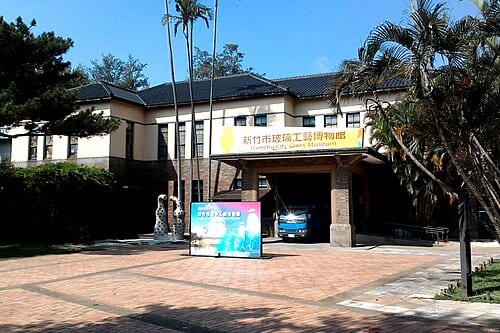
Glass Art Museum is a museum inside Hsinchu Park occupying a former 1936 Japanese-era public assembly hall for Hsinchu Prefecture. The reinforced-concrete building, faced in scraped-finish plaster with modernist-style detailing, was designated a Hsinchu City historic building in 2017 and reopened as a glass museum in 1999. The permanent collection traces the development of Taiwan's glassmaking craft from the Qing dynasty to the present and covers the evolution of glassblowing techniques, making it the most complete gateway to understanding Hsinchu's glass industry.
The building was completed in 1936 as the Hsinchu Prefecture public assembly hall, designed by prefectural engineer Techijima Seigo as a reinforced-concrete, modernist-style structure (not the brick classical-style building often described in secondhand sources); it was designated a Hsinchu City historic building on September 6, 2017. Following the success of the 1995 Hsinchu International Glass Art Festival, the site was converted and reopened as the Glass Art Museum on December 8, 1999.
What to see at the Glass Art Museum
Hsinchu developed Taiwan's most important glassmaking hub during the Japanese colonial era, thanks to a combination of geographic conditions and natural gas resources; the industry at its peak accounted for the bulk of Taiwan's total glass output. The permanent exhibition covers raw materials, glassblowing techniques, product evolution, and contemporary artistic creation, presenting a complete picture of this industrial history. Some exhibits hold both craft and artistic value — the bubble patterns and layered color within blown-glass pieces reward close inspection.
The Japanese-era brick building is worth a careful look in its own right. The exterior arcades and the interior gallery spaces retain the spatial character of a historic building. The museum sits within Hsinchu Park, which also contains a Confucius Temple and Lichi Pond; after touring the museum you can extend the day with a walk through the park.
Tips for getting the most out of your visit
Practical information
Getting there and timing
- About a 15-minute walk from TRA Hsinchu Station, or take a city bus to the Hsinchu Park stop — check the latest bus routes before you go.
- Opening hours and admission fees are set by the Hsinchu City Cultural Affairs Bureau's official announcements. The museum is usually closed on Mondays; confirm before visiting.
Nearby connections
- Lichi Pond and the Confucius Temple are within the park and can be combined for a half-day cultural loop.
- The City God Temple food district is about a 15-minute walk away — plan a meal there before heading home.
Sources: Official information from the Hsinchu City Glass Art Museum and its Wikipedia entry.
Frequently Asked Questions
What did the Glass Art Museum building originally serve as?
It was built in 1936 as the Hsinchu Prefecture public assembly hall and changed uses several times after the war before becoming a museum in 1999.
What architectural style is the Glass Art Museum building?
It is a reinforced-concrete, modernist-style structure faced in scraped-finish plaster and tile, not a brick classical-style building, and was designated a Hsinchu City historic building in 2017.
When did the Glass Art Museum open?
It opened on December 8, 1999, timed to coincide with the third Hsinchu International Glass Art Festival.
Why did Hsinchu develop a glass industry?
Hsinchu's local silica sand and natural gas resources helped it become Taiwan's most important glassmaking hub starting in the Japanese colonial era, a history the museum's permanent exhibition traces in full.
Sources
- 新竹市文化局-玻璃工藝博物館 — 新竹市政府官方介紹頁
- 新竹市立玻璃工藝博物館 — 維基百科條目,含建築材質、樣式與沿革