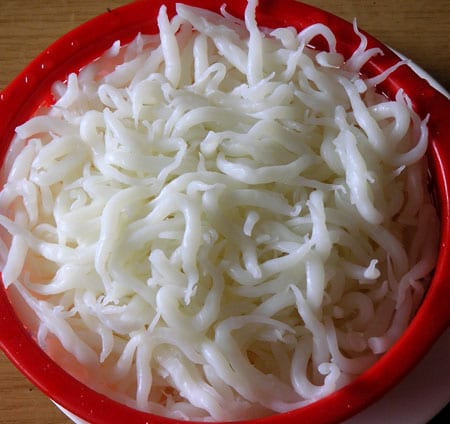
Mi shai mu is a traditional Hakka rice food made by pressing a paste of indica rice flour mixed with sweet potato starch through a perforated board into thick strands, served cold with sugar water and peanut powder in summer or hot in pork-bone broth in winter — a staple found at both Hsinchu's East Gate Market and Zhudong Market. According to the New Taipei City Hakka Culture Archive, the name comes from a process resembling sifting rice through a sieve (shai), which became mi tai mu in the Hoklo pronunciation.
The traditional method for mi shai mu mixes indica rice flour with sweet potato starch into a paste, presses it through a perforated board into thick strands, and drops them into cold water to set; the name comes from a process resembling sifting rice through a sieve, called mi shai mu in Hakka and mi tai mu in the Hoklo pronunciation.
What Is Mi Shai Mu
Mi shai mu is made by soaking indica rice, grinding it into a slurry, steaming it until cooked, then pressing the hot mixture through a wooden or metal board perforated with round holes (the "shai mu" board) so that it forms strands approximately 0.5–1 cm in diameter that drop into cold water to set. The texture falls between rice vermicelli and ban tiao noodle sheets — springy and chewy, with the characteristic rice fragrance of indica rice, quite different from the sticky softness of glutinous rice products. Compared with Hsinchu's fine rice vermicelli, mi shai mu is thicker, chewier, and more filling.
Mi shai mu is a traditional Hakka food; the Council of Agriculture's Hakka Affairs Council has listed it as a representative Hakka food item. In Hakka communities it was historically a celebratory or post-harvest reward food, later becoming an everyday snack. East Gate Market is one of Hsinchu City's oldest traditional markets; the mi shai mu stalls inside the market have histories stretching back decades. Zhudong Market also has dedicated old stalls, reflecting the continuity of Hakka food culture across Hsinchu City and County.
How to Eat It the Local Way
Local Knowledge
Verified endorsements
- The Council of Agriculture's Hakka Affairs Council has listed mi shai mu as a representative Hakka food and it is included in publications related to Hakka food culture documentation.
- East Gate Market is a long-established traditional market in Hsinchu City; the mi shai mu stalls inside are an important component of the market's food ecosystem.
- Mi shai mu and Hsinchu fine rice vermicelli are both representative Hsinchu rice foods, but they differ clearly in raw material (indica rice), method (pressing into strands), and texture (thick and chewy) — the two should not be confused.
Tips for Visiting
- Mi shai mu stalls are not available all day and may sell out in the afternoon; visit East Gate Market or Zhudong Market in the morning to make sure you get some.
- Some visitors easily confuse mi shai mu with rice vermicelli; before ordering, confirm that the stall is offering the thick-strand pressed version made from indica rice, not fine rice vermicelli.
- Mi shai mu at Zhudong Market is primarily consumed by the local Hakka community; the setting is more unpretentious than East Gate Market and offers a different kind of local experience.
Sources: Hakka Affairs Council of the Council of Agriculture Hakka food culture promotion materials, Hsinchu City East Gate Market Management Office.
Frequently Asked Questions
Is mi shai mu the same as rice vermicelli?
No, mi shai mu is made from indica rice flour mixed with sweet potato starch and has a thick, chewy texture, while rice vermicelli is thinner and made differently — the two should not be confused.
Where does the name mi shai mu come from?
It comes from a process resembling sifting rice through a sieve (shai), called mi shai mu in Hakka and mi tai mu in the Hoklo pronunciation.
Where can you find mi shai mu?
Old stalls at both Hsinchu's East Gate Market and Zhudong Market sell it, offering an everyday window into Hakka food culture.
Sources
- 米篩目|新北市客家文化典藏資料庫 — 新北市政府官方客家文化資料庫,確認名稱由來與傳統製法