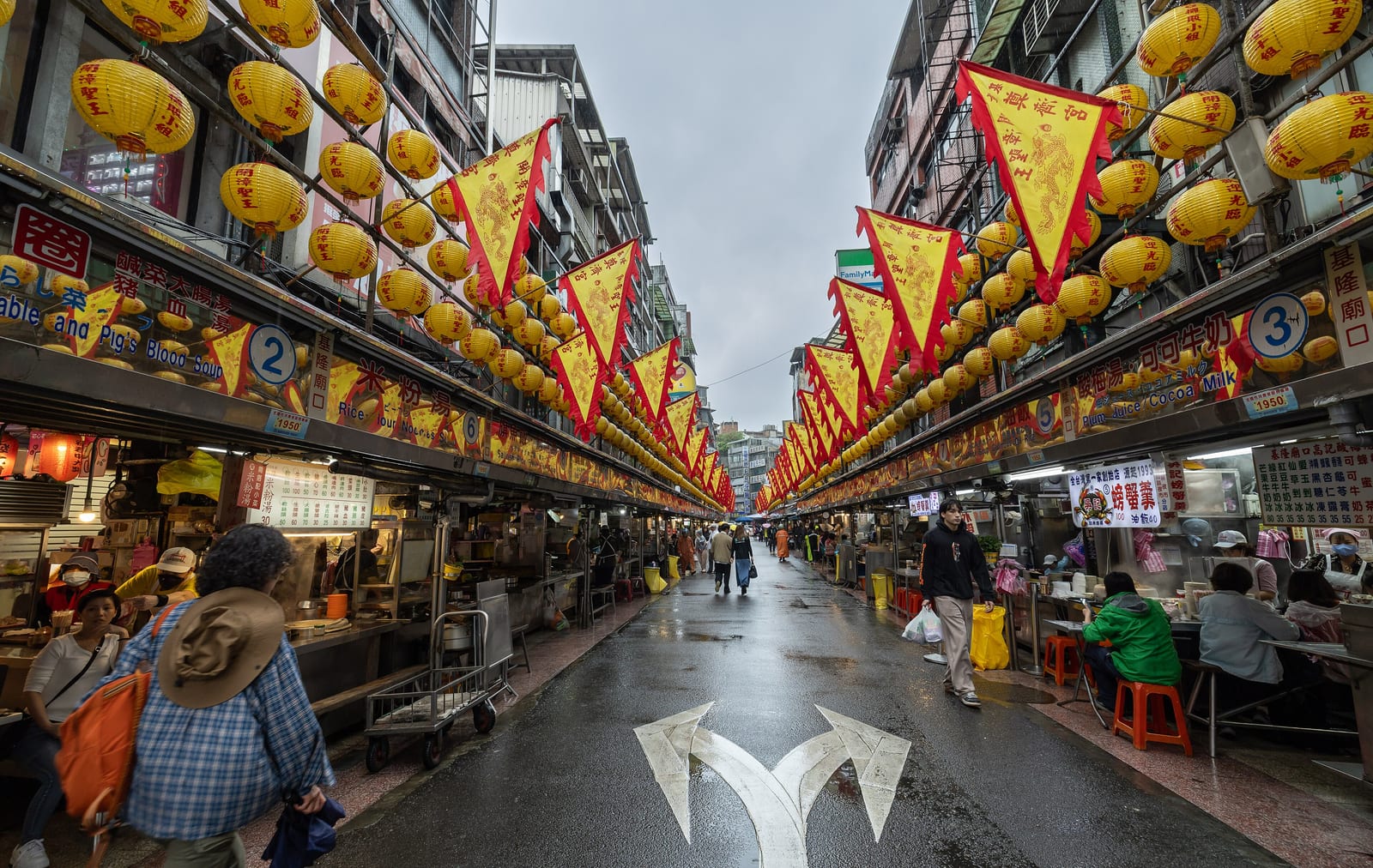
Miaokou Night Market is a traditional street-food market in Keelung centered on Dianjigong Temple, with roughly 64 fixed stalls along Rensan Road and more than 200 additional stalls along Aisi Road, operating year-round.
Miaokou's street-food scene took shape in the late Japanese colonial period, as itinerant vendors gathered around Dianjigong Temple's pilgrims and gradually formed a market. The Keelung city government later organized Rensan Road into roughly 64 fixed stalls, while more than 200 additional stalls line Aisi Road; the whole market stretches roughly 300–400 meters.
What to See at Miaokou Night Market
The night market developed alongside Dianjigong Temple, with the religious and commercial spaces coexisting over time. The fixed stalls along Rensan Road have histories spanning decades, and some vendors are now in their third generation. The stall layout follows the original street-block configuration, and food-seekers weave between the temple forecourt and the surrounding streets — a dining scene unique to Keelung.
Dingbian cuo is Keelung's signature dish: rice batter is spread along the rim of a hot wok, then scraped into broth, yielding a texture between rice cake and noodle. In Keelung, "tempura" refers to a fish-paste product rather than the Japanese-style battered fry — a local term that has persisted since the Japanese colonial period. Bubble ice is shaved ice compressed to a fluffy texture; expect longer queues in summer.
How to Get the Most Out of Your Visit
Practical Information
Getting There & Hours
- Taiwan Railways (TRA) Keelung Station is about a 5–8-minute walk to the Rensan Road entrance.
- Open year-round; some vendors start during the day, and the market gets livelier after dusk.
- Each stall sets its own hours — check the stall's social media or confirm on-site.
Nearby Connections
- Dianjigong Temple sits at the heart of the night market — worth a look for the temple architecture and religious history.
- Keelung Harbor and the harborside plaza are within walking distance, ideal for a post-meal stroll.
Source: compiled from on-site information and publicly available documents.
Frequently Asked Questions
How many stalls does Miaokou Night Market have?
About 64 fixed stalls line Rensan Road, plus more than 200 additional stalls along Aisi Road.
When did Miaokou Night Market form?
It traces back to the late Japanese colonial period, when itinerant vendors gathering around Dianjigong Temple's pilgrims gradually formed a market.
Is Keelung-style tempura Japanese-style tempura?
No, in Keelung 'tempura' refers to a fish-paste product, a local term surviving from the Japanese colonial period, unlike Japanese battered-and-fried tempura.
How do you get to Miaokou Night Market?
It is about a 5–8-minute walk from TRA Keelung Station to the Rensan Road entrance.
Sources
- 基隆廟口 - 維基百科 — 廟口小吃歷史沿革與攤位分區、數量