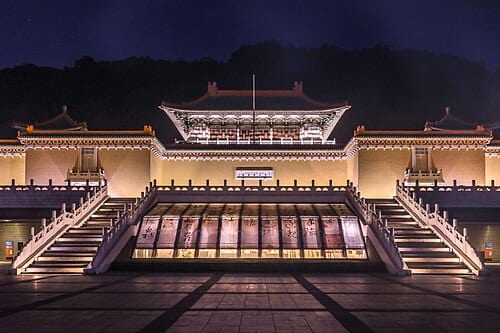
The National Palace Museum is a national-level museum in Taipei's Shilin District holding nearly 700,000 pieces of Chinese cultural heritage, originating from the imperial collection of Beijing's Forbidden City; the collection moved to Taiwan with the government in 1949 and the museum reopened at its current Taipei site on November 12, 1965. The permanent exhibition is organized by material type and rotated every three months, annual visitor numbers have reached as high as roughly 6.14 million, and the museum ranked sixth among the world's most-visited art museums in 2015. The Mao Gong Ding bronze vessel, the Jadeite Cabbage, and the Meat-shaped Stone are the three best-known major works in the collection.
The museum holds nearly 700,000 artifacts drawn from the imperial collection of Beijing's Forbidden City, which relocated to Taiwan with the government in 1949; it reopened at its current Taipei site on November 12, 1965, and annual visitor numbers have reached roughly 6.14 million at their peak, with the museum ranking sixth globally among the most-visited art museums in 2015.
Highlights of the National Palace Museum
The museum's collection originates from the imperial collection of the Forbidden City in Beijing. After the government relocated to Taiwan in 1949, a museum was established at the current Taipei site and officially opened in 1965. The collection spans bronzes, ceramics, paintings and calligraphy, jades, rare books and documents, and more, covering the period from the Neolithic age to modern times. Annual visitor numbers exceed 3.5 million, making it one of Taiwan's most visited museums.
The Mao Gong Ding is a late Western Zhou bronze vessel with an inscription of over 500 characters, one of the longest known bronze inscriptions in existence. The Jadeite Cabbage was carved from a single piece of jadeite with naturally distinct coloration; the katydids on the leaves are rendered in fine detail. The Meat-shaped Stone is a naturally formed agate that so convincingly resembles braised pork belly it is nearly indistinguishable from the real thing. All three pieces often draw queues, so allow ample time.
How to make the most of your visit
Practical information
Getting there and time needed
- Take the MRT Tamsui–Xinyi Line to Shilin Station, then transfer to a bus to reach the museum entrance directly — about a 15-minute ride.
- Opening hours and ticket prices should be checked on the museum's official website; closure days may be adjusted around certain public holidays.
- The museum is large. Plan for at least half a day and select key galleries to focus on rather than trying to see everything at once.
Nearby connections
- Zhishan Garden, a Chinese-style garden adjacent to the museum, is a pleasant place to walk and rest after visiting. A restaurant and gift shop are also available.
- Shilin Night Market, Taipei's largest tourist night market, is nearby and makes a natural evening destination for food.
Source: National Palace Museum official information and public collection data.
Frequently Asked Questions
When did the National Palace Museum open in Taipei?
The collection moved to Taiwan with the government in 1949, and the museum reopened at its current Taipei site on November 12, 1965.
How many artifacts does the museum hold?
The collection holds nearly 700,000 pieces, spanning bronzes, ceramics, paintings and calligraphy, jades, and rare books.
How many visitors does the museum receive annually?
Annual visitor numbers have reached roughly 6.14 million at their peak, and the museum ranked sixth globally among the most-visited art museums in 2015.
Sources
- 國立故宮博物院官方網站 — 官方典藏與展覽資訊
- 國立故宮博物院 - 維基百科(粵文版) — 開幕日期與年參觀人次數據