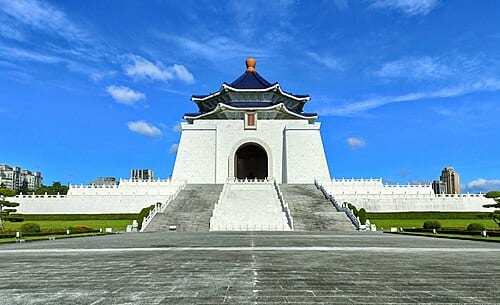
Chiang Kai-shek Memorial Hall is a national monument in Taipei's Zhongzheng District, construction of which began in 1976 and was completed in April 1980. Its main building is modeled on the style of Beijing's Temple of Heaven, with 84 granite steps plus 5 lobby steps at the front totaling 89 steps, symbolizing Chiang Kai-shek's age of 89 at his death. The Liberty Square archway on the western side of the plaza and the expansive marble square together form one of the largest open public spaces in central Taipei, and the National Theater and National Concert Hall flanking the east and west wings are among Taiwan's premier performing arts venues.
Chiang Kai-shek Memorial Hall broke ground in 1976 and held its completion ceremony on April 4, 1980; the front staircase totals 89 steps (84 granite steps plus 5 lobby steps), symbolizing Chiang's age of 89 at death, while the octagonal glazed-tile roof follows the style of Beijing's Temple of Heaven and Guangzhou's Sun Yat-sen Memorial Hall, representing the "eight virtues."
Highlights of Chiang Kai-shek Memorial Hall
Chiang Kai-shek Memorial Hall was built in 1980. The overall complex is dominated by white marble; the main building's roof is a blue octagonal hip-and-gable design incorporating the vocabulary of traditional Chinese palace architecture. The spacious plaza is used daily by residents for leisure, dog-walking, and morning exercise, and can accommodate tens of thousands of people during large gatherings. The entire complex is listed as a national monument.
The interior of the memorial hall houses a permanent exhibition displaying related historical materials and artifacts. An honor guard changing ceremony is held on the hour, drawing visitors to watch. The National Theater and National Concert Hall flanking the plaza were designed by architect Yang Cho-cheng in the same Chinese palace style. They host domestic and international performances year-round and are an important hub of Taiwan's performing arts scene.
How to make the most of your visit
Practical information
Getting there and time needed
- Take the MRT Tamsui–Xinyi Line to Chiang Kai-shek Memorial Hall Station; the plaza is accessible directly from the exit and is open all day.
- Opening hours and closure days for the indoor exhibition area should be checked on official announcements; admission is free.
- Tickets for National Theater and Concert Hall performances are purchased separately — consult the National Theater and Concert Hall official website for the program schedule.
Nearby connections
- Taiwan Guest House, the Executive Yuan, and other Japanese colonial-era buildings are within walking distance, making this a good base for a half-day historical neighborhood walk.
- Nearby Yongkang Street is a well-known Taipei area for local snacks and cafes, and can be added as a lunch or afternoon tea stop.
Source: Public architectural records and official information.
Frequently Asked Questions
What do the 89 steps at the front of Chiang Kai-shek Memorial Hall represent?
The front staircase totals 89 steps — 84 granite steps plus 5 lobby steps — symbolizing Chiang Kai-shek's age of 89 at death.
When was Chiang Kai-shek Memorial Hall built?
Construction began in 1976, and the completion ceremony was held on April 4, 1980.
What performance venues surround the plaza?
The east and west wings house the National Theater and National Concert Hall, both designed by architect Yang Cho-cheng, hosting performances year-round.
Sources
- 揭密中正紀念堂!階梯共有89階原因竟「是這樣」 — 89階台階與落成年份
- 國立中正紀念堂-中正紀念堂的歷史軌跡 — 官方沿革頁面