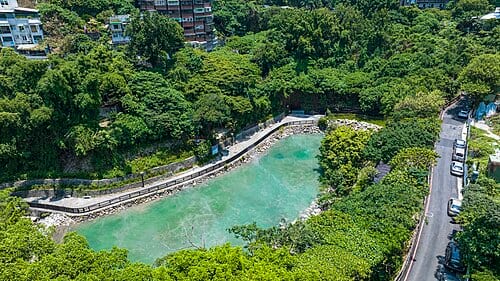
Beitou Thermal Valley is a volcanic geothermal site in Taipei's Beitou District and the source of Beitou Hot Spring Creek, with water temperature staying between 80 and 100 degrees Celsius year-round and steam rising continuously. The site gave rise to Hokutolite, a rare radioactive mineral first identified here in 1905 by Japanese geologist Okamoto Yohachiro and formally named at the 1912 International Geological Congress in Saint Petersburg, Russia — the only mineral in the world named after a Taiwanese place. The lake surface takes on a blue-green hue due to the spring's mineral composition, and walkways and interpretive signs along the shore let visitors learn about the volcanic geothermal geology up close.
Hokutolite was discovered at Beitou Creek by Japanese geologist Okamoto Yohachiro in 1905 and formally named at the International Mineralogical Congress in Saint Petersburg, Russia, in November 1912; it is currently known to occur naturally in only two places worldwide — Beitou Creek and Tamagawa Onsen in Akita Prefecture, Japan — and, due to trace radioactivity, is a protected mineral that may not be collected.
Highlights of Beitou Thermal Valley
Hokutolite is a mineral first documented by a Japanese geologist in 1905. It is known to occur naturally in only two places in the world: Beitou Creek and Tamagawa Onsen in Akita Prefecture, Japan. Due to its trace radioactivity it has been designated a protected mineral and collecting it is prohibited. The strongly acidic spring water has eroded the surrounding rock over time, creating the distinctive terrain and coloration of the valley walls.
The park has a circular walkway that lets visitors observe the hot spring upwelling areas and steam vents from different angles. Interpretive panels in Chinese and English explain the geothermal processes and properties of Hokutolite, making it suitable for visitors interested in geology and hot spring science. The color of the lake surface varies with light and steam density — steam is heavier in the morning and on cloudy days, producing a noticeably different scene from clear afternoons.
How to make the most of your visit
Practical information
Getting there and time needed
- Take the MRT Tamsui–Xinyi Line to Xinbeitou Station, then transfer to a bus or walk about 20 minutes to reach Thermal Valley.
- Thermal Valley charges an entrance fee. For current opening hours and prices, check the latest announcements from the Taipei City Government Department of Information and Tourism.
- The park is compact; a visit of 30 to 45 minutes is generally sufficient.
Nearby connections
- Beitou Hot Spring Museum, Beitou Library (a green building), and Meizhuting are all within walking distance, making it easy to plan a half-day Beitou cultural route.
- Beitou has a wide range of commercial hot spring bathhouses; it is advisable to call ahead to confirm reservations and fees before going.
Source: Taipei City Government tourism information and public geological data.
Frequently Asked Questions
When was Hokutolite discovered?
It was discovered at Beitou Creek in 1905 by Japanese geologist Okamoto Yohachiro and formally named at the 1912 International Mineralogical Congress in Saint Petersburg.
Why is collecting Hokutolite prohibited?
Hokutolite carries trace radioactivity and occurs naturally in only two places worldwide, so it has been designated a protected mineral and collecting it is banned.
How hot is the water at Thermal Valley?
Water temperature stays between 80 and 100 degrees Celsius year-round; guardrails prevent visitors from approaching or touching the surface.
Sources
- 岡本要八郎 - 國家文化記憶庫 — 北投石發現者與發現年份
- 地質知識服務網地質百科-北投石 — 北投石命名與產地資訊官方頁面