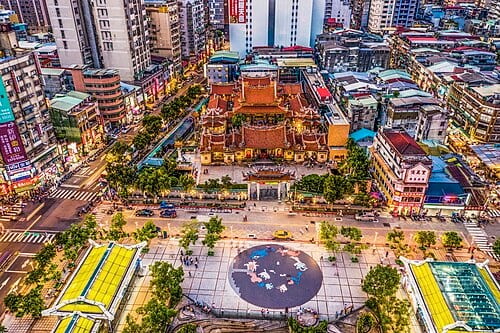
Longshan Temple is a Hokkien-style temple in Taipei's Wanhua District, founded in 1738 with funds raised by settlers from Quanzhou, Fujian, and dedicated to Guanyin Bodhisattva; it was completed in 1740. The current structure is largely based on a 1919 reconstruction led by abbot Fu-zhi, and the main hall was destroyed by Allied incendiary bombs during the 1945 bombing of Taipei, only being restored to its original scale by 1955. The entire complex is listed as a national monument and remains a major center of worship today.
Longshan Temple was founded in 1738 with funds raised by settlers from Quanzhou, Fujian, and completed in 1740; in 1919, due to the aging structure, abbot Fu-zhi and local gentry raised funds for a reconstruction carried out by master carpenter Wang Yi-shun and stonemason Xin A-jiu; the main hall was destroyed by Allied incendiary bombs during the 1945 bombing of Taipei and was not fully restored to its original scale until 1955.
Highlights of Longshan Temple
From its founding in 1738 by Fujianese settlers from Quanzhou, Longshan Temple has undergone multiple reconstructions and restorations. The surviving structure is based on the 1919–1924 reconstruction and was restored again after being bombed during World War II. The temple is laid out in three halls — front, main, and rear — enshrining Guanyin Bodhisattva and a large number of accompanying deities, with a belief system that crosses Buddhist, Daoist, and folk religious traditions.
The temple's architectural craftsmanship is a highlight: the bronze dragon columns, granite stone carvings, ridge-top mosaic decorations, and painted door gods are all works of skilled artisans. After the lights come on at night, the temple silhouette and rising incense create an atmosphere entirely different from daytime. Guangzhou Street Night Market and the surrounding Monga commercial district form the commercial core of Wanhua's old city.
How to make the most of your visit
Practical information
Getting there and time needed
- Take the MRT Bannan Line to Longshan Temple Station; Exit 2 is about a 3-minute walk to the temple gate.
- The temple is open year-round and has worshippers morning and evening. Crowds are largest during major festivals such as Guanyin's birthday on the lunar calendar.
- Admission is free. Avoiding national holidays in the morning is recommended to minimize crowding.
Nearby connections
- Bopiliao Historic Block is about a 5-minute walk away, offering a glimpse of the surviving commercial street from the Qing-era Monga district.
- Guangzhou Street and the area around Xichang Street are home to Wanhua's traditional markets and street food — a natural next stop for eating.
Source: Taipei City Cultural Bureau monument records and public historical materials.
Frequently Asked Questions
When was Longshan Temple founded?
It was founded in 1738 with funds raised by settlers from Quanzhou, Fujian, and completed in 1740.
Why was Longshan Temple damaged during World War II?
The main hall was destroyed by Allied incendiary bombs during the 1945 bombing of Taipei and was not restored to its original scale until 1955.
What era does the current temple structure date from?
The current structure is largely based on a 1919 reconstruction led by abbot Fu-zhi.
Sources
- 艋舺龍山寺-臺灣宗教文化地圖 — 內政部官方宗教文化資料,創建與重建沿革
- 艋舺龍山寺 - 維基百科 — 1919年重建工匠與1945年轟炸修復年份交叉驗證