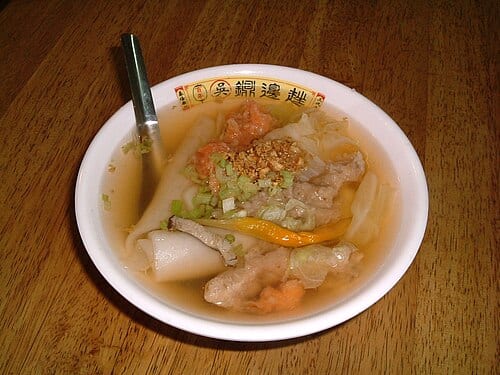
Ding Bian Cuo is a Fuzhou-style rice sheet soup made by sliding rice batter down the rim of a hot wok until it sets into thin sheets — the Taiwanese word "cuo" describes that sliding motion. Behind the stalls at Keelung's Miaokou Night Market, a large iron wok billows steam as the cook ladles rice batter along the blazing rim; it slides down and sets instantly. The sheets go into a broth simmered from dried shrimp, day lily, wood ear mushroom, and minced pork rolls — the Fuzhou flavor Keelung locals have grown up drinking.
Ding Bian Cuo originated as a traditional Fuzhou rice dish and was localized in Keelung after post-war Fuzhou immigrants settled at Miaokou, incorporating Keelung's local seafood. Miaokou once had two long-running Ding Bian Cuo shops, Wu Jia and Xing Ji; Xing Ji, which had operated for more than 70 years across three generations, went on hiatus starting December 2020. Today, Wu Jia Ding Bian Cuo remains the only one of the two still open, and stands as Miaokou's representative Ding Bian Cuo shop.
What is Ding Bian Cuo?
Ding Bian Cuo originated as an everyday dish in Fuzhou, China. "Ding bian" means the rim of the iron wok; "cuo" (趖) is a Taiwanese verb meaning to slip or slide, describing the motion of rice batter gliding down the hot wok rim and instantly setting into sheets. To make it, in-lai rice is ground into batter, poured in circles along the heated wok rim, steamed with the lid on, then scraped off into sheets and dropped into a broth simmered from dried shrimp, flat fish, and minced pork rolls. The broth is clear and golden; the rice sheets are silky and mildly fragrant. Common toppings include day lily, wood ear mushroom, shiitake, bamboo shoots, shrimp, and small pork rolls — a light yet satisfying thick soup.
Ding Bian Cuo came to Keelung with Fuzhou immigrants around the Japanese colonial period. The port's busy trade and Fuzhou community made Miaokou the natural home of this dish, where it became one of Keelung's defining street foods. The Tourism Administration and Keelung City Government both officially name Ding Bian Cuo as a Miaokou must-eat. "Wu Jia Ding Bian Cuo," a Miaokou century-old stall passed down through three generations, and "Xing Ji" are both recognized local institutions. The same rice-batter technique exists in Fuzhou and Matsu, but the version loaded with varied toppings building layers of savory sweetness is a form unique to Keelung's port character.
How to eat it like a local
Local knowledge
Verified references (no sponsored content)
- The Tourism Administration and Keelung City Government both list Ding Bian Cuo as a signature Miaokou dish.
- Wu Jia Ding Bian Cuo has passed through three generations spanning over a century — the established benchmark among Miaokou's old stalls.
- Xing Ji and Wu Jia are the two old shops that local regulars consistently recommend to each other.
Practical tips
- Wu Jia and Xing Ji have slightly different flavor profiles — if time allows, try both.
- Ding Bian Cuo is a hot, soft soup dish; it suits winter visits or early mornings better than sweltering afternoons.
- Miaokou gets crowded on weekends — please queue patiently and don't cut in line; shared seating is common.
Information compiled from the Keelung City Government Department of Tourism and City Marketing and large-volume public reviews, with sponsored content filtered out.
Frequently Asked Questions
What does "cuo" mean in Ding Bian Cuo?
"Cuo" is a Taiwanese/Eastern Min word meaning "to slide," describing how rice batter slips down the hot wok rim and instantly sets into thin sheets — the origin of the dish's name.
Can visitors still eat at Xing Ji at Miaokou?
No, Xing Ji Ding Bian Cuo went on hiatus starting December 2020; only Wu Jia Ding Bian Cuo remains open at Miaokou today.
Was Ding Bian Cuo invented in Keelung?
No, it originated as a traditional Fuzhou rice dish and was brought to Keelung's Miaokou by post-war Fuzhou immigrants, who adapted it with local seafood.
Sources
- 基隆廟口傳承三代70年邢記鼎邊趖吹熄燈號 老顧客不捨 — 聯合報報導邢記鼎邊趖2020年12月歇業
- 基隆廟口70年鼎邊趖熄燈 臉書無預警「最後營業」曝光 — 鏡週刊報導邢記歇業細節
- 鼎邊趖 - 維基百科 — 鼎邊趖詞源與做法說明