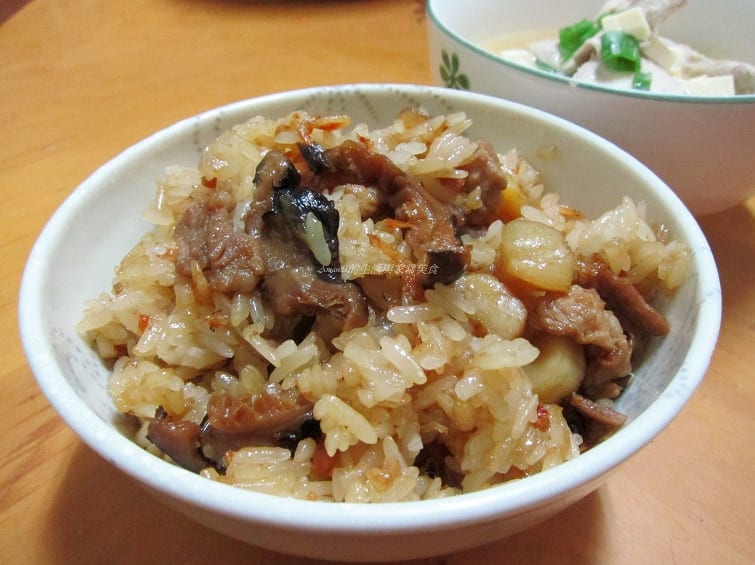
Miaokou oil rice is a glutinous rice dish served at Keelung's Miaokou Night Market, topped with braised pork and typically paired with crab thick soup. When the lights come on at Miaokou, what gets swept away first is often not the fried food but that plate of oil rice — each grain distinct yet rich, braised pork in dark sauce resting on top, the aroma of shiitake and dried shrimp rising from below.
Wu Ji Crab Thick Soup and Oil Rice, Stall No. 5 at Miaokou, first opened on Ai-Si Road in 1993 (Republic of China year 82) before moving to its current spot on Ren-San Road; now in its third generation and over 30 years in business, it's one of Miaokou's combination stalls pairing oil rice with crab thick soup. The Miaokou food street itself traces back to vendors gathering around Dianji Temple in the late Japanese colonial period, later organized by the city government after the war.
What is Miaokou oil rice?
Miaokou oil rice uses long glutinous rice as its base. The rice is first stir-fried in pork lard with soy sauce, five-spice powder, and rice wine for seasoning, then mixed with rehydrated diced shiitake and dried shrimp and steamed until done. Braised pork — usually pork belly or shoulder — is placed on top after cooking, finished with the original braising liquid. The texture is firm and richly flavored; the complexity comes from layers of pork lard base, five-spice aromatics, and the ocean depth of dried shrimp. Unlike the sweeter oil rice of southern Taiwan, the Miaokou version is primarily savory with minimal sweetness.
Oil rice holds a ceremonial place in Taiwanese traditional culture, long associated with one-month-old baby celebrations and temple festivals. Keelung Miaokou's version has shed its ritual function and evolved into an everyday night-market food. In the early days, Miaokou drew a large harbor labor population that needed calorie-dense staple food, so the rice recipe skewed practical: generous portions, ample fat, ready to fill up alongside a bowl of thick soup. The stall has been operating for over 60 years and is one of Miaokou's older-tenured items.
How to eat it like a local
Local knowledge
Verified references
- Wu Ji Crab Thick Soup at Stall No. 5 in Miaokou has long sold oil rice alongside, with the stall operating for over 60 years — one of Miaokou's longer-running composite stalls.
- The official Keelung Miaokou Night Market stall introduction lists oil rice as a permanent menu item, included in Keelung City Government tourism materials.
- Miaokou oil rice is a representative glutinous rice dish of northern Taiwan, with a clearly regional character distinct from the sweeter southern versions.
Practical tips
- Most Miaokou oil rice stalls start serving in the evening; some sell out and close early. On weekends, arriving earlier is advisable.
- Stalls on Ren-San Road are arranged by number; Stall No. 5 is near the entrance to Miaokou, where crowds gather early.
- Oil rice portions are usually a small single-serving bowl. If visiting with a group, ordering several bowls lets everyone compare different stalls' recipes.
Source: Official Keelung Miaokou Night Market stall introduction; Keelung City Government Tourism Office data.
Frequently Asked Questions
What is Miaokou oil rice usually paired with?
It's most commonly paired with crab thick soup — Stall No. 5's Wu Ji Crab Thick Soup and Oil Rice is a well-known combination stall built around exactly this pairing.
How long has the Miaokou oil rice stall been operating?
The well-known Stall No. 5 opened its first shop on Ai-Si Road in 1993 and has been run by the same family for over 30 years, now in its third generation.
How does Miaokou oil rice differ from southern Taiwan's version?
Miaokou oil rice is primarily savory with very little sweetness, topped with braised pork and its sauce — a clear contrast to the sweeter oil rice found in southern Taiwan.
Sources
- 廟口5號吳記螃蟹羹油飯 — 1993年創立、傳承三代
- 吳記螃蟹羹油飯|基隆廟口夜市第5號攤 — 位置與經營年數佐證