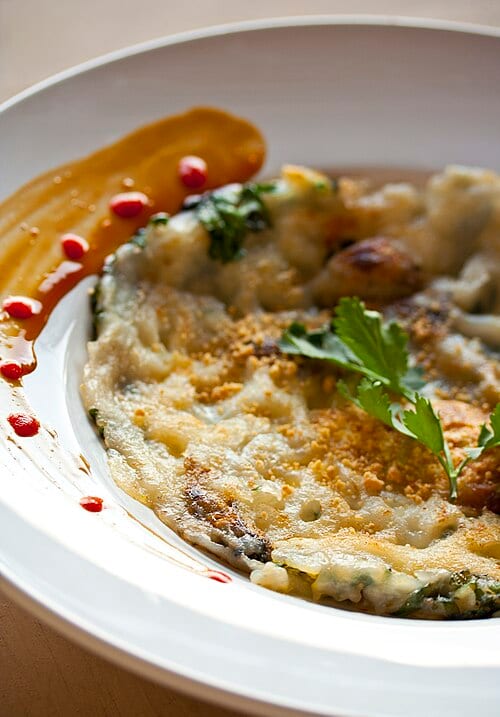
Keelung oyster omelette is a Taiwanese street snack made by frying fresh oysters and egg in a sweet potato starch batter on a griddle; Keelung's Miaokou version benefits from its proximity to the Kanziding Fish Market, giving it noticeably plump, fresh oysters. On the griddle, the batter slowly sets in the oil as oysters are pressed in one by one and the edges begin to crisp; the cook flips it in one swift motion and finishes it with a mix of ketchup and sweet chili sauce — a Miaokou standard.
Kanziding Fish Market, located around Xiao-Yi and Xiao-Er Roads near Keelung Harbor, is northern Taiwan's largest fish wholesale market, with the busiest trading starting around 2 a.m. and continuing until 6-7 a.m.; some Miaokou oyster omelette vendors source their fresh oysters directly from Kanziding. Near Keelung Train Station, Far East Oyster Omelette is a long-established shop with about 40 years in business, also known for its fresh oyster omelettes.
What is Oyster Omelette
Oyster omelette uses sweet potato starch as the base of its batter, cooked together with egg and oysters on an iron griddle. When heated, the sweet potato starch forms a translucent, chewy layer that wraps around the oysters to create a uniquely soft and silky texture. The Keelung Temple Street version is characterized by larger oysters, a relatively restrained batter ratio (so the flavor of the oysters isn't masked), and a northern-style sauce combining ketchup with sweet chili. Some long-established stalls insist on hand-flipping the entire omelette throughout, without using a press to set the shape — the overall texture has more character than mechanically produced versions.
Keelung's coastal geography gives it an advantage in the oyster supply chain: northern Taiwan's oyster farms are centered mainly along the coasts of Taoyuan and Chiayi, but Keelung Harbor's role as a transit hub allows Temple Street vendors to access fresher stock. Oyster omelette is found throughout Taiwan, but the northern Taiwan version differs noticeably from southern versions (especially Tainan) in batter recipe and sauce choice: the Tainan version uses a thinner batter with garland chrysanthemum as the main vegetable; the Keelung Temple Street version uses a thicker batter with a sweeter, spicier sauce. These are regional variations of the same dish, each evolved by local culinary habits.
How to eat like a local
Local knowledge
Objective credentials
- Oyster omelette is a permanent fixture at Keelung's Temple Street Night Market, recorded in the official introduction to the night market.
- Keelung's coastal geography gives it a relative advantage in the freshness of seafood ingredients like oysters — this geographic benefit is documented in local oyster supply chain assessments.
Visitor tips
- Oyster omelette stalls are concentrated around Ren 3rd Road; they open mainly in the evening, with longer wait times on weekends and holidays.
- Oyster omelette is made to order and takes about 5 to 10 minutes. Consider ordering first, then browsing other nearby stalls before coming back to pick it up.
- Recipes vary slightly between stalls — some have more oysters, others a higher batter ratio. You can ask before choosing.
Sources: Keelung Temple Street Night Market permanent item records; local oyster supply chain information.
Frequently Asked Questions
Why are the oysters in Keelung oyster omelette especially fresh?
Keelung sits near Kanziding Fish Market, northern Taiwan's largest fish wholesale market; some Miaokou vendors buy directly from Kanziding, so their oysters turn over quickly and stay plump.
When is Kanziding Fish Market busiest?
Trading picks up around 2 a.m. and stays busy until about 6-7 a.m., making it northern Taiwan's largest fish wholesale market.
How does Keelung oyster omelette differ from Tainan's version?
The Keelung Miaokou version tends to use larger oysters and a more restrained batter, finished with a northern-style ketchup-and-sweet-chili sauce, unlike Tainan's saltier-sweet hai shan sauce.
Sources
- 基隆廟口炭燒蚵仔煎 — 崁仔頂進貨蚵仔佐證
- 基隆崁仔頂魚市場介紹 — 崁仔頂為北台灣最大魚貨集散地、交易時間
- 基隆美食 遠東蚵仔煎 — 40年老店佐證