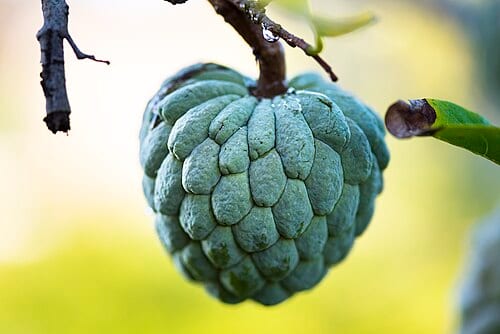
Taitung Sugar Apple is a custard apple grown mainly across the terraced hillsides of Taimali and Beinan in the Rift Valley, where the county produces the large majority of Taiwan's national crop. Driving south from Taitung City along the South-Link Highway, hillsides in Beinan and Taimali are blanketed in custard apple trees; from November through March, fruit hangs from every branch and the air carries a ripened, buttery sweetness — peel back the creamy flesh for a bite that is Taitung agriculture's loudest calling card.
According to Agriculture and Food Agency statistics for the 114/115 crop period, Taiwan's total pineapple custard apple harvest area was 2,454 hectares, of which Taitung County accounted for 2,430 hectares — about 99%. The pineapple custard apple variety descends from the Gefner cultivar imported from Israel in 1965, though it did not become a full-scale industry until 1997. Separately, per the Ministry of Agriculture's year-2000 agricultural yearbook, Taitung's total custard apple growing area across all varieties was roughly 4,500 hectares, 81.8% of Taiwan's national total at the time — long establishing it as Taitung County's top fruit.
What is Sugar Apple / Custard Apple?
The custard apple (scientific name Annona squamosa) gets its Chinese name 釋迦 from its resemblance to the Buddha's curled hair. The flesh is snow-white, fragrant, and sweet as butter, with black seeds scattered throughout. Two main varieties dominate in Taitung: "Damu" (large-eye) custard apple, centered in Taimali — larger segments, classic sweet fragrance — and "Pineapple Custard Apple," pioneered around Beinan and Taitung City — elongated oval shape, pineapple-like acidity, fewer seeds and more flesh. The two taste completely different and each has devoted fans.
Why Taitung? According to the Ministry of Agriculture's AgrICulture Knowledge Portal statistics, Taitung custard apples account for 81.8% of Taiwan's total production, making them Taitung County's top-billed fruit. The hills along Route 9 have good drainage; the northeast monsoon is blocked by the Central Mountain Range; ample sunshine and large diurnal temperature swings match perfectly the custard apple's preference for dry conditions and high sugar content. The Taimali District Farmers' Association and the Taitung District Farmers' Association have long supervised quality standards. November through March is peak season; Pineapple Custard Apple extends the season into summer.
How to eat it the authentic way
Local knowledge
Verified sources (sponsored content filtered)
- Ministry of Agriculture AgrICulture Knowledge Portal data: Taitung custard apples account for 81.8% of Taiwan's production, ranking as Taitung County's top fruit.
- Taimali is the definitive home of Damu custard apples, with long-term quality and branding support from the Taimali District Farmers' Association.
- The Taitung District Farmers' Association and the Beinan Township Farmers' Association have established production and marketing traceability records for Pineapple Custard Apple, with a scannable QR code for origin verification.
Practical tips
- The fruit is ripe when the skin segments begin to separate slightly and it yields gently under a light press. Eating one that is still hard will give you a bitter, sour experience — don't rush.
- After November, roadside direct-sale stalls from orchards line the South-Link Highway. You can taste and compare on the spot — don't judge by packaging alone.
- Pineapple Custard Apple is largely sold through export channels and convenience stores. Locally grown Damu custard apples are more often found in Taimali and Jinfeng.
Data compiled from the Taitung County Government Department of Transportation and Tourism Development, township and village farmers' associations, and large-scale public reviews. Sponsored listings have been filtered out.
Frequently Asked Questions
When is Taitung Sugar Apple in season?
Traditional custard apple peaks from November through March, while pineapple custard apple runs roughly December to April, so Taitung has fruit available nearly year-round.
What's the difference between Damu and Pineapple Custard Apple?
Damu is the traditional variety with larger segments and a rich sweet fragrance that needs to soften before eating; Pineapple Custard Apple has a pineapple-like tartness, fewer seeds, more flesh, and can be sliced with a knife and eaten right away.
Is Pineapple Custard Apple a native Taiwanese variety?
No — it descends from the Gefner cultivar imported from Israel in 1965 and only became a full-scale Taitung industry in 1997.
How long should a custard apple sit before eating?
A Damu custard apple usually needs two to five days at room temperature until the skin segments loosen and it yields to gentle pressure; Pineapple Custard Apple doesn't need to soften first.
Sources
- 鳳梨釋迦竟非台灣原品種!台東產量佔99% - 壹蘋新聞網 — 引用農糧署114/115期作統計、Gefner品種來源與1997年產業化
- 釋迦的產期是何時呢?除了台東還有哪是產地呢? - 農業知識入口網 — 農業部官方知識平台,民國89年農業年報81.8%數據