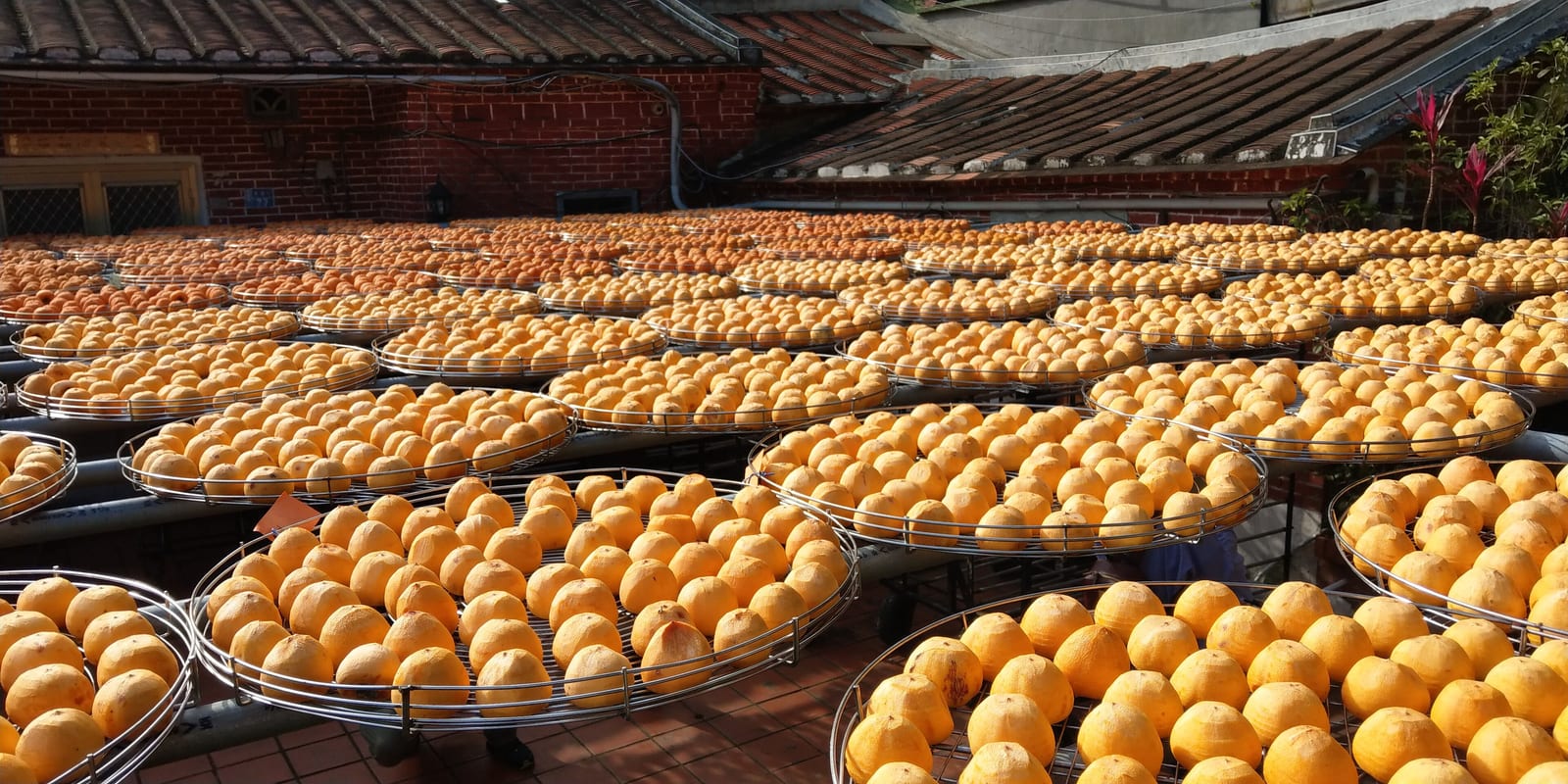
Xinpu dried persimmon cakes are a naturally sun- and wind-dried persimmon product from Hankeng Village in Xinpu, Hsinchu, made without ovens or sulfur fumigation, relying entirely on the autumn-winter Nine Descending Winds and sunlight to dehydrate and sweeten the fruit. Peak drying season runs from September to December, when orange-red persimmon trays fill the drying yards — one of Taiwan's most iconic autumn food landscapes.
According to the Hakka Affairs Council's Hakka Cultural Heritage Digital Archive, the traditional drying process takes about 6–7 days and uses a ratio of roughly 4 jin of fresh persimmons to make 1 jin of dried persimmon cake; Xinpu's Persimmon Festival has been held annually since 1998. Jinhan Persimmon Educational Farm was founded in 1947 (nearly 80 years old), while Weiweijia Persimmon Farm has operated for about 30 years — both are well-known local drying yards, though the persimmon-drying craft itself has been practiced in Xinpu for more than a century.
What Are Xinpu Dried Persimmons
Dried persimmon cakes are a processed persimmon product with astringency removed through dehydration. Xinpu dried persimmons mainly use stone persimmons and ox-heart persimmons; after peeling, the fruit is placed on round bamboo trays and naturally dehydrated using a "three parts sun, seven parts wind" approach. The entire process takes about 7–10 days, during which the persimmons must be repeatedly turned and pressed to encourage the persimmon frost to emerge; moisture is reduced to 30–35%, and the texture transitions from crisp to soft and from astringent to sweet, with a white surface coating of persimmon frost (fructose crystals) indicating completion. Xinpu dried persimmons use no oven drying and no sulfur fumigation — a fully natural method.
Why Xinpu? The answer lies in terrain and climate. Xinpu's Hankeng Village sits beside the Touqian River; in autumn and winter the northeast monsoon funnels through the river valley, producing the "Nine Descending Winds" — strong, dry, and sunny — the ideal natural conditions for dehydration. Other persimmon-producing areas in Taiwan (such as Gongguan in Miaoli) mostly produce crisp or soft persimmons; only Xinpu developed a dried-persimmon industry on the strength of this wind. Weiweijia, Jinhan, and Weizhenhiang are century-old family operations that open to visitors from September to December each year for viewing, tasting, and purchasing, making them one of Taiwan's most representative autumn food landscapes. Xinpu dried persimmons are also one of the Hakka Three Treasures.
How to Enjoy Them the Local Way
Local Knowledge
Verified endorsements (advertiser-filtered)
- Xinpu dried persimmons are one of the Hakka Three Treasures, produced using the natural "three parts sun, seven parts wind" method powered by the Nine Descending Winds.
- Weiweijia, Jinhan, and Weizhenhiang are century-old family operations open for visits during peak season from September to December.
- Xinpu's Hankeng Village generates Taiwan's strongest natural drying winds through the Touqian River valley topography — conditions found nowhere else in Taiwan.
Tips for Visiting
- The drying yards are private family workshops that also serve as tourist sites; follow the designated route, and do not touch the persimmons on the drying trays.
- Weekends during the September–December peak are extremely crowded; weekday or morning visits help avoid tour-bus rush hours.
- Dried persimmons keep for about 1 month refrigerated and up to 6 months frozen; they deteriorate quickly at room temperature, so refrigerate immediately after purchase.
Information compiled from the Michelin Guide, Hsinchu City Government Tourism Bureau, Hsinchu County Government Tourism and Travel Division, and a large volume of public reviews, with sponsored content filtered out.
Frequently Asked Questions
Why doesn't Xinpu persimmon drying use machine dryers?
The traditional method insists on 'three parts sun, seven parts wind,' relying entirely on the Nine Descending Winds and sunlight for natural dehydration — no oven drying, no sulfur fumigation — a process that takes about 6–7 days.
When is the best season to see or taste Xinpu dried persimmons?
September through December is peak drying season, with the most dramatic orange-red persimmon-tray scenery appearing in November and December when the Nine Descending Winds blow strongest.
What's the difference between Weiweijia and Jinhan?
Both are well-known persimmon-drying tourist farms in Xinpu; Jinhan, founded in 1947, has the longer history, while Weiweijia is a newer operation known for its photogenic drying-yard scenery that draws photography travelers.
Sources
- 新埔柿代相傳(客家文化資產數位網) — 客家委員會官方資料,含製程天數與柿餅節沿革
- 味衛佳柿餅教育農園 — 台灣休閒農業發展協會,農場經營年資