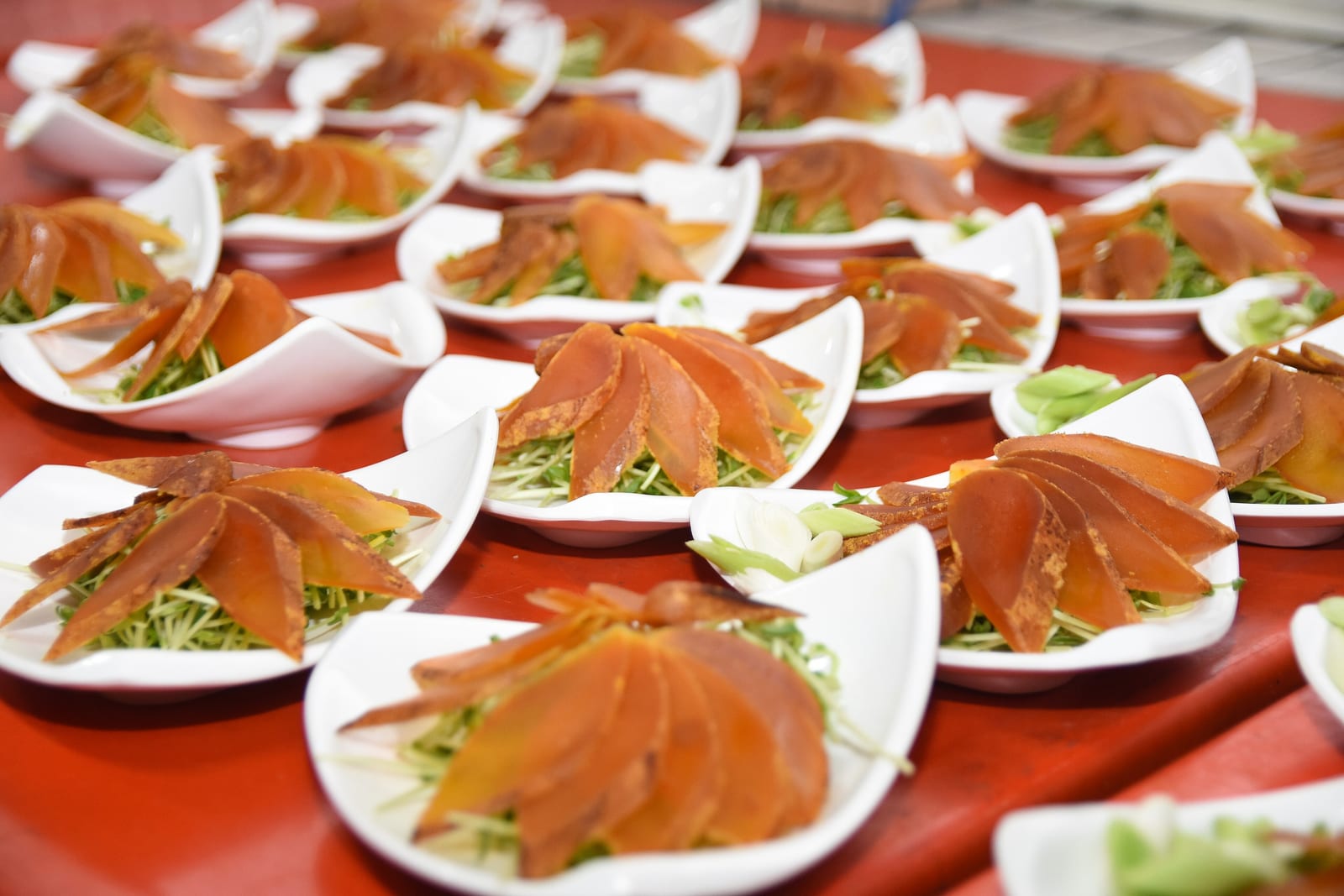
Donggang oilfish roe is a Donggang specialty made from the ovaries of oilfish (escolar), cured with salt and sun-dried; larger, thicker, and richer in fat than mullet roe, it ranks alongside bluefin tuna and sakura shrimp as one of the 'Three Treasures of Donggang.' A cluster of long-established dried-goods shops along Chaolong Road and Xinsheng 3rd Road is the main place to buy and taste it.
The Donggang Township Office lists bluefin tuna, sakura shrimp, and oilfish roe together as the 'Three Treasures of Donggang.' Oilfish roe is taken from the ovaries of oilfish, processed through salting and sun-drying, and is larger and thicker than typical mullet roe. Donggang's fishery products direct-sales center (Huaqiao Market) sits at No. 39 Chaolong Road, covering nearly 1,500 ping with over 400 stalls, while Xinsheng 3rd Road is home to the fishermen's association and a cluster of long-established dried-goods shops.
What is Donggang Oilfish Roe
Oilfish roe is not mullet roe. It is made from the ovaries of oilfish (Lepidocybium flavobrunneum, escolar), processed through salting, pressing, and sun-drying. Compared to mullet roe, it is larger, thicker, saltier, and richer in fat, with a texture that is springy yet chewy. Sliced thin and pan-fried until fragrant, then eaten with garlic shoots, white radish slices, or apple slices, the contrast of salty richness and fresh sweetness is the classic way to enjoy it — and a connoisseur's choice for Taiwanese banquet spreads and New Year gift boxes.
Why Donggang? The Donggang Township Office lists oilfish roe as the third of the 'Three Treasures of Donggang,' and the local processing and drying industry is well established. Deep-sea oilfish caught by Donggang ocean-going vessels are brought to the cluster of dried-goods shops along Chaolong Road and Xinsheng 3rd Road, where traditional methods — removing the roe sac, salting, and sun-drying — produce oilfish roe with evenly distributed saltiness and beautifully spread fat, the hallmark of Donggang's craft. The category is defined by a cluster of producers rather than a single dominant shop; choosing a reputable long-standing store and reading the origin label clearly is what matters most.
How to eat it like a local
Local knowledge
Verified endorsements (sponsored content filtered out)
- The Donggang Township Office designates oilfish roe as the third of the 'Three Treasures of Donggang' and one of Donggang's representative dried goods.
- Chaolong Road and Xinsheng 3rd Road form Donggang's dried-goods cluster, with many shops operating for 30 years or more.
- Donggang's climate and processing techniques produce oilfish roe with evenly distributed saltiness and beautifully spread fat — making it the main production area in Taiwan.
Visitor tips
- Oilfish roe is high in salt and fat; those with sensitive digestion should not eat too much at once — thin slices for tasting is the right approach.
- When buying, look for origin labels reading 'locally processed in Donggang.' Some products use imported roe processed elsewhere, and the flavor is noticeably different.
- Price gaps in gift box sets can be large; head directly to the dried-goods cluster on Chaolong Road to compare prices — considerably cheaper than tourist-area shops.
Information compiled from the Pingtung County Government Tourism Bureau, Donggang Township Office, and large volumes of public reviews; sponsored content has been filtered out.
Frequently Asked Questions
What's the difference between oilfish roe and mullet roe?
Oilfish roe comes from the ovaries of oilfish and is larger, thicker, and higher in both fat and salt than mullet roe, which comes from grey mullet and has a lighter, more delicate flavor.
Where's the best place to buy Donggang oilfish roe?
Chaolong Road and Xinsheng 3rd Road form Donggang's dried-goods cluster, home to many shops that have operated for more than 30 years; buying directly there is usually cheaper than gift-box sets sold in tourist areas.
How do you pan-fry oilfish roe without drying it out?
Slice it about 0.3 cm thick and dry-fry over low heat until lightly browned on both sides — overcooking makes it dry and hard; pairing it with garlic shoot whites and sliced white radish is the classic way to serve it.
Sources
- 東港鎮公所-東港三寶:黑鮪魚、櫻花蝦、油魚子及特產小吃 — 官方三寶排序與定義
- 東港漁港漁產品直銷中心(華僑市場) — 交通部觀光署,市場地址與規模