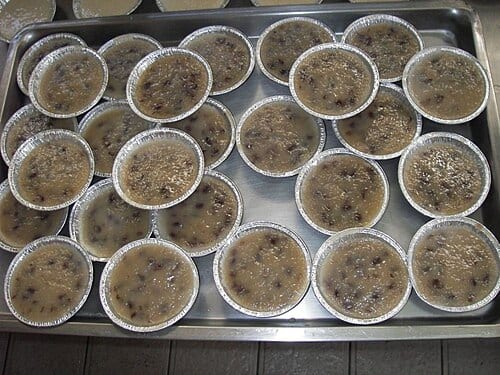
Donggang bah-kué is a steamed rice cake dish topped with shrimp-paste braised pork and milkfish broth, a signature breakfast in Donggang, Pingtung. At six each morning, the shops along Guangfu Road are already packed with locals starting their day with it. Snow-white rice cakes are cut into cubes, pan-fried until golden at the edges, and finished with sakura shrimp for a layered, savory bite.
The term "Donggang's Small Three Treasures" (rice cake, rice soup, and shuanggaorun) is a popular media label, distinct from the Donggang Township Office's officially designated "Three Treasures of Donggang" — bluefin tuna, sakura shrimp, and oilfish roe — and the two lists should not be confused. On Guangfu Road, Ye Family Bah-kué is reported by multiple local sources to have operated for 50-plus years across two to three generations, one of the area's representative long-running shops.
What is Donggang Bah-kué Rice Cake
Bah-kué (Taiwanese: bah-kué) is a rice-based snack made by grinding non-glutinous rice into a slurry, adding a pinch of salt, and steaming it into a firm slab, which is then cut into cubes and cooked together with shrimp-paste (a small crustacean similar to tiny shrimp), braised pork, milkfish, or sakura shrimp as a broth; there is also a dry-tossed version and a pan-fried version. The rice cake is soft yet slightly chewy, soaking up the savory broth. The sweetness of the shrimp-paste and milkfish, the fragrance of the braised pork, and the crunch of sakura shrimp all arrive on the same spoon — a simple structure with layered flavor, a true fishing-port dish.
Why Donggang? The Donggang Township Office lists bah-kué as one of the 'Small Three Treasures of Donggang' (the other two are shuanggaorun and, by some counts, oilfish roe), and it has long been the heart of local breakfast culture. Ye Family Bah-kué on Guangfu Road is a representative shop, with three generations of operation spanning decades, serving shrimp-paste braised pork and milkfish broth. Lin Ji and A-rong are also choices frequented by locals. The category is a cluster rather than one dominant shop; several old establishments in Donggang each have their own following, with slightly different flavors, but all uphold the Donggang standard of freshly steamed rice cakes and freshly simmered broth.
How to eat it like a local
Local knowledge
Verified endorsements (sponsored content filtered out)
- The Donggang Township Office designates bah-kué as one of the 'Small Three Treasures of Donggang' and a representative local breakfast.
- Guangfu Road is the core of the bah-kué cluster; Ye Family Bah-kué has operated for three generations over several decades.
- Donggang's coastal location means ingredients like shrimp-paste, sakura shrimp, and milkfish are all sourced directly from local fishermen.
Visitor tips
- Almost all shops are breakfast-only; they frequently sell out by 11 a.m. On weekends, aim to arrive by 8–9 a.m.
- Shrimp-paste comes in the shell; if you're not comfortable with that, ask the shop to reduce the amount or strain them out — don't eat them aggressively.
- Parking is scarce; the recommended approach is to park near Huaqiao Market and walk over.
Information compiled from the Pingtung County Government Tourism Bureau, Donggang Township Office, and large volumes of public reviews; sponsored content has been filtered out.
Frequently Asked Questions
What is Donggang bah-kué?
Donggang bah-kué is a traditional Pingtung breakfast made from steamed non-glutinous rice cake cubes topped with shrimp-paste braised pork and milkfish broth.
Is the "Small Three Treasures of Donggang" an official designation?
No — it is a popular media and local term (rice cake, rice soup, and shuanggaorun); the Donggang Township Office's officially designated "Three Treasures of Donggang" are actually bluefin tuna, sakura shrimp, and oilfish roe.
What time is best to eat Donggang bah-kué?
Arrive before 8 a.m. — most old shops sell out and close around midday.
Sources
- 食尚玩家—吃貨必嘗「東港小三寶」:肉粿、飯湯、雙糕潤 — 「小三寶」為媒體與在地慣用稱呼,非鎮公所官方三寶
- 屏東縣東港鎮公所—東港三寶:黑鮪魚、櫻花蝦、油魚子 — 官方認定的東港三寶,與媒體所稱小三寶為不同名單
- 屏東東港美食》葉家肉粿,超過50年傳承三代的肉粿湯