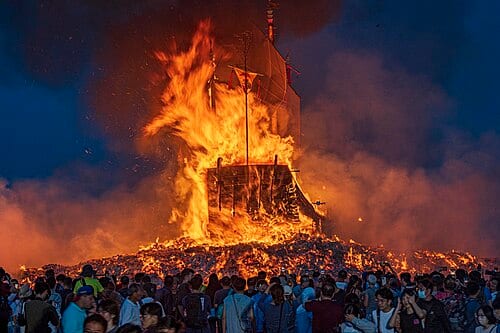
The Donggang Yingwang Pingan Festival is a Wang Yeh deity worship ceremony centered on Donglong Temple, held once every cycle of the Chou, Chen, Wei, and Xu zodiac years; it was designated a National Important Folk Custom by Taiwan's Ministry of Culture (then the Council for Cultural Affairs) in 2010, with a certificate issued in 2011. Spanning roughly eight days from the initial water-fetching rite, the ceremony proceeds through welcoming the deities, fire-walking, the procession, and ritual assemblies before concluding with the burning of the Wang boat, mobilizing more than ten thousand worshippers and artisans.
The festival was designated a National Important Folk Custom by Taiwan's Ministry of Culture (then the Council for Cultural Affairs) on June 18, 2010, with an official certificate issued on November 26, 2011. Since a 1973 ritual cycle, the Wang boat has been built of wood at roughly one-tenth the scale of a real vessel; earlier boats were made of paper. The festival is held once every three years, in the zodiac years of Chou, Chen, Wei, and Xu.
Highlights of the Donggang Yingwang Pingan Festival
Donglong Temple is dedicated to Lord Wen (Wen Fu Qian Sui). The core ceremonies of the Yingwang festival include: "Welcoming the Wang Yeh" (receiving the arrival of the Qiansui — the emissaries of Heaven), "Fire-walking" (worshippers walk barefoot across burning charcoal), "Procession" (the ceremonial parade passes through each neighborhood of the entire town), and "Sending off the Wang Yeh" (burning the Wang boat to send the deities back to Heaven). The Wang boat is a large wooden sailing vessel, carefully built by craftsmen for each ceremony cycle. The hull is made of real materials, stocked with food, daily necessities, and gold and silver treasures, and is ultimately burned to send the Wang Yeh off — symbolizing the dispatch of plague and misfortune away from the human world.
During the festival, all of Donggang Township is enveloped in incense smoke and the sound of gongs and drums. Neighborhood temples compete to display their palanquin-bearing skills, and the procession lines extend for several kilometers. The Wang boat burning site is usually on a beach or open ground; on the evening of the burning, crowds are enormous and the spectacle is awe-inspiring. In non-festival years, you can visit Donglong Temple, which houses historical Wang boat models and artifacts providing insight into the history and craft heritage of the festival. In non-festival years, Donggang remains an important fishing town where you can sample local specialties such as bluefin tuna, mullet roe, and sakura shrimp.
How to make the most of your visit
Practical information
Getting there and timing
- Donggang has no train station. You can take a bus from Kaohsiung to Donggang, or drive yourself; the journey from central Kaohsiung to Donggang takes about 50 to 60 minutes. During the festival, traffic controls are complex; public transport is recommended and you should allow ample travel time.
- The Yingwang festival is held every three years (in the years of Chou, Chen, Wei, and Xu). The exact dates are determined by the lunar calendar; be sure to check official announcements from Donglong Temple to confirm the event schedule before visiting.
- In non-festival years, Donglong Temple is open for visits year-round. The temple's general visiting hours run from early morning to evening and are open for worship.
Nearby connections
- The Xiao Liuqiu ferry pier (Dong-Liu route) is located in Donggang; you can take a boat to Xiao Liuqiu, making Donggang a transit hub for the island.
- The Guangcai Wetland and Qifeng Wetland ecological area in Linbian Township is about 15 minutes from Donggang by car and can serve as a nature-themed extension beyond the festival.
Sources: Bureau of Cultural Heritage, Ministry of Culture (national important folk customs records); Donglong Temple official information.
Frequently Asked Questions
How often is the Donggang Yingwang Pingan Festival held?
It is held once every three years, in the zodiac years of Chou, Chen, Wei, and Xu.
What happens to the Wang boat in the end?
On the final morning of the festival, the boat is burned in the sending-off ritual along with the offerings, symbolizing the deities' return to heaven.
What material is the Wang boat made of?
Since a 1973 ritual cycle it has been built of wood at roughly one-tenth the scale of a real vessel; earlier boats were made of paper.
Sources
- 東港迎王平安祭典 - 維基百科 — 祭典週期、天數、王船材質沿革
- 東港迎王平安祭典 - 臺灣宗教文化地圖 — 國家重要民俗指定日期與王船規模