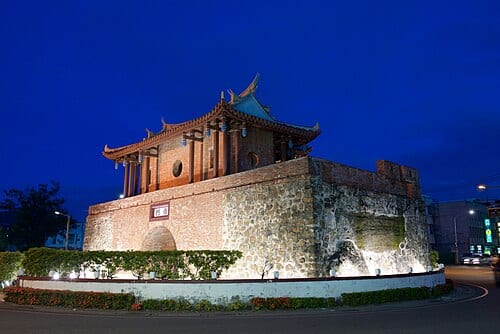
Hengchun Old Town Walls is one of Taiwan's most completely preserved Qing-dynasty brick-and-stone walled towns, built starting in the first year of the Guangxu reign (1875). All four gates — east, west, south, and north — still stand at their original locations, with a wall circumference of about 880 zhang (roughly 2,600 meters). Designated a National Historic Site, it is an important physical record for studying Qing-dynasty defensive architecture in Taiwan and forms the spatial core of Hengchun Township.
Construction of the Hengchun town walls began on November 15, 1875 (the 18th day of the 10th month, first year of the Guangxu reign) and was completed on September 1, 1879, taking about four years; the wall has a circumference of 880 zhang (roughly 2,600 meters), built using rammed lime-and-sand construction (sanheitu) with four gates — east, west, south, and north — and is now designated a National Historic Site.
Highlights of Hengchun Old Town Walls
The historical background of Hengchun's fortification is closely linked to the 1874 Mudan Incident, in which Japan used the deaths of Ryukyuan fishermen as a pretext to send troops to Taiwan. The Qing court subsequently moved to establish defensive installations in southern Taiwan. The Hengchun town walls were overseen by Fujian Land Commander Luo Dachun and took three years to build, using a mixed brick-and-stone construction method. All four gates feature a barbican (wengcheng) structure, and the battlements (zhidié) are preserved along the top of the walls, retaining the complete form of a Qing-dynasty military walled town — one of the best-preserved examples among existing ancient towns in Taiwan.
Among the four gates, the South Gate (Mingdu Gate) faces toward Eluanbi and was historically the main thoroughfare in and out of Hengchun; the North Gate (Gongchen Gate) has the most complete surviving gate tower and can be climbed for views over the Hengchun Basin. Some sections of the town wall are still embedded within residential buildings, creating a distinctive urban texture where the ancient walls coexist with everyday life. Every spring, the retreat of the Luoshan wind coincides with kapok blossoms; autumn and winter bring the strong-wind season.
How to make the most of your visit
Practical information
Getting there and timing
- From Kaohsiung, take a bus to Hengchun Terminal; all four gates are within walking distance with no additional transfer needed.
- The town walls are open for viewing at all hours with no admission fee. Opening hours for the North Gate tower depend on announcements by the managing authority; it is recommended to check the latest information from the Pingtung County Government Cultural Affairs Department before visiting.
- Summer afternoons are very hot; it is advisable to visit before 10 a.m. or after 4 p.m., and to bring water and sun protection.
Nearby connections
- Hengchun Old Street and the market near the East Gate can be explored for local food and everyday life after the walking circuit.
- Kenting Main Street is about 8 km from Hengchun Township and can be reached by bus or rental vehicle to extend the itinerary.
- Eluanbi Lighthouse is at the southern tip of Hengchun Township, about 14 km from the Old Town, and can be combined into a half-day itinerary.
Sources: Bureau of Cultural Heritage, Ministry of Culture (national historic site records); Pingtung County Government Cultural Affairs Department.
Frequently Asked Questions
When was Hengchun Old Town built?
Construction began in 1875 (the first year of the Guangxu reign) and was completed in 1879, taking about four years.
How long is the wall circumference?
The wall's circumference is about 880 zhang, roughly 2,600 meters, built using rammed lime-and-sand construction.
How many gates survive at Hengchun Old Town?
All four gates — east, west, south, and north — still stand intact at their original locations, making it one of Taiwan's most completely preserved Qing-era walled towns.
Sources
- 恆春古城 - 國家文化資產網 — 國定古蹟登錄資料查證
- 恆春縣城 - 維基百科 — 動工/完工日期、城牆周長(880丈≈2,600公尺,修正原稿880公尺之誤)查證