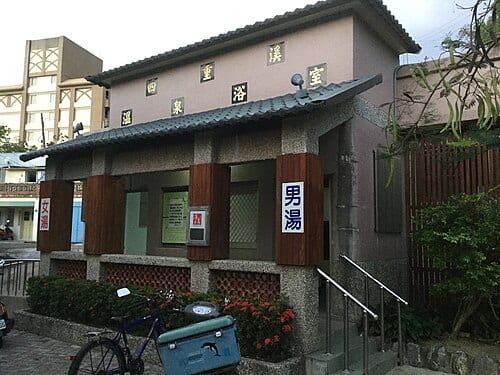
Sichongxi Hot Spring is one of Taiwan's four major hot spring destinations, alongside Beitou, Wulai, and Guanziling, with an alkaline sodium bicarbonate spring known for its clear, bathable water. It was developed as a hot spring sanatorium by the Japanese colonial authorities. Multiple hot spring hotels line the valley stream, and the quiet ambience of a Japanese-style hot spring village remains to this day; a Pingtung Hot Spring and Food Carnival is held each autumn.
Sichongxi Hot Spring was discovered by a Japanese military police officer stationed in Hengchun in 1895 (Meiji 28), with bathhouse facilities built the following year; during the Japanese colonial era it was ranked among Taiwan's four major hot springs alongside Beitou, Guanziling, and Caoshan (present-day Yangmingshan). Prince Nobuhito, younger brother of Emperor Showa, honeymooned here with his new wife, prompting Kaohsiung Prefecture to fund a guest villa and honeymoon bathhouse that still stand today.
Highlights of Sichongxi Hot Spring
The place name Sichongxi dates from the Qing dynasty. The terrain is a basin-like landform surrounded by hilly valley streams, lushly shaded in summer and serene in winter. During the Japanese colonial period, the high quality of the springs led to plans for official sanatorium facilities, and some hotel buildings retain a Japanese wooden-structure architectural style. The spring type is mildly alkaline, and the water has a skin-softening effect, earning it the nickname "beauty spring." The spring water contains carbonic acid components; upon contact with air after emerging, it gradually produces white calcium carbonate deposits — a visible marker of the spring's characteristic quality.
The Pingtung Hot Spring and Food Carnival (approximately October to November) is held at Sichongxi, featuring hot springs, indigenous song-and-dance performances, and sales of local agricultural products — making it one of the more lively periods to visit. In winter (approximately December to February), the northeast monsoon brings relatively cool temperatures; the hot-spring experience is most comfortable, and with fewer visitors, you can enjoy the facilities at a leisurely pace. There are a few trails around the valley, and a post-meal stroll along the stream is a common leisure activity.
How to make the most of your visit
Practical information
Getting there and timing
- From Hengchun, take a bus heading toward Checheng to reach Sichongxi; bus frequency is sparse, so bringing your own transport is recommended. The distance from Hengchun to Sichongxi is about 16 kilometers, approximately 20 to 25 minutes.
- Most hot spring hotels offer day-use (no overnight stay) soaking services; it is recommended to book by phone in advance, as hotels often fill up on weekends and during the carnival period.
- Summer temperatures are high, making soaking less comfortable; autumn and winter are the best seasons to visit.
Nearby connections
- Baoli Temple (Fu'an Temple) in Checheng Township is about 5 km from Sichongxi. The temple is impressively large and worth a brief visit.
- Longluantan Nature Center is about 15 km from Sichongxi; during the winter migratory bird season, it can be combined into a half-day nature-ecology itinerary.
- Hengchun Old Town Walls is about 16 km from Sichongxi and can be combined into a one-day south Pingtung historic sites, hot springs, and culture itinerary.
Sources: Tourism Administration, Ministry of Transportation; Pingtung County Government Tourism and Communications Department.
Frequently Asked Questions
What type of spring is Sichongxi?
It is an alkaline sodium bicarbonate spring with clear water that softens skin, earning it the nickname "beauty spring."
When was Sichongxi Hot Spring discovered?
It was discovered in 1895 (Meiji 28) by a Japanese military police officer stationed in Hengchun, with bathhouse facilities built the following year.
Which four major hot springs is Sichongxi grouped with?
It is grouped with Beitou, Guanziling, and Caoshan (present-day Yangmingshan) as one of Taiwan's four major hot springs from the Japanese colonial era.
Sources
- 四重溪溫泉 - 交通部觀光署 — 泉質、發現年代官方描述
- 台灣四大名湯,日本皇太子也欽點—屏東 四重溪溫泉 — 宣仁親王蜜月與四大溫泉並列細節