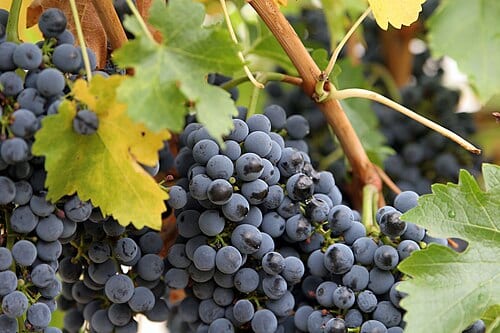
Xinyi highland grapes are a signature Kyoho table grape grown on the hillsides of Xinyi Township, Nantou, at elevations of 400–1,800 meters across roughly 200 hectares, with three harvests a year — mid-July, mid-September, and early December through late January. The wide day-night temperature swing forces the grapes to accumulate sugar during the day and slowly convert acidity at night, producing a well-balanced highland grape style that makes for one of Nantou's essential autumn-to-winter agri-tourism routes.
According to the Taichung District Agricultural Research and Extension Station, Xinyi Township has about 200 hectares under Kyoho table grape cultivation at elevations of 400–1,800 meters, yielding roughly 3,600 metric tons a year through 11 production and marketing groups with 200 members. The township harvests three times annually — mid-July, mid-September, and early December through late January — and the Fengqiu Grape Tourist Orchard, at 500 meters elevation, has offered pick-your-own visits since 1983.
What Are Xinyi Highland Grapes
Xinyi Township grapes are mainly Kyoho (a large-berry variety introduced from Japan) and Jinsiang (a white grape variety developed in Taiwan). Kyoho has large, thick-skinned berries with abundant juice and can reach 18–22 Brix sugar content; Jinsiang has thin skin and clear juice with a citrus fragrance, slightly lower sugar but refreshingly acidic. Highland cultivation uses a trellis system, and growers bag individual clusters to prevent pest damage, resulting in far lower pesticide use than lowland farms. Xinyi Township Farmers' Association also processes some grapes into grape juice and wine, extending the local industry chain.
Xinyi Township is the traditional territory of the Bunun people; the modern grape industry has developed since roughly the 1970s, with most farms operated by tribal members. The Xinyi Township Farmers' Association holds an annual Grape Festival from August to October, connecting farm pick-your-own visits, association sales events, and tribal cultural experiences — it is listed as the township's representative agricultural festival on the Nantou County Government tourism website. Farm pick-your-own visits require confirming harvest status in advance, and some farms require reservations.
How to Choose Like a Local
Local Knowledge
Verified Sources
- The Xinyi Township Farmers' Association official website maintains a dedicated grape production and marketing page, updated annually with harvest schedules and cooperating farm listings — the most reliable source for checking availability.
- The Nantou County Government tourism website lists Xinyi grapes as the township's representative agricultural product and includes official information about the annual Grape Festival.
Visitor Tips
- Outside the harvest season (November through July the following year), almost no fresh grapes are available for picking; some vendors in tourist areas substitute grapes from other counties, so check the origin label.
- Farm pick-your-own operates on a pay-by-weight basis; confirm the day's price before picking and bring your own bags to avoid excess packaging charges.
- During the Grape Festival (August–October), the road from Xinyi toward Dongpu is severely congested on weekends — consider taking the Farmers' Association shuttle bus or visiting on weekdays.
Sources: Xinyi Township Farmers' Association Grape Production and Marketing Division, Nantou County Government Tourism Website.
Frequently Asked Questions
How many harvests does Xinyi Township grapes have per year?
Xinyi Township's Kyoho grapes are harvested three times a year — mid-July, mid-September, and early December through late January.
At what elevation are Xinyi highland grapes grown?
Cultivation spans elevations of 400 to 1,800 meters across about 200 hectares, entirely planted with the Kyoho table grape variety.
Where can visitors pick grapes themselves?
The Fengqiu Grape Tourist Orchard, at 500 meters elevation, has offered pick-your-own visits since 1983, one of the longest-running orchard experiences in the township.
Sources
- 信義鄉的葡萄 — 臺中區農業改良場官方資料,栽培面積、海拔、產季、產量