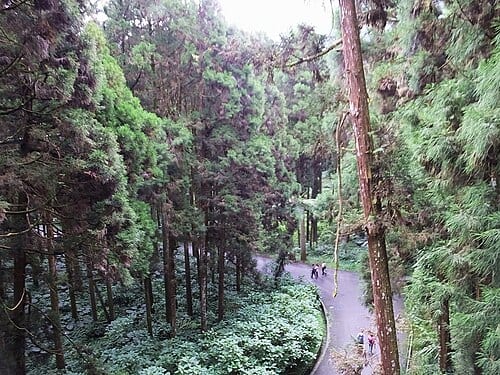
Xitou Nature Education Area is a 2,500-hectare conifer forest reserve managed by National Taiwan University's Experimental Forest at an elevation of about 1,150 meters, dominated by Taiwan cedar, Japanese cedar, and red cypress. Its lush forest canopy provides a cool summer escape for residents of southern Taiwan, and its University Pond and elevated Sky Corridor walkway are popular attractions.
Xitou Nature Education Area covers about 2,500 hectares at an elevation of about 1,150 meters and is managed by National Taiwan University's Experimental Forest (whose total holdings exceed 30,000 hectares). The park's roughly 2,800-year-old red cypress Ancient Tree fell on September 11, 2016; the fallen trunk has been left in place, with a viewing platform built in 2017. The park's well-known elevated walkway is officially called the Sky Corridor, about 220 meters long with a highest point roughly 22.6 meters above ground — a different structure from the Houtanjing Sky Bridge (204 meters), a separate attraction in Nantou City that is sometimes confused with it.
Highlights of Xitou Nature Education Area
The core trails center on University Pond (a mirror-surface reservoir), a grove of moso bamboo, and a Taiwan cedar plantation, with interpretive signage along each route explaining species characteristics, forest management, and ecosystem functions. The Ancient Tree, a roughly 2,800-year-old red cypress, was the most iconic individual specimen in the area until it fell in September 2016; the fallen trunk has been left in place with a viewing platform, and it remains an important ecological reference point that the Experimental Forest has long preserved. The Sky Corridor is an elevated walkway about 220 meters long with a highest point roughly 22.6 meters above ground, offering views across the forest canopy. It can draw queues on weekends during peak season.
The area is positioned as a "nature education" site and offers ecological education and interpretive services, with guided interpretation programs led by rangers during certain time slots. The surrounding area has clusters of guesthouses and hotels; staying overnight allows you to experience the quiet forest atmosphere in the early morning and at night — the misty Taiwan cedar forest in the predawn hours is a stillness impossible to feel during the busy daytime. Summer (June to August) is peak season with large weekend crowds; autumn and winter see fewer visitors, the forest remains lush green, and temperatures are more pleasant.
Tips for Making the Most of Your Visit
Practical Information
Getting There & Time Required
- By car from Zhushan via Highway 151 or from Caotun, the drive takes about 1 to 1.5 hours. Nantou Bus operates service but with limited departures on weekends — check the latest timetable.
- A relaxed visit covering the main trails takes about 2 to 3 hours; including the Sky Corridor and Ancient Tree route, plan for 4 to 5 hours or stay overnight.
Nearby Connections
- Lugu Township is famous for Dongding Oolong tea; heading toward Lugu town center, several tea farms offer tours and tastings that can be combined with an Xitou visit.
- Heading north to Zhushan connects to Zinan Temple, forming a southwest Nantou half-day to full-day itinerary.
Sources: National Taiwan University Experimental Forest Xitou Nature Education Area official website.
Frequently Asked Questions
Is the ancient tree at Xitou Nature Education Area still standing?
The roughly 2,800-year-old red cypress Ancient Tree fell on September 11, 2016; the fallen trunk remains on site, with a viewing platform built in 2017.
What is the name of Xitou's elevated walkway?
It is officially called the Sky Corridor, about 220 meters long with a highest point roughly 22.6 meters above ground — a different attraction from the Houtanjing Sky Bridge in Nantou City.
Which institution manages Xitou Nature Education Area?
It is managed by National Taiwan University's Experimental Forest, covering about 2,500 hectares at an elevation of about 1,150 meters.
Sources
- 溪頭自然教育園區 - 維基百科 — 面積海拔、神木倒伏年份
- 猴探井天空之橋 - 南投旅遊網 — 確認天空之橋為猴探井景點、非溪頭設施
- 國立臺灣大學生物資源暨農學院實驗林管理處 — 溪頭空中走廊官方資訊來源