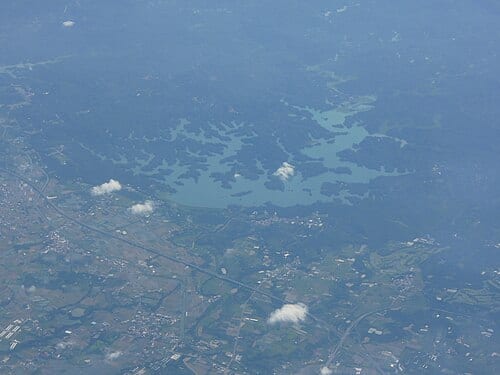
Wushantou Reservoir is a Japanese-colonial-era reservoir in Guantian District, Tainan, designed by Japanese civil engineer Hatta Yoichi and built between 1920 and 1930 as the core water source for the Chianan Canal irrigation system; its irregular, bay-indented shoreline earned it the name Coral Lake.
Wushantou Reservoir was proposed by Japanese civil engineer Hatta Yoichi in 1917 as the Kanden Creek Irrigation Plan, with construction beginning on September 1, 1920. It was built using his self-devised semi-hydraulic fill method for the earthen dam — about 1,273 meters long and 56 meters high — and was completed and began supplying water on May 15, 1930. At the time, its storage capacity of 150 million tonnes was the largest in East Asia, irrigating roughly 150,000 jia of the Chianan Plain.
What to See at Wushantou Reservoir
Wushantou Reservoir was designed and overseen by Japanese civil engineer Hatta Yoichi; construction began in the 1920s and was completed in 1930. It is a key facility in the Chianan Canal water system. The Chianan Canal's irrigation area covers the Chianan Plain, making it one of the largest-scale water engineering projects in Taiwan's agricultural history. The dam was built using the Hydraulic Fill Dam method, which was an advanced engineering technique at the time.
The reservoir's lake surface, shaped by the surrounding hilly terrain, formed a contour with many bays and inlets — resembling coral when viewed from above, hence the name Coral Lake. Inside the grounds is the Hatta Yoichi Memorial Park, which preserves his work quarters and features an exhibition documenting the reservoir's construction process and the impact of the Chianan Canal on Taiwan's agriculture. A bronze statue of Hatta Yoichi stands beside the dam — the park's signature landmark.
How to Make the Most of Your Visit
Practical Information
Getting There & Timing
- Located in Wushantou, Guantian District, about 30 km from central Tainan; driving is recommended — public transport near the area is infrequent.
- The grounds charge admission; the Hatta Yoichi Memorial Park and the lake tour boat may be priced separately — check the official website for ticket prices and opening hours before you go.
- Weekends are more crowded; if you want to visit the memorial park at a leisurely pace, a weekday visit is better.
Nearby Connections
- Guantian District is known for water caltrop; the season runs from September to November each year — available at rural markets around the reservoir.
- Zengwen Reservoir is about a 40-minute drive from Wushantou — they can be combined into a two-reservoir day route through Tainan's reservoir landscapes.
For ticket prices and opening hours, please consult the official Wushantou Reservoir website.
Frequently Asked Questions
Who designed Wushantou Reservoir?
Japanese civil engineer Hatta Yoichi designed and supervised construction, which began in 1920 and finished in 1930.
Why is it called "Coral Lake"?
The hilly terrain shaped the shoreline into many bays and inlets that resemble coral when viewed from above, giving it the name Coral Lake.
What special construction method was used?
Hatta's self-devised semi-hydraulic fill method, using cobbles, gravel, and clay to build a wet earthen dam.
How large an area did Wushantou Reservoir irrigate?
Through the Chianan Canal system it irrigated about 150,000 jia of the Chianan Plain, one of the largest water engineering projects in Taiwan's agricultural history.
Sources
- 嘉南大圳 - 維基百科 — 八田與一提案年代、動工日期
- 「由小因而得大果報」八田與一和先民建造烏山頭水庫和嘉南大圳 — 半水力沖淤式工法、堤長堤高、貯水量、完工通水日期