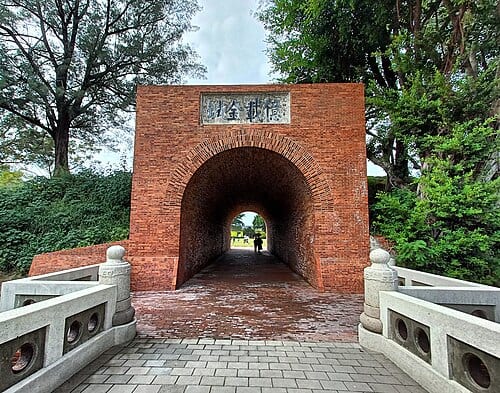
Eternal Golden Castle is a Qing-dynasty Western-style fort in Anping District, Tainan, formally known as Erkun Fort. Commissioned by imperial commissioner Shen Baozhen after the 1874 Mudan Incident exposed weaknesses in Taiwan's coastal defense, it was designed by French engineers and completed in 1876. The fort follows a four-bastion layout surrounded by a moat, built partly with bricks salvaged from the ruins of Fort Zeelandia, and was Taiwan's first fort equipped with British Armstrong cannons.
Construction of Eternal Golden Castle began in September 1874 and finished in August 1876 (the second year of the Guangxu reign); French engineer Berthault, who referenced Paris's outer defensive fortifications, led the design, and part of the building material was brick salvaged from the demolished ruins of Fort Zeelandia. It was Taiwan's first fort equipped with British Armstrong cannons and later served a defensive role during the Sino-French War and Liu Yongfu's 1895 anti-Japanese resistance.
What to See at Eternal Golden Castle
Eternal Golden Castle is formally known as Erkun Fort. Completed in the second year of the Guangxu reign (1876), it was planned and built by Shen Baozhen using Western fortification techniques. The floor plan follows a four-angled bastion design, with the moat encircling all four sides. The brick outer walls combined with earthworks reflect late-19th-century European fortress design concepts, making it one of the better-preserved examples of its type surviving in Taiwan.
The grounds are spacious, with the moat surface reflecting the silhouette of the walls. Replica cannons placed on the lawn inside the fort mark the original gun positions. The stone gate at the entrance is inscribed with 'Eternal Golden Castle' — calligraphy by Shen Baozhen himself. The overall preservation is good; the brick texture on all four walls is clearly defined, making it a worthwhile historical landmark to include on a visit to southern Tainan.
How to Make the Most of Your Visit
Practical Information
Getting There & Timing
- Located on Guangzhou Road in Anping District, about 2 km from Anping Old Fort; recommended to connect the Anping District attractions by shared bicycle.
- Check the Tainan City Bureau of Cultural Affairs website before you go to confirm opening hours. The grounds have no shade, so be mindful of sun exposure on summer afternoons.
- Parking is limited on weekends; arriving by bicycle or bus is more convenient.
Nearby Connections
- Cycling connects to Anping Old Fort and Anping Tree House, forming a cultural route through Anping District.
- Anping Harbor Fish Market is nearby — you can sometimes catch fishing boats returning in the evening and observe the working harbor alongside.
For administrative information, please consult official announcements from the Tainan City Bureau of Cultural Affairs.
Frequently Asked Questions
What is Eternal Golden Castle's official name?
Its official name is Erkun Fort, a Qing-dynasty Western-style fort built to strengthen coastal defense.
When was Eternal Golden Castle completed?
Construction began in September 1874 and was completed in August 1876, the second year of the Guangxu reign.
Who designed Eternal Golden Castle?
It was commissioned by imperial commissioner Shen Baozhen and designed by French engineer Berthault, who referenced Paris's outer defensive fortifications.
Sources
- 二鯤鯓砲臺 - 維基百科 — 興建起訖年份、設計者、建材來源、裝備阿姆斯特朗大砲等沿革