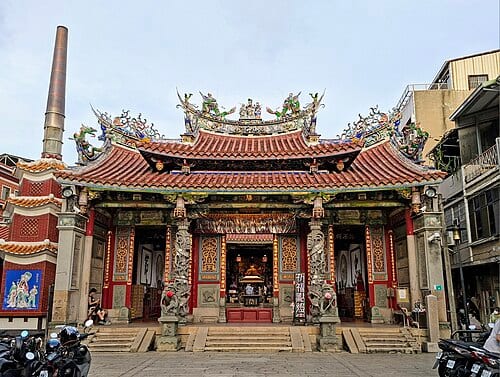
Grand Mazu Temple (Datianhougong) is a Qing-dynasty Mazu temple in West Central District, Tainan, originally the residence of Ming prince Zhu Shugui, Prince Ningjing. After Qing forces took Penghu in 1683, the prince took his own life in loyalty to the Ming and donated his residence to become a temple; the following year the Qing court converted it into a Mazu temple, and in 1720 it was formally added to the state's spring and autumn sacrificial rites, becoming Taiwan's first officially sanctioned Mazu temple.
In the 37th year of the Yongli reign (1683), after Qing general Shi Lang captured the Penghu Islands, Prince Ningjing Zhu Shugui took his own life in loyalty to the Ming and donated his residence to become a temple, initially named Dongning Tianfei Temple; the following year the Qing court formally converted the residence into a Mazu temple. In 1720 (the 59th year of the Kangxi reign), Hanlin scholar Xu Baoguang, on his return from a mission to the Ryukyu Kingdom, petitioned to have the Mazu temple added to the state's official spring and autumn sacrificial rites — making it the earliest Mazu temple in Taiwan to receive official recognition.
What to See at Grand Mazu Temple
Grand Mazu Temple was built in 1684; its predecessor was the residence of Prince Ningjing Zhu Shugui of the Ming dynasty. After the Qing took Taiwan, they converted the prince's residence into a Mazu temple — the earliest one to receive official Qing government recognition in Taiwan, and the first officially sanctioned Mazu temple on the island. The interior layout preserves the Qing-dynasty style: the main hall enshrines the Heavenly Holy Mother, with accompanying deities in the side halls.
The temple preserves a number of Qing-dynasty artifacts, including plaques, sedan chairs, and ancient stele — some donated by Qing officials — reflecting the official importance placed on this temple. Records kept by the temple document the history from Prince Ningjing's residence to the Mazu temple, making it an important site for understanding Taiwan's dynastic transition. The temple remains a thriving center of worship to this day, one of Tainan's most important religious sites.
How to Make the Most of Your Visit
Practical Information
Getting There & Timing
- Located on Section 2 of Yongfu Road in the West-Central District; about a 5-minute walk from Chihkan Tower, with several bus routes serving the area.
- The temple is generally open all day; hours differ during special ceremonies — check the temple's announcements in advance.
- Be mindful that ritual activities may be in progress inside; please keep quiet and avoid disturbing worshippers.
Nearby Connections
- Walking distance to Chihkan Tower, Confucius Temple, and Sacrificial Rites Martial Temple — the West-Central District temple walking route is well connected.
- The area around Yongfu Road has a traditional ingredient market — a good way to experience the atmosphere of everyday Tainan.
For ceremony information, please consult official announcements from Grand Mazu Temple.
Frequently Asked Questions
What building originally stood on the site of Grand Mazu Temple?
It was originally the residence of Ming Prince Ningjing, Zhu Shugui, donated to become a temple after his death in 1683.
When was Grand Mazu Temple officially added to state sacrificial rites?
In 1720 (the 59th year of the Kangxi reign), following a petition by Hanlin scholar Xu Baoguang.
What is Grand Mazu Temple's significance among Taiwan's Mazu temples?
It is Taiwan's first officially built Mazu temple to be included in the state's official sacrificial rites.
Sources
- 大天后宮 - 維基百科 — 寧靖王殉明、王府改建媽祖廟、康熙59年納入官方祀典等沿革