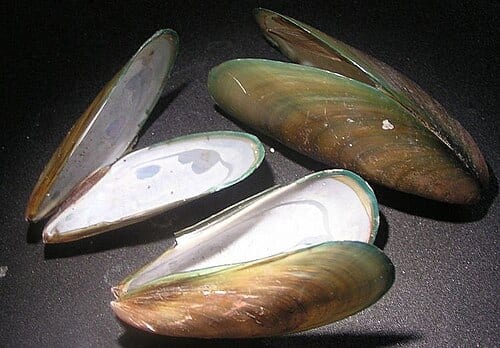
Mussels in Matsu are a rope-cultured shellfish farmed in the sheltered waters of Nangan's Furong'ao, at their fattest and most abundant from May to August, prized for thin shells and thick, richly flavored meat — the most representative mussel-farming area in Taiwan. In summer, boats passing Furong'ao reveal rows of white buoys with ropes hanging heavy with black-shelled mussels; a fisher pulls up a string and out comes a dense cluster of plump shellfish, steamed on the spot with aged rice wine until the shells open to reveal thick, orange flesh.
Matsu's mussel-farming technique originated at the Matsu Fisheries Research Station in Nangan and was successfully commercialized around 1981, giving the industry over 40 years of history; the main farming area is Nangan's Furong'ao, where a headland forms a natural windbreak creating calm cultivation waters. Achi's Fresh Mussels in Nangan received recognition in the third edition of the '500 Bowls' food guide.
What Are Matsu Mussels
Mussels (scientific name Mytilus) are bivalve molluscs; the Chinese name danai ("fresh vegetable") comes from the old practice of preserving them without salt. Matsu's mussels are the Mediterranean mussel variety, raised using suspended rope culture: ropes are hung below buoys in the sheltered lagoon, allowing the mussels to attach and grow by filtering plankton and minerals from the water. The waters around Matsu are clear and the tidal currents steady, producing mussels with thin shells, thick meat, and a full, deep-orange color. May through August is the peak season, when the meat is at its richest.
Matsu's mussel-farming technology grew out of years of research and development by the Matsu Fisheries Research Station; commercial production was successfully established in the 1980s. The main farming areas are currently Nangan's Furong'ao and Dongju Island, with a small wild population on Dongju. The Lienchiang County government lists mussels as a representative Matsu seafood, and there is a market for them ranging from restaurants on the main island to tourist souvenirs. Compared with imported New Zealand green-lipped mussels, Matsu's mussels are larger and more intensely flavored — a freshness achievable only on the islands.
How to Eat It Like a Local
Local Know-How
Verified Third-Party Endorsements (Sponsorship Filtered)
- The Council of Agriculture's Food and Agriculture Education Platform records that Matsu mussel-farming technology came from the Matsu Fisheries Research Station and that commercial production was achieved in the 1980s.
- The Lienchiang County Tourism Bureau lists mussels as a representative Matsu seafood specialty.
- Nangan's Furong'ao and Dongju Island are the main farming areas; Dongju is the distribution area for the wild population.
Visiting Tips
- Mussels are freshest when cooked immediately after harvesting — eat them at a portside or farm-adjacent restaurant; the flavor of cold-stored product shipped to the main island differs considerably.
- People with shellfish allergies should avoid them; gout sufferers should also eat in moderation.
- Supply is plentiful and prices are more accessible during the May–August peak season; outside peak season there may be shortages or higher prices.
Data compiled from the Lienchiang County Tourism Bureau, Matsu Distillery, and a large volume of public reviews; sponsored content has been filtered out.
Frequently Asked Questions
When are Matsu mussels at their best?
May through August, when the orange gonads are fullest; in other months they are leaner.
How do Matsu mussels differ from imported New Zealand mussels?
Matsu mussels are larger, more intensely flavored, and eaten fresh off the boat rather than frozen and shipped.
Where are they mainly farmed?
Nangan's Furong'ao and Dongju Island are the main farming areas, with a small wild population on Dongju.
Sources
- 【產地與飯】冬養海帶,夏殖淡菜:在馬祖遇見前線養殖業者的餐桌 — 養殖技術源自馬祖水產試驗所,民國70年試驗成功,芙蓉澳養殖區、40餘年歷史
- 馬祖美食8選!跟著500碗以美食體驗離島的地域風情 — 阿池現吃淡菜獲第三屆500碗