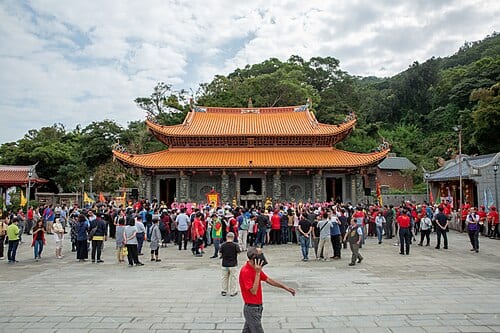
Mazu Village Tianhou Temple is the most venerated Mazu temple in the Matsu Islands, traditionally believed to be where Mazu's sacred remains washed ashore — the origin of the place name "Matsu." On the cliff behind the temple stands a giant Mazu statue completed in October 2009: the figure itself is 28.8 meters tall, carved from 365 blocks of granite symbolizing 365 days of safety, and reaches 29.6 meters including its lightning rod — a height that echoes the Matsu Islands' total land area of 29.6 square kilometers.
The giant Mazu statue behind the temple was completed in October 2009; the figure is 28.8 meters tall and built from 365 blocks of granite symbolizing 365 days of safety, reaching 29.6 meters with its lightning rod, matching the Matsu Islands' measured total area of 29.6 square kilometers (sources: Matsu National Scenic Area tourism site, National Cultural Memory Bank).
What to See at Mazu Village Tianhou Temple
Tianhou Temple holds a central place in the legend of Matsu's place-name origin: it is said that the body of Lin Moniang (Mazu) drifted ashore here, and local residents built a temple on the spot to worship her. "Matsu" (馬祖) is a phonetic transformation of "Mazu" (媽祖) in the Min-Dong dialect. This makes Mazu Village Tianhou Temple not merely an ordinary Mazu temple, but the symbolic site of the entire place-name and the origin of the faith. The temple architecture follows the Min-Dong "fire-wall gable" style; the undulating silhouette of the gable walls is the most recognizable visual feature of Min-Dong architecture.
Incense burns at the temple year-round; each year, around the 23rd day of the third lunar month (Mazu's birthday), grand ceremonies draw worshippers from both sides of the strait. The Mazu giant statue on the cliff behind the temple (a separate attraction, see sp-lc-9) echoes Tianhou Temple, together forming the spiritual landmark cluster of Mazu Village. The plaza in front of the temple is the commercial center of Mazu Village; at night, food vendors gather and local snacks can be sampled here.
How to Get the Most Out of Your Visit
Practical Information
Getting There & Timing
- To reach Nangan, take the Taiwan–Matsu ferry (departing Keelung) or fly (Songshan / Taipei to Nangan). Sailings and flights are easily affected by weather; check official announcements from Taiwan Navigation Co. or the Civil Aviation Administration before departure.
- Mazu Village Tianhou Temple is in the center of Mazu Village; about 10–20 minutes by taxi from Fuao Harbor or Nangan Airport.
- The temple is open year-round; during the lunar 3rd-month festival, crowds are larger — arriving early is advisable.
Nearby Connections
- The Mazu giant statue is on the cliff behind the temple, reachable on foot — can be combined with Tianhou Temple as a single stop.
- Jinsha Village is about 15 minutes by vehicle from Mazu Village and can be an afternoon extension into Min-Dong village culture.
Source: Lienchiang County Government Tourism Bureau, related historical records.
Frequently Asked Questions
Why is Mazu Village Tianhou Temple linked to the origin of the name "Matsu"?
Mazu's sacred remains are said to have washed ashore here; "Matsu" is a phonetic transformation of "Mazu" in the Min-Dong dialect.
When was the giant Mazu statue completed?
It was completed in October 2009, standing on the cliff behind the temple.
How tall is the giant Mazu statue?
The figure itself is 28.8 meters tall, built from 365 blocks of granite, reaching 29.6 meters with its lightning rod.
Sources
- 媽祖巨神像-馬祖國家風景區觀光資訊網 — 落成年份、高度、花崗岩塊數與總面積呼應數字