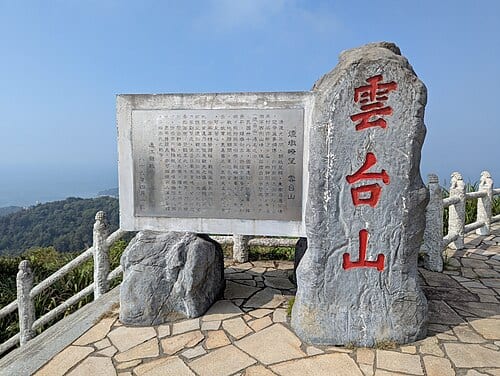
Yuntai Mountain is the highest peak on Nangan at 248 meters, ranked 98th among Taiwan's Little Hundred Peaks. Its granite summit hosts a Matsu Defense Command observation post, lookout tower, and Military Intelligence Museum; in good weather, the peak offers views of nearby islands such as Beigan, Gaodeng, and Liangdao, and, in the distance, the faint outline of the mainland Chinese coastline near the Minjiang River estuary.
Yuntai Mountain stands 248 meters tall, Nangan's highest peak and Taiwan's 98th Little Hundred Peak; its summit is the site of the Matsu Defense Command, with an observation post and lookout tower, and its Military Intelligence Museum is currently open only to ROC nationals (sources: Hiking.biji.co, UDN travel report).
What to See at Yuntai Mountain
Yuntai Mountain sits on Nangan's central ridge and is composed of granite — a commanding, solid massif. Its designation as a "Taiwan Little Hundred Peak" relates primarily to its landmark status among offshore-island peaks rather than to absolute elevation. The summit observation deck has an almost unobstructed view; the spatial relationships among the four townships and five islands are all visible at once: to the north, Beigan Airport runway and its settlement; to the northwest, the outer islands of Gaodeng and Liangdao; and on the clearest days, the outline of the mainland coastline around the Minjiang River estuary faintly appears.
The Military Intelligence Museum at the summit displays materials on Matsu's front-line military intelligence operations and wartime life during the Cold War, serving as a supplementary stop for understanding Matsu's wartime history. Yuntai Mountain's summit trail is well-maintained and presents no particular challenge for visitors of average fitness. Arriving at the summit in the morning or when afternoon light falls obliquely generally gives better visibility and lighting for photography. The fog season (roughly March–May) can reduce summit visibility significantly; check weather forecasts before heading out.
How to Get the Most Out of Your Visit
Practical Information
Getting There & Timing
- To reach Nangan, take the Taiwan–Matsu ferry (departing Keelung) or fly (Songshan / Taipei to Nangan). Sailings and flights are easily affected by weather; check official announcements from Taiwan Navigation Co. or the Civil Aviation Administration before departure.
- Yuntai Mountain is on Nangan's central ridge; about 10–15 minutes by rented scooter or taxi from Fuao Harbor or Nangan Airport to the trailhead.
- The trail gradient is moderate; wear athletic shoes or hiking footwear and bring adequate water.
Nearby Connections
- Baba Tunnel is in Fuxing Village on Nangan, not far from Yuntai Mountain — can be scheduled as a combination stop on the same day.
- Nangan Airport is occasionally visible from the summit when planes take off and land; together with Bishan Lookout (Beigan), it is one of Matsu's spots for close-up plane-watching.
Source: Lienchiang County Government Tourism Bureau, Taiwan Little Hundred Peaks related materials.
Frequently Asked Questions
How high is Yuntai Mountain?
It stands 248 meters tall, the highest peak on Nangan.
Where does Yuntai Mountain rank among Taiwan's Little Hundred Peaks?
It is ranked 98th among Taiwan's Little Hundred Peaks.
Is the summit Military Intelligence Museum open to all visitors?
It is currently open only to ROC nationals, so foreign travelers should note this restriction.
Sources
- 雲台山-健行筆記 — 海拔數字與台灣小百岳排序
- 仰望媽祖巨神像、必拍馬祖地標!南竿島最高峰「雲台山」小百岳之旅-聯合新聞網 — 山頂軍事設施與開放對象說明