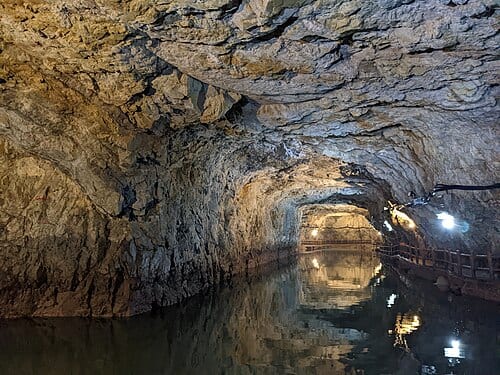
Beihai Tunnel is a Cold War-era underwater waterway carved into Nangan's Tieban Village in 1968, built by two army divisions, three infantry battalions, one engineer battalion, and one dump-truck company working in three shifts over 820 working days. The waterway stands 18 meters high, 10 meters wide, and 640 meters long, with a 700-meter walking loop; visitors can board a traditional wooden boat into the tunnel at low tide, making it one of Matsu's largest underwater tunnel systems.
Beihai Tunnel was excavated in 1968 by two army divisions, three infantry battalions, one engineer battalion, and one dump-truck company working around the clock in three shifts over 820 working days. The waterway is 18 meters high, 10 meters wide, and 640 meters long, with a 700-meter walking loop (source: Nangan Township Office, Lienchiang County).
What to See at Beihai Tunnel
The tunnel was excavated under the "Beihai Project" at the height of the Cold War, primarily to provide concealed mooring for guerrilla vessels, sheltering them from aerial surveillance and artillery threats. The waterway is 18 meters high and 10 meters wide, with a depth of up to 8 meters at high tide; at low tide, the interior forms an enclosed navigable body of water. The tunnel entrance is hidden between the coastal cliffs of Tieban Village, nearly invisible from the open sea — a perfect embodiment of Cold War military camouflage thinking.
At low tide, visitors can board traditional wooden boats and enter the tunnel, experiencing the echo of sound and the shifting of light within a space almost entirely enclosed by rock. The tool marks on the walls are both uniform and dense — direct evidence of entirely manual excavation, a feat of labor that is hard for modern visitors to fathom. The tunnel closes at high tide; be sure to check the tide schedule before planning your visit to avoid a wasted trip.
How to Get the Most Out of Your Visit
Practical Information
Getting There & Timing
- To reach Nangan, take the Taiwan–Matsu ferry (departing Keelung) or fly (Songshan / Taipei to Nangan). Sailings and flights are easily affected by weather; check official announcements from Taiwan Navigation Co. or the Civil Aviation Administration before departure.
- On Nangan Island, rent a scooter or take a taxi to Tieban Village; the tunnel is about 15 minutes by vehicle from Nangan Airport.
- Whether the tunnel is open depends on tidal conditions. Check the Lienchiang County Government Tourism Bureau's announcements in advance or ask on-site.
Nearby Connections
- Iron Fort (Tiebu) is on a reef in the same cove as Tieban Village, reachable on foot — recommended to combine in the same day.
- Renai Village Beach and Dahan Outpost are on the northern side of Nangan and can be added as extension stops on a half-day itinerary.
Source: Lienchiang County Government Tourism Bureau, on-site signage.
Frequently Asked Questions
When was Beihai Tunnel excavated?
Beihai Tunnel was excavated in 1968 and took 820 working days to complete.
How long is the Beihai Tunnel waterway?
The waterway is 640 meters long, with a 700-meter walking loop.
When can visitors board a boat into Beihai Tunnel?
Wooden boats only enter at low tide; the walkway and waterway are submerged at high tide.
Sources
- 馬祖-連江縣南竿鄉公所:北海坑道 — 官方公告開鑿年份、水道尺寸與施工兵力數字