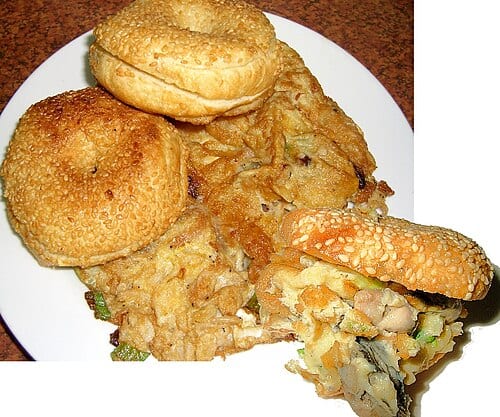
Guang Bing is a traditional savory flatbread from Eastern Fujian (Fuzhou), baked with a hole in the center and a sesame-crusted surface. According to Taiwan's National Cultural Memory Bank, the name honors Ming-dynasty general Qi Jiguang, who is said to have had the bread's center hole added so soldiers could string it on rope and carry it as rations on the march. Matsu preserves the traditional charcoal-baking method while also developing a split-and-fill version — officially termed the "Matsu Burger" by both the National Cultural Memory Bank and the Matsu National Scenic Area — now one of the archipelago's most iconic street snacks.
Taiwan's National Cultural Memory Bank entry on Guang Bing states that the name honors Ming-dynasty anti-piracy general Qi Jiguang, with the center hole designed so soldiers could carry the bread strung on rope during marches; Matsu developed a split-and-filled version of the traditional flatbread known as the "Matsu Burger," a term used both by the National Cultural Memory Bank and the official Matsu National Scenic Area (Tourism Administration) website.
What Is Guang Bing
Guang Bing is a traditional savory baked flatbread originating in Eastern Fujian (Fuzhou). It is said to have been invented by the Ming-dynasty general Qi Jiguang as military rations — the center hole allowed the bread to be threaded on a rope and hung from a soldier's belt for easy access on the march. The Matsu version follows the Fuzhou recipe: dough kneaded from flour, salt, and sesame, then pressed against the inner wall of a charcoal oven and baked until the outside is crisp and the inside chewy, with a distinct wheat aroma and a mild saltiness.
Unlike the thin, crispy guang bing occasionally seen on the Taiwanese mainland, Matsu's version is thick and substantial, with a narrow hole and thick rim that can support a generous filling. Locals habitually split it open to stuff with fried egg, sliced pork belly, deep-fried oyster fritters, or pork chops — the Lienchiang County Tourism Bureau officially lists the result as the "Matsu Burger" among its promoted specialties. From breakfast stalls to tourist old streets, it is practically the first thing visitors taste when they set foot on Matsu.
How to Eat It Like a Local
Local Know-How
Verified Third-Party Endorsements (Sponsorship Filtered)
- The Lienchiang County Tourism Bureau officially promotes Guang Bing as the "Matsu Burger" and lists it as a signature Matsu street food.
- The National Cultural Memory Bank records the history of Guang Bing as Ming-dynasty military rations invented by general Qi Jiguang in his anti-piracy campaign.
- The Beigan Township Office's tourism information names Xianmei Lian as the local representative stall on Beigan, while Baoli Xuan is noted as the long-established flagship in Nangan's Jieshou.
Visiting Tips
- Charcoal-oven output is limited; popular stalls frequently sell out before noon — aim to go in the morning.
- The filling stall and the baking stall are often separate operations. The common approach is to buy a Guang Bing first, then head to a nearby stall to add egg or pork chop.
- Several souvenir shops near Matsu Airport and the Nangan and Beigan ferry piers sell vacuum-packed Guang Bing, but the flavor difference from fresh-baked is significant.
Data compiled from the Lienchiang County Tourism Bureau, Matsu Distillery, and a large volume of public reviews; sponsored content has been filtered out.
Frequently Asked Questions
Where does the name Guang Bing come from?
It is said to honor Ming-dynasty general Qi Jiguang, whose soldiers strung the center-holed bread on rope to carry as rations while marching.
What is the "Matsu Burger"?
It is the local practice of splitting Guang Bing open and filling it with egg, meat, or other toppings — a term used officially by both the National Cultural Memory Bank and the Matsu National Scenic Area.
How is Matsu's Guang Bing traditionally baked?
It is pressed against the inner wall of a charcoal oven, giving the crust a crisp, toasted finish.
Sources
- 食譜 繼光餅 - 國家文化記憶庫 — 國家文化記憶庫官方條目,戚繼光由來與馬祖漢堡吃法
- 口味眾多有故事的道地美食「馬祖漢堡」- 馬祖國家風景區觀光資訊網 — 交通部觀光署馬祖國家風景區官方網站,確認「馬祖漢堡」名稱(非連江縣政府觀光處,已修正來源歸屬)