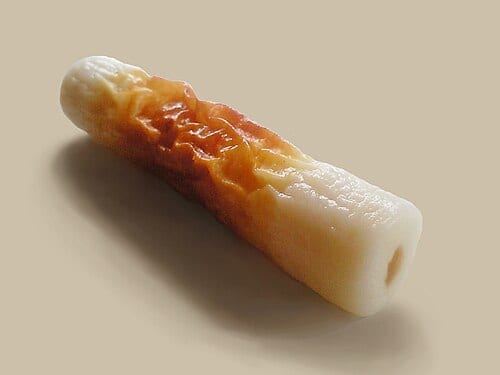
Jikula is a hand-made charcoal-grilled fish paste roll unique to Keelung's Zhengbin Fishing Harbor, its name derived from a Taiwanese pronunciation of the Japanese word "chikuwa." Fresh fish paste is spread around a metal rod and grilled over charcoal while rotating, leaving a hollow tube once the rod is removed. On a side street across from Zhengbin's colorful buildings, charcoal fires are lit before 5 a.m.; the cook wraps fish paste around a thin rod and turns it slowly over the coals as the paste shifts from white to golden, filling the air with a toasty aroma — crisp outside, springy inside, with an immediate ocean flavor. It is one of the last hand-made traditions surviving from the Japanese colonial era.
The pronunciation "jikula" derives from the Japanese word "chikuwa," one of the fish-paste processing techniques introduced to Keelung during the Japanese colonial period. As factory-made chikuwa has become dominant, only about 3–4 stalls at Zhengbin Fishing Harbor still insist on hand-made charcoal grilling today. Tu Da Hand-made Charcoal-grilled Jikula is the representative stall, open only about 4 hours a day (7–11 a.m.), closed Mondays and Tuesdays, with limited daily output that sells out and closes for the day.
What is jikula?
Jikula is what locals at Zhengbin Fishing Harbor in Keelung call hand-made charcoal-grilled chikuwa. The name comes from a Taiwanese pronunciation of the Japanese word "ちくわ" (chikuwa). The method involves spreading fresh fish paste — primarily swordfish, shark, or lizardfish — around a long thin metal rod, then grilling it on a charcoal fire while rotating it so the paste heats evenly, the surface caramelizes, and the inside stays tender. After grilling, the rod is pulled out, leaving a hollow tube — the jikula. Unlike factory-pressed commercial chikuwa, hand-made charcoal-grilled jikula has irregular char marks on the surface and a firm, satisfying bite. Eaten plain it carries charcoal smoke and ocean flavor; dipping it in soy sauce with wasabi or tucking it into a rice ball are both Keelung local ways to enjoy it.
Why Keelung? The Japanese colonial government brought fish-paste processing techniques to Taiwan. With many fishing harbors and large catches, Keelung had a natural incentive to process excess or less-presentable fish into chikuwa, fish cake, fish paste rolls, and other products. After the Japanese left post-war, Keelung fishing families carried on the craft around Zhengbin and Badouzi. As factory-made chikuwa replaced handmade versions, only about 3–4 stalls at Zhengbin Fishing Harbor still insist on charcoal-fired hand-made production. Tu Da Hand-made Charcoal-grilled Jikula is the recognized representative. Daily output is limited; sales begin at dawn and the stall often sells out by afternoon — an increasingly rare harbor flavor.
How to eat it like a local
Local knowledge
Verified references (no sponsored content)
- The fish-paste processing tradition from the Japanese colonial period, and the Taiwanese pronunciation of "jikula" from the Japanese "ちくわ," are historically documented.
- Only about 3–4 stalls at Zhengbin Fishing Harbor still insist on charcoal-fired hand-made production — a high rarity.
- Tu Da is the representative hand-made jikula stall at Zhengbin, consistently named by local media and travel coverage.
Practical tips
- Daily quantities are limited and the stall closes when sold out — call ahead to confirm availability on the day you plan to visit.
- The colorful buildings at Zhengbin Fishing Harbor (a popular photo spot) are about a 5–10 minute walk from the jikula stall.
- The charcoal grilling produces considerable smoke — don't stand in the airflow while taking photos, or your clothes will absorb the smell.
Information compiled from the Keelung City Government Department of Tourism and City Marketing and large-volume public reviews, with sponsored content filtered out.
Frequently Asked Questions
Where does the name "jikula" come from?
"Jikula" is a Taiwanese pronunciation of the Japanese word "chikuwa," a fish-paste processing technique introduced to Keelung during the Japanese colonial period.
How is jikula different from regular chikuwa?
Hand-made jikula is grilled fresh over charcoal with an irregular char pattern on the surface, giving it a firmer bite and more smoky aroma than factory-pressed commercial chikuwa.
When can visitors buy jikula at Zhengbin Fishing Harbor?
Tu Da Hand-made Charcoal-grilled Jikula is open only from 7 to 11 a.m. daily, closed Mondays and Tuesdays — arrive early, as it sells out and closes for the day.
Sources
- 現吃更對味!正濱漁港限量「吉古拉」口感厚實不死板,手工現烤嘗得到迷人炭香 | 食尚玩家 — TVBS食尚玩家報導吉古拉手工碳烤與稀有性
- 涂大的吉古拉,手工碳烤吉古拉,基隆正濱漁港限量版必吃美食 — 涂大吉古拉店家資訊、營業時間與價格