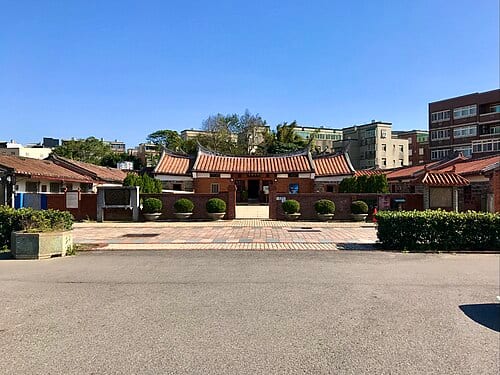
Fan-Jiang Ancestral Hall (Fan-Jiang Historic Compound) is a cluster of Hakka courtyard houses in Xinsheng Village, Xinwu District, Taoyuan, built incrementally by the Fan-Jiang clan who crossed to Taiwan during the Qianlong reign of the Qing dynasty (around 1751). Of the five surviving houses, all traditional three-sided courtyard structures, the Fan-Jiang Ancestral Hall is the largest; its front hall was built in 1855 (the 5th year of the Xianfeng reign) and the complex was designated a third-grade historic monument on August 19, 1985 (now a Taoyuan City municipal historic site). The very place name Xinwu — literally "new house" — originates from the historical event of the Fan-Jiang clan "building a new house" here, and the compound preserves intact both the spatial form of traditional Hakka courtyard architecture and the spatial relationships of a clan settlement.
The Fan-Jiang clan originally bore only the surname Fan; from the eleventh generation onward they adopted the double surname Fan-Jiang in gratitude to the Jiang family who raised an ancestor. Clan members began crossing to Taiwan and settling in Xinwu starting in 1751 (the 16th year of the Qianlong reign). The ancestral hall's front hall was built in 1855 (Xianfeng era), with the rear hall added in 1912; the five surviving houses stand along Zhongzheng Road and were designated a third-grade historic monument on August 19, 1985 (now a Taoyuan City municipal historic site).
What to See at Fan-Jiang Ancestral Hall
The Fan-Jiang clan settled in the Xinwu area after crossing to Taiwan during the Qing dynasty, making their living through agricultural pioneering and gradually accumulating the means to build a courtyard compound. The ancestral hall adopts the two-entry one-drop layout with a threshing ground (hediting, a sun-drying courtyard) in front. The main structure uses a mix of rammed earth brick and red brick. The upturned swallow-tail ridge is a distinctive identifying feature of traditional Minnan-Hakka architecture. The building decoration retains Hakka folk painting, clay sculpture, and wood carving, with themes predominantly featuring auspicious motifs and historical narratives.
The five historic houses are closely connected in space, reflecting the traditional logic of clan co-residence settlement patterns. Some buildings are still occupied or used by Fan-Jiang descendants; overall maintenance is shared between the descendants and the local government. Xinwu District is an important distribution zone for coastal Hakka settlements in Taoyuan. The Fan-Jiang Historic Compound is tangible architectural evidence for understanding the pioneering journey of Hakka migrants in Taoyuan, and one of the more formally complete examples of preserved courtyard house architecture in Taiwan.
How to Make the Most of Your Visit
Practical Information
Getting There & Time
- Drive from Provincial Highway 1 or Expressway 61 into Xinwu District; use navigation to locate the Fan-Jiang Historic Compound in Xinsheng Village. Roadside parking is limited.
- Public transport connections are limited; Taoyuan Bus has some routes to Xinwu, but check the timetable before departing. The outdoor compound space is open all day.
Nearby Connections
- Xinwu District's coastline features a stone weir (shíhù) landscape, and a combined itinerary of historic house culture and coastal terrain is feasible.
- Extend to Guanyin District's lotus farming area or Caotuo Sand Dune to create a Taoyuan coastal Hakka agricultural landscape route.
Sources: Bureau of Cultural Heritage, Ministry of Culture, historic site data; Xinwu District Office local historical and cultural materials.
Frequently Asked Questions
When did the Fan-Jiang clan cross to Taiwan and settle in Xinwu?
Clan members began crossing over starting in 1751, the 16th year of the Qianlong reign, and settled in what is now Xinwu District, Taoyuan.
When was the Fan-Jiang Ancestral Hall built?
Its front hall was built in 1855, during the Xianfeng reign, with the rear hall added in 1912.
How many historic houses survive, and when were they designated a monument?
Five three-sided courtyard houses survive; they were designated a third-grade historic monument on August 19, 1985, now reclassified as a Taoyuan City municipal historic site.
Sources
- 新屋范姜祖堂 - 維基百科 — 渡台年代(乾隆16年)、祖堂興建年份(咸豐5年)、古蹟登錄日期(1985年8月19日)