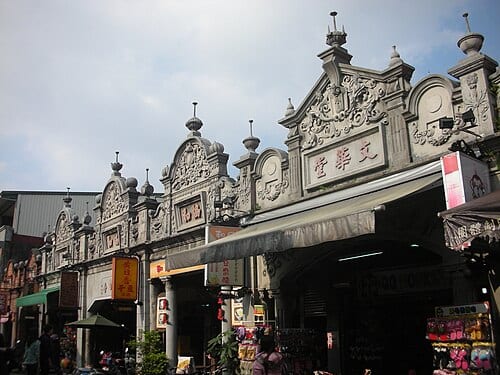
Daxi Old Street is a Qing-dynasty market street in Daxi District, Taoyuan, whose surviving shophouse facades were largely rebuilt during the Japanese Taisho-era street improvement project that began in 1912. The brick gable walls are densely decorated with Minnan cut-and-paste ceramic ornamentation and Western Baroque motifs, making it one of the few old streets in Taiwan that still preserves a continuous block-scale facade ensemble. Since the Qing era this area served as an important transit port for camphor and tea from the upper Tamsui River, and the traces of that commercial prosperity are carved into every lime-plastered shopfront.
The surviving shophouse facades of Daxi Old Street were mainly rebuilt between 1912 and 1919 during the Japanese-era “Dagakam Street Improvement Plan,” when craftsmen brothers Chen Wanglai and Chen Sanchuan pioneered applying cut-and-paste ceramic and jiaozhi pottery techniques—normally reserved for temples—to the shophouse facades, sparking a wave of ornamentation along the street. In the Qing dynasty, Dagakam (Daxi’s former name) had risen on Tamsui River trade, with camphor, tea, and timber shipped by boat to Manka and merchants clustering along today’s Heping Road.
What to See at Daxi Old Street
In the Qing era, Daxi (formerly known as Dagakam) rose to prominence through Tamsui River navigation. Camphor, tea, and timber were transported by boat to Manka, and merchant houses clustered along Heping Road. After the Japanese colonial urban planning reforms, merchants rebuilt their shopfronts incorporating Western facade styles promoted by the Governor-General's Office, but craftsmen filled the spaces between gable walls and column capitals with local motifs such as plum, orchid, chrysanthemum, bamboo, bats, and auspicious clouds. This created a distinctive mixed style unique to Taiwan, which architectural scholars call "Taisho Eclecticism."
The most rewarding aspect of walking Daxi Old Street is slowing down to study the facade details: the gable shape of nearly every shophouse is unique, featuring different combinations of semicircular arched tops, square crenellations, and corbelled moldings. The streets are paved with stone slabs, and the arcades are generously wide, formerly serving as semi-outdoor spaces for stacking goods and haggling. Today the old street still sells traditional foods such as dried tofu and moon cakes, and some weaving and woodcraft shops remain on either side, with the spatial layers extending from the building exteriors into the business types within.
How to Make the Most of Your Visit
Practical Information
Getting There & Time
- Taoyuan Bus or Unibus can take you from Taoyuan Train Station to Daxi; the journey takes about 30 to 40 minutes. Check the day's schedule before departing.
- The outdoor old street space is open all day. Store hours vary; crowds are noticeably larger on weekends than on weekdays.
- Drivers can park at nearby paid lots. Spaces are limited on holidays; plan ahead.
Nearby Connections
- The Daxi Wood Art Ecomuseum's multiple buildings are within walking distance and are well-suited for a same-day visit.
- Heading north along Provincial Highway 3 connects to Jiaobanshan Presidential Villa and Cihu Mausoleum, allowing for a half-day to full-day Daxi area itinerary.
Sources: Daxi Wood Art Ecomuseum; Bureau of Cultural Heritage, Ministry of Culture.
Frequently Asked Questions
When were Daxi Old Street’s facades built?
The surviving shophouse facades were mainly rebuilt between 1912 and 1919 during the Japanese-era street improvement project, when craftsmen applied temple decorative techniques to the shopfronts.
Why does Daxi Old Street have Baroque-style decoration?
The Japanese colonial street improvement introduced Western classical decorative vocabulary, which local craftsmen combined with Minnan cut-and-paste ceramic work, producing a mixed East-West facade style.
What role did Daxi play during the Qing dynasty?
In the Qing era, Dagakam (Daxi’s former name) was a key transit port for camphor, tea, and timber shipped along the upper Tamsui River, and this trade fueled the street’s commercial growth.
Sources
- 大溪老街 - 維基百科,自由的百科全書 — 大溪老街歷史與立面沿革
- 大溪老街是巴洛克建築?誤會大了 - J-media 聚傳媒 — 牌樓立面市街改正年代與匠師考證