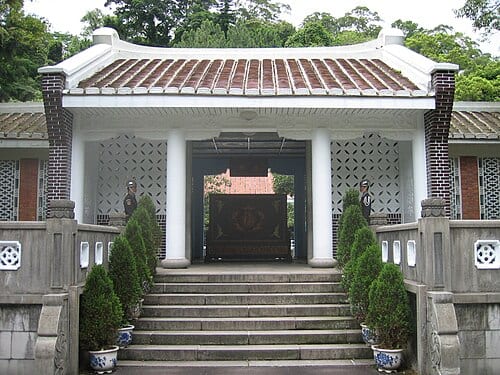
Cihu Mausoleum is the temporary resting place of President Chiang Kai-shek in Daxi District, Taoyuan, built on land donated in 1955 by the Banqiao Lin family; its predecessor, the “Dongkou Guesthouse,” was completed in 1959, and Chiang named the site “Cihu” (Compassionate Lake) in 1962 in memory of his mother. Following Chiang’s death in 1975, his coffin was moved here for temporary interment, where it remains today. The park also houses the Cihu Memorial Sculpture Park, displaying more than 200 statues of Chiang removed from public spaces across Taiwan, creating a distinctive exhibition context around the fate of public monuments.
The Cihu site was donated to the government in 1955 by the Banqiao Lin family; the “Dongkou Guesthouse” was completed in 1959 as Chiang Kai-shek’s retreat, and in 1962 Chiang named it “Cihu” in memory of his mother, Wang Tsai-yu. Following Chiang’s death in April 1975, his coffin was moved here for temporary interment, a status that continues today. The adjacent Cihu Memorial Sculpture Park was established by Daxi Town Office in 1997—Taiwan’s only memorial park dedicated to statues of a single individual—and has held roughly 200-plus Chiang Kai-shek statues over the years, according to various counts.
What to See at Cihu Mausoleum
The original site of Cihu was a rest house for officials established by the Taiwan Governor-General's Office near the upper reaches of the Dagakam River during the Japanese colonial period. After 1945 it was transferred to the Republic of China government, and from 1952 it was renovated for use by Chiang Kai-shek. Because the topography and lakeside scenery reminded him of Xikou in his home province of Zhejiang, he named it "Cihu" (Compassionate Lake) in memory of his mother. The main building retains a mixed layout of Japanese timber construction and stone foundations; the lake setting is tranquil and surrounded by pines and cypresses.
The statue ensemble at Cihu Memorial Sculpture Park represents a relatively rare display format in Taiwan's public spaces. Each statue reflects a different state of preservation depending on its historical circumstances; some show obvious damage or breakage, preserving the actual appearance of the statues as they were when removed. For visitors interested in understanding Taiwan's postwar political history and the evolution of public monuments, this park provides concrete material for observation.
How to Make the Most of Your Visit
Practical Information
Getting There & Time
- From Daxi Old Street, take the Taiwan Tourist Shuttle Taoyuan-Daxi Line toward Jiaobanshan; Cihu has a designated stop. Check the latest timetables before traveling.
- The park has a car park; opening hours follow official announcements. Arrive early on holidays.
Nearby Connections
- Cihu and Jiaobanshan Presidential Villa are both along Provincial Highway 7 in Fuxing District and can be visited on the same day.
- After returning to Daxi, you can continue to Daxi Old Street or the Wood Art Ecomuseum to complete a full Daxi historical day trip.
Sources: Publicly available information from the Mausoleum Administration; Bureau of Cultural Heritage, Ministry of Culture.
Frequently Asked Questions
What was Cihu Mausoleum before it became a mausoleum?
It began as the “Dongkou Guesthouse,” built on land donated by the Banqiao Lin family in 1955 and completed in 1959 as Chiang Kai-shek’s summer retreat.
How did the name “Cihu” originate?
In 1962 Chiang Kai-shek named the site “Cihu” (Compassionate Lake) because its scenery reminded him of his mother’s hometown, honoring her memory.
Where do the statues in the Cihu Memorial Sculpture Park come from?
Most are Chiang Kai-shek statues removed from public institutions across Taiwan and relocated here, forming a distinctive memorial park landscape.
Sources
- 慈湖陵寢 - 維基百科,自由的百科全書 — 慈湖陵寢歷史沿革(1955捐地、1959落成、1962命名、1975移靈)
- 慈湖紀念雕塑公園 - 桃園觀光導覽網 — 雕塑公園設立與銅像展示現況
- 巨大蔣介石銅像卸成200多片連夜用回收車載去重拼 全台最爭議景點「慈湖」秘辛 - 風傳媒 — 銅像數量與遷移背景報導