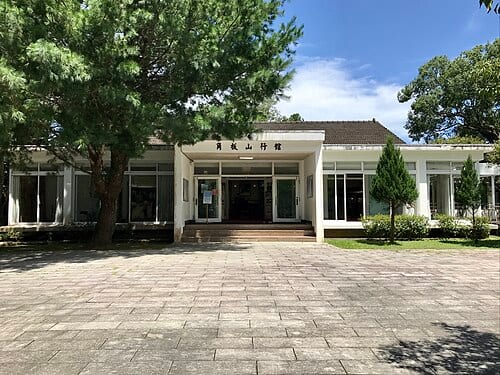
Jiaobanshan Presidential Villa is a summer retreat for President Chiang Kai-shek in Fuxing District, Taoyuan, completed in 1960, replacing the older Jiaobanshan VIP Guesthouse built in 1923 during the Japanese colonial period for a visit by Crown Prince Hirohito that never took place. Plum trees planted around the villa form a well-known garden that blooms in late winter and early spring each year. President Lee Teng-hui announced the site’s transfer to Taoyuan County in 1995, after which it opened to the public, and today it combines a historic building with a plum-viewing attraction.
Jiaobanshan Presidential Villa was completed in 1960 as a postwar retreat for Chiang Kai-shek, replacing the nearby Jiaobanshan VIP Guesthouse (also called Crown Prince Villa), which was built in 1923 during the Japanese Taisho era for a planned visit by Crown Prince Hirohito that never actually took place. On July 29, 1995, President Lee Teng-hui announced the villa’s transfer to Taoyuan County, and it opened to the public on August 20 the same year. The surrounding plum garden typically blooms from late January to the end of February.
What to See at Jiaobanshan Presidential Villa
The villa was built in the Japanese timber-frame architectural style, with roof pitch and veranda proportions consistent with the standard official residence format of the Taisho era. The timber members have been maintained and retain their original character. From the villa's position, visitors can look out over the canyon topography of the upper Dahan River. The place name Jiaobanshan itself derives from a Chinese phonetic transcription of an Atayal toponym. During the Japanese colonial period, the site served as one of the administrative nodes for controlling the traditional Atayal territory, carrying the spatial significance of colonial history.
The plum garden occupies sloping ground surrounding the villa and contains several plum varieties. It typically blooms from January to March, with the precise timing varying by year depending on temperature. The blooming season draws local residents and visitors from further afield. The highland elevation means temperatures are lower here than on the plains, so warm clothing is needed when viewing the blossoms. After the blossoms drop, the park returns to its everyday greenery; the villa buildings themselves are open for visits year-round.
How to Make the Most of Your Visit
Practical Information
Getting There & Time
- From Daxi, take a Taoyuan Bus toward Fuxing; the Jiaobanshan section has a stop. Schedules differ between weekdays and weekends — check in advance.
- Driving: take Provincial Highway 7 or connect via Highway 3; the road is winding — drive carefully. Parking is limited.
- Villa opening hours follow the management authority's announcements; expect larger crowds on holiday weekends during plum blossom season.
Nearby Connections
- Can be combined with Cihu Mausoleum in a single day, connecting the sites along Provincial Highway 7 from Daxi to Fuxing.
- Fuxing District has Atayal tribal communities; if you are interested in learning about indigenous culture, booking a local guided tour in advance is recommended — respect tribal protocols.
Sources: Fuxing District Office and cultural heritage related materials.
Frequently Asked Questions
Is Jiaobanshan Presidential Villa a Japanese colonial-era building?
No—the current villa was built in 1960 as a postwar retreat for Chiang Kai-shek; the Japanese-era building nearby, completed in 1923, is the separate Jiaobanshan VIP Guesthouse.
Are the Jiaobanshan VIP Guesthouse and the Presidential Villa the same building?
No, they are different buildings. The guesthouse was built in 1923 during the Japanese era for a planned visit by Crown Prince Hirohito, while the villa was newly built in 1960 and later took over its function.
When do the plum trees at Jiaobanshan bloom?
They typically reach peak bloom from late January to the end of February, with the exact timing varying slightly by that year’s temperature.
Sources
- 角板山行館 - 維基百科,自由的百科全書 — 確認1960年興建,非日治時期建築
- 角板山貴賓館 - 國家文化資產網 — 1923年舊貴賓館(太子樓)史料
- [桃園復興].角板山賓館.《蔣總統祕錄》 - Tony的自然人文旅記 — 角板山貴賓館與行館歷史區辨