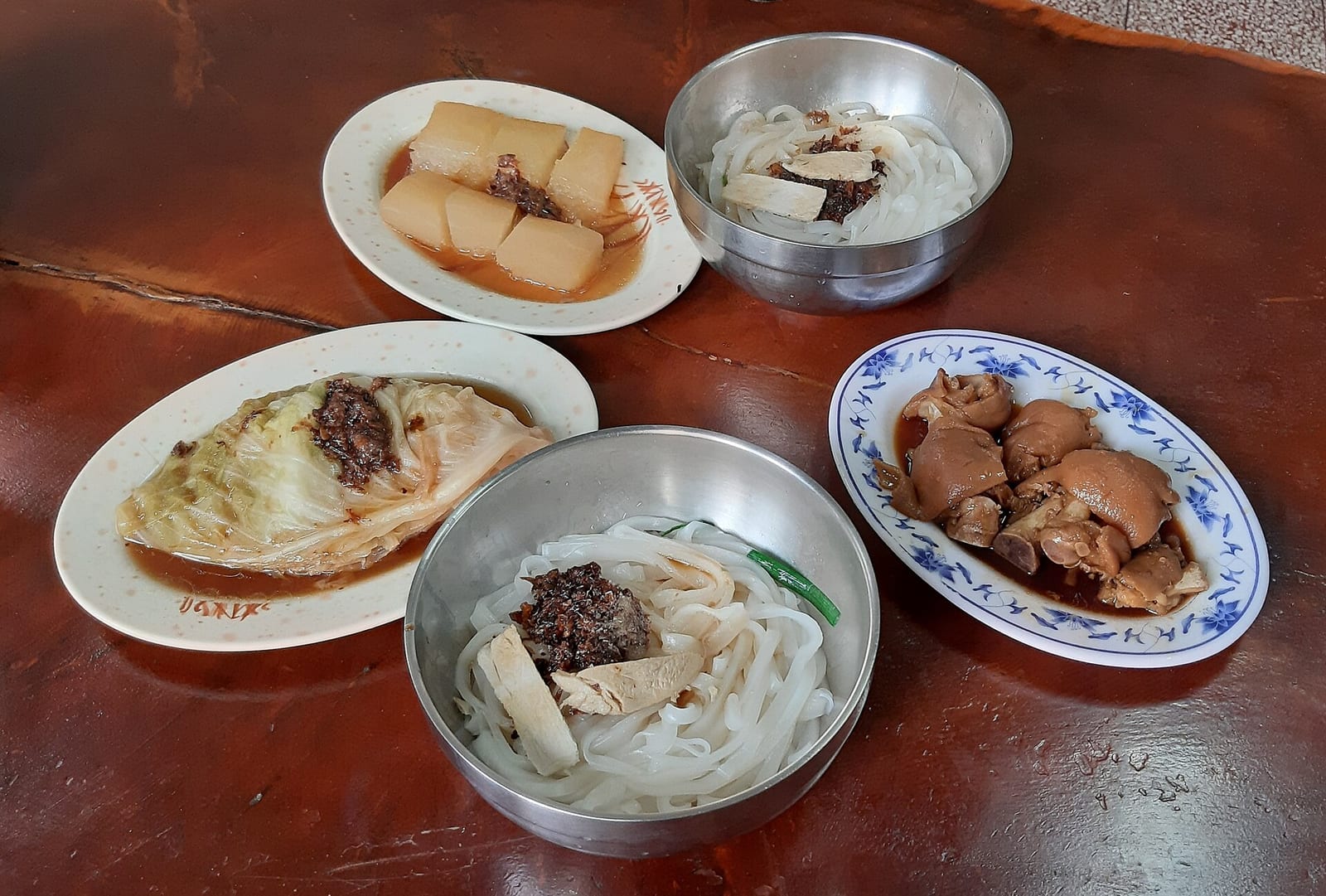
Hakka ban tiao is a wide, flat rice noodle made by steaming ground indica rice, a staple that Hakka migrants carried from Meizhou in Guangdong and that took root in Hakka communities across Taoyuan, Hsinchu, and Miaoli. The nameless stall at Yangmei's Fugang Old Street is known for its traditional handmade method, and old shops in Zhongli have kept the tradition alive as well. When a bowl of dry-tossed ban tiao arrives at the table, rice fragrance, scallion-oil fragrance, and minced pork fragrance layer together — one staple dish that strikes at the very core of Hakka cuisine.
Ban tiao was named by CNN in 2015 as one of Taiwan's 40 essential local snacks, giving this Hakka staple international visibility. Taoyuan's Hakka communities are concentrated around Yangmei, Longtan, Zhongli, and Daxi; the nameless handmade ban tiao stall on Fugang Old Street in Yangmei has been confirmed still operating through field visits documented by bloggers such as Kalinmoyuer, while the Apo Noodle Shop on Zhongxing Lane in Zhongli has more than 50 years of history.
What is Hakka ban tiao
Ban tiao is made by grinding indica rice (long-grain non-glutinous rice) into a slurry, spreading it thin, and steaming it until cooked, then cutting it into flat strips about two to three centimeters wide. The texture is thicker than Vietnamese rice noodles and springier than ordinary flat rice noodles, with the characteristic fragrance of indica rice and a slight stickiness. It is served two ways: the dry-tossed version is mixed with lard, soy sauce, fried shallots, and braised pork, giving it a savory-sweet base flavor; the soup version uses pork bone or bonito stock as the base, topped with pork slices, garlic chives, and bean sprouts — clean and not heavy.
Hakka communities are spread across Yangmei, Longtan, Zhongli, and Daxi in Taoyuan. In these areas, ban tiao is not a tourist food — it is a regular fixture on the everyday breakfast and brunch menu. The traditional handmade ban tiao stall on Fugang Old Street in Yangmei (with no fixed shop name) has been passed down from a generation of local elders; rice batter is ground and steamed fresh on-site with uniform thickness. In Zhongli, the Apo Noodle Shop has become a multi-generational local landmark as an old establishment. The Council for Hakka Affairs lists ban tiao as a representative item of Hakka food culture, with official cultural documentation as support.
How to eat it authentically
Local knowledge
Verified sources
- The Council for Hakka Affairs lists ban tiao as a representative item of Hakka food culture, and the tradition of ban tiao in Taoyuan's Hakka communities has official cultural documentation supporting it.
- The Kalinmoyuer blog conducted a field visit to Fugang Old Street and confirmed the current status of the traditional handmade ban tiao stall; the Lo Huo De Da Fang blog documented information on the Zhongli Apo Noodle Shop.
- Ban tiao in Taoyuan's Hakka communities is an everyday staple, not a tourist product — it has genuine roots in local daily life.
Visitor tips
- The nameless ban tiao stall at Fugang Old Street has no fixed phone number or website. It is advisable to check recent blog posts or Google reviews before heading out to confirm it is still operating.
- For the Zhongli Apo Noodle Shop's location and hours, refer to the most current map information, as old establishments sometimes adjust their days off.
- Ban tiao itself has a mild flavor. Those who dislike the taste of lard can inform the shop and request vegetable oil instead; some establishments are able to accommodate this.
Sources: Council for Hakka Affairs Hakka food records; Kalinmoyuer blog (Fugang Old Street field investigation); Lo Huo De Da Fang blog (Zhongli Apo Noodle Shop).
Frequently Asked Questions
How is Hakka ban tiao different from Vietnamese rice noodles or ordinary flat rice noodles?
Ban tiao is made by grinding indica rice and steaming it, giving it a thicker texture than Vietnamese rice noodles and more spring than ordinary flat rice noodles, with the characteristic fragrance of indica rice.
Why is the nameless ban tiao stall at Fugang Old Street worth a special trip?
It has been passed down through generations of local elders, with rice batter ground and steamed fresh on-site; bloggers such as Kalinmoyuer have confirmed through field visits that it is still operating, making it a representative example of traditional handmade ban tiao.
Has ban tiao received international media coverage?
Yes — CNN listed ban tiao among its "40 Taiwanese foods we can't live without" in 2015, giving this Hakka staple international visibility.
Sources
- 桃園美食 | 楊梅 富岡老街 無名小吃店 - 卡琳。摸魚兒趣 — 富岡老街田調
- [中壢] 阿婆麵店 - 樂活的大方 — 中壢阿婆麵店介紹
- 40 of the best Taiwanese foods and drinks - CNN Travel — 2015年CNN將粄條列入台灣40大必吃美食