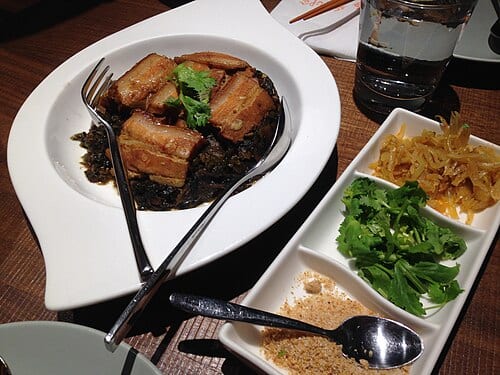
Mei gan kou rou is a traditional Hakka dish of steamed pork belly layered over salted, sun-dried mustard greens, and it serves as the centerpiece of a Hakka table. It calls for no fancy ingredients — only time and patience: mustard greens are pickled and sun-dried into mei gan cai, pork belly is fried to develop color, then cut into pieces and steamed at length together with the mei gan cai. Hakka restaurants in Taoyuan's Daxi and Longtan areas almost universally serve this dish, making it the best entry point for understanding the Hakka food philosophy of cherishing, preserving, and transforming ingredients.
Lao Di Fang Hakka Restaurant in Daxi opened in May 1993, moved to its current address at No. 489, Section 1, Yuanlin Road, Daxi, in 2000, and underwent a major renovation and expansion in December 2007; it has since been featured on TV food programs. Lao Tou Bai Hakka Restaurant in Longtan opened in 1997 inside a traditional sanheyuan compound house more than 160 years old, reinforcing the building's steel structure after the 921 earthquake. Both restaurants list mei gan kou rou as a signature dish.
What is mei gan kou rou
Mei gan cai is made from mustard greens that are pickled and then sun-dried, a process that concentrates their salty-savory quality and produces a distinctive fermented aroma. For the pork, belly or three-layer pork is used — it is marinated in soy sauce and rice wine, then deep-fried until golden, sliced, and arranged skin-side down in a bowl. Rehydrated mei gan cai is layered on top, and the whole assembly is steamed for at least one hour until the fat turns translucent and soft and the mei gan cai has fully absorbed the rendered fat. The finished dish is rich but not greasy: the salted, slightly sour mei gan cai cuts through the fat of the pork belly, and an even ratio of lean to fat yields the best texture.
Historically, Hakka people lived and farmed in the mountains where food was precious, so pickling and preservation were central survival skills. Mei gan cai was a product of that necessity — the large winter harvest of mustard greens could not all be eaten fresh, so they were pickled and dried for storage. Paired with pork belly, they form a perfect match of "salt against fat" — a practical expression of Hakka food philosophy. The Lao Di Fang Hakka Restaurant on Yuanlin Road in Daxi has been listed on the Taoyuan Tourism Guide website; Lao Tou Bai Hakka Restaurant in Longtan, housed in a 160-year-old traditional building, has been covered by both Shi Shang Wan Jia (Travel Gourmet) and TVBS.
How to eat it authentically
Local knowledge
Verified sources
- Lao Di Fang Hakka Restaurant (Yuanlin Road, Daxi) has been listed on the Taoyuan Tourism Guide website and is an officially recommended representative Hakka restaurant.
- Lao Tou Bai Hakka Restaurant (Longtan, 160-year-old traditional building) has been covered by Shi Shang Wan Jia and TVBS, and is included in Taoyuan's Hakka starred cuisine list.
- Mei gan kou rou is recognized as a representative Hakka dish in both academic and folklore records — it is not a marketing term coined by any single restaurant.
Visitor tips
- Mei gan kou rou takes time to steam, and some Hakka restaurants require advance booking — either as a pre-ordered table dish or as a reservation. Ordering on the spot may result in it being sold out or a long wait.
- Lao Tou Bai in Longtan is inside a traditional building in Longtan District. Parking requires following signage; first-time visitors should navigate carefully to confirm the entrance.
- The saltiness of mei gan cai varies depending on the batch. If you are sensitive to salt, balancing it with plain unseasoned rice or vegetables during the meal will help.
Sources: Taoyuan Tourism Guide website (Lao Di Fang Hakka Restaurant); Shi Shang Wan Jia / TVBS coverage (Lao Tou Bai); Taoyuan Hakka starred cuisine list.
Frequently Asked Questions
How is the mei gan cai in this dish made?
Mei gan cai is mustard greens that are pickled and then sun-dried, giving it a concentrated salty-savory taste and a fermented aroma — a signature of Hakka preserved food.
What are notable restaurants for mei gan kou rou in Daxi and Longtan?
Lao Di Fang Hakka Restaurant in Daxi has operated since 1993, and Lao Tou Bai Hakka Restaurant in Longtan opened in 1997 inside a sanheyuan house over 160 years old; both list mei gan kou rou as a signature dish.
Which cut of pork works best for this dish?
Three-layer pork belly is recommended — its alternating fat and lean layers let the rendered fat fully soak into the mei gan cai, giving a more complete flavor than all-lean cuts.
Sources
- 老地方客家菜 | 桃園觀光導覽網 — 老地方客家菜官方介紹,開業/遷址/裝潢年份
- 桃園龍潭必吃美食推薦!「老頭擺客家菜」藏百年三合院 - 食尚玩家 — 老頭擺客家菜歷史