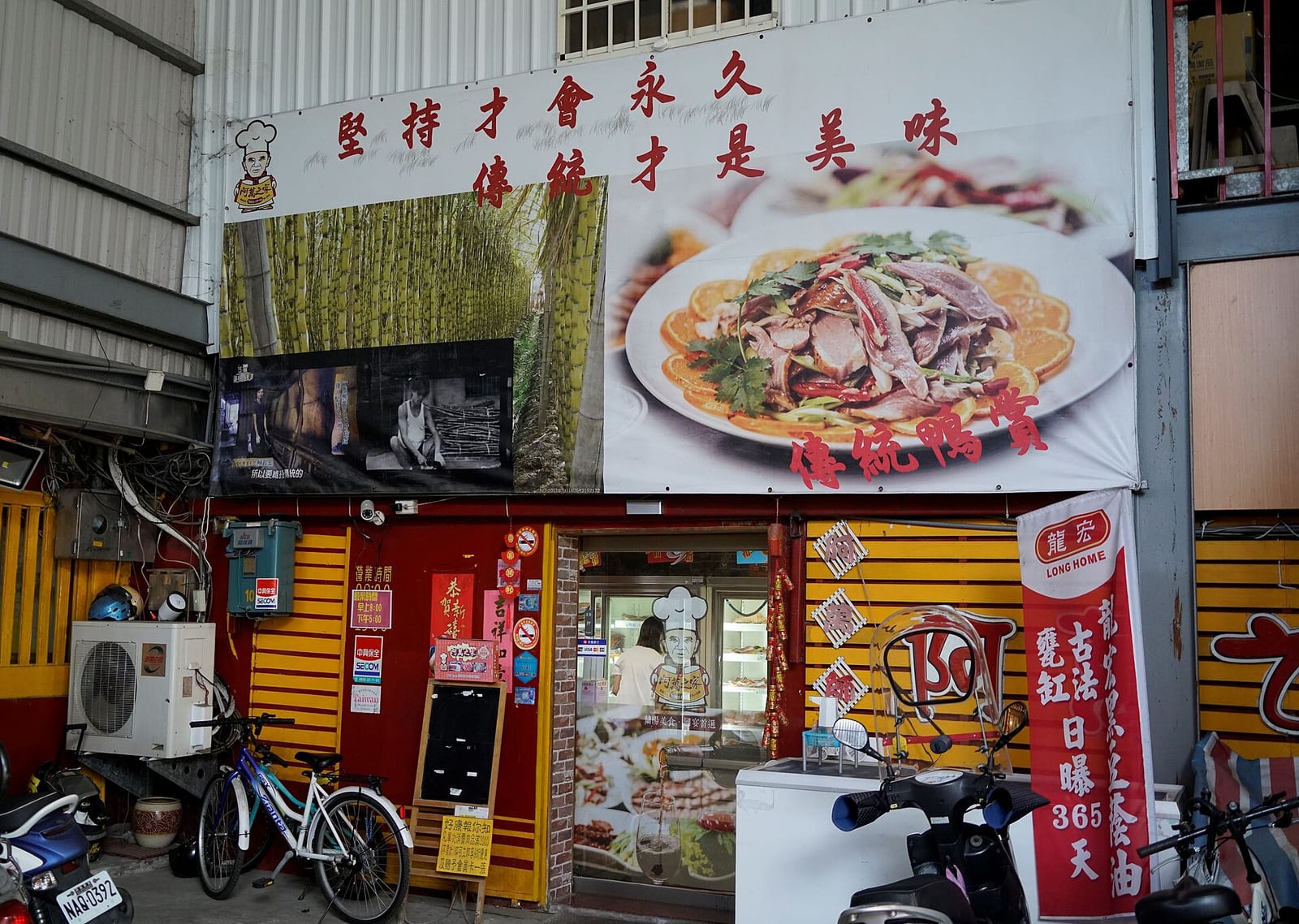
Yaoshang is a traditional Yilan cured duck, salted then slowly smoked over burning sugarcane and served cold in thin slices — a cold platter found on every Lanyang Plain family's table at holidays and celebrations. Step into a Yilan traditional market and you will often see rows of whole ducks, pressed flat and glazed to a deep caramel color, hanging at the stalls: that is yaoshang. Sliced thin and dressed with garlic-vinegar and garlic shoots, each piece reveals amber-hued meat and semi-translucent fat, releasing a simultaneous hit of salt, sweetness, and sugarcane smoke.
According to the Lanyang Museum, yaoshang originated in Xiafu, Wujie, Yilan, in 1941 (Showa 16), when Zhang Ashu first preserved duck meat by salting it and smoking it over burning sugarcane. In 1971, Lin Zantian commissioned the first dedicated smoking cabinet to boost output, and in 1997 boilers and drying machines were introduced to further increase capacity.
What is Yaoshang?
Yaoshang is Yilan's traditional cured duck. The process begins by butterflying the duck flat and rubbing it with salt to cure it, then slowly smoking it over burning sugarcane so that the sugar from the cane caramelizes onto the duck skin, creating a distinctive savory-sweet char. The finished yaoshang has very low moisture content and a firm texture. It is eaten cold in thin slices, typically accompanied by garlic shoots, white vinegar, and a little sugar. It works equally well as a drinking snack, a side dish with rice, or a banquet cold course.
Yilan's abundant paddy fields meant that farming households commonly kept ducks. The Council of Agriculture's Food and Agriculture Education Platform identifies yaoshang as a Yilan specialty originating in the Wujie Xiafu area during the Japanese colonial period, and lists it as one of the folk-named Lanyang Four Treasures (yaoshang, dang-gan, preserved fruits, and gaozha). In earlier times, without refrigeration, salting and smoking extended shelf life; over time the preservation food became Yilan's signature flavor. Wujie, Lize, and Yilan City remain the areas with the highest concentration of old-established producers.
How to eat it like a local
Local knowledge
Verified sources (sponsored content filtered out)
- The Council of Agriculture's Food and Agriculture Education Platform explicitly records yaoshang as a Yilan specialty, with sugarcane smoking as its defining technique.
- Yaoshang, dang-gan, preserved fruits, and gaozha are collectively called the Lanyang Four Treasures and appear on Yilan County's official list of traditional food products.
- Wujie Lize and Yilan City have several third-generation family producers; production is community-based rather than dominated by any single brand.
Visitor tips
- Yaoshang is high in salt and quite salty in taste. Those who are sodium-sensitive should stick to a few slices rather than eating it as a main dish.
- When buying loose yaoshang at the market, check the production date and storage conditions. In summer, it is best eaten the same day or refrigerated immediately.
- Products labeled 'native duck' or 'Muscovy duck' cost more; the difference is mainly in texture and fat content. Choose based on your budget.
Information compiled from the Yilan County Government's Bureau of Commerce and Tourism, local township farmers' associations, and large-scale public reviews. Sponsored listings have been filtered out.
Frequently Asked Questions
When and by whom was yaoshang invented?
According to the Lanyang Museum, yaoshang originated in 1941 in Xiafu, Wujie, Yilan, first created by Zhang Ashu, who preserved duck meat by salting it and smoking it over burning sugarcane.
What are the "Lanyang Four Treasures"?
The Lanyang Four Treasures is a folk term in Yilan referring collectively to yaoshang, dang-gan (cured pork liver), preserved fruits, and gaozha.
What's the authentic way to eat yaoshang?
The classic local pairing is thin slices with garlic shoots, white vinegar, and a little sugar for a sweet-sour balance; it can also be served over hot steamed rice.
Sources
- 蘭陽博物館-052期-鴨賞 — 鴨賞起源年代、發明者、產能演進