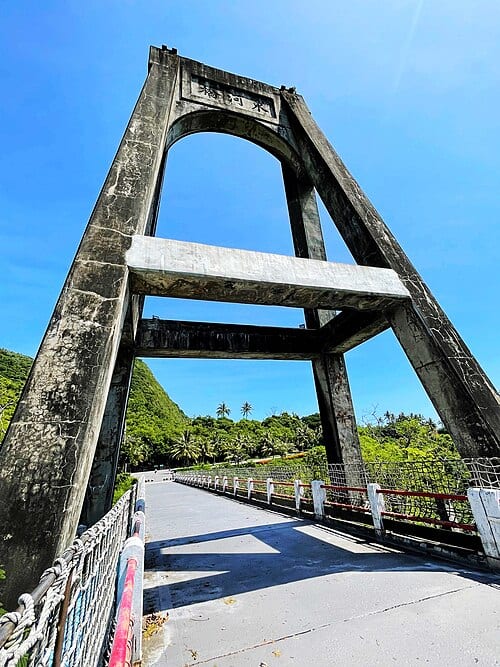
Donghe Old Bridge is the remains of a Japanese colonial-era bridge spanning the Mawuku River in Taitung's Donghe Township. The first timber suspension bridge was built in 1920 and named Yoshida Bridge; it was rebuilt as a roughly 133-meter steel cable suspension bridge in 1926, then reconstructed in concrete at 126.88 meters long in 1953. The old bridge is now a disused pedestrian landmark, with a new bridge alongside carrying vehicle traffic. Its intact piers stand in the river valley near the well-known Donghe Bao Zi steamed-bun vendor cluster.
The first timber suspension bridge was built in November 1920 and named Yoshida Bridge after the Taitung Prefecture civil engineer who designed it. It was rebuilt as a roughly 133-meter steel cable suspension bridge in 1926, then reconstructed in concrete in 1953 at a total length of 126.88 meters and width of 4.6 meters (five T-beam spans on the south side, one open-spandrel arch span on the north). It became a pedestrian-only landmark after the new bridge opened to traffic.
Highlights of Donghe Old Bridge
Donghe Old Bridge is located in Donghe Village, Donghe Township, spanning the Mawuku River. Built during the Japanese colonial period, the old bridge deck has since been dismantled, leaving only the piers standing intact in the river. The piers are constructed of concrete, with a simple form that blends with the natural environment of the valley — presenting a unique landscape where historical traces and natural scenery coexist. The Mawuku River runs clear, and the valley vegetation is lush, forming a tranquil river valley scene.
The most famous culinary landmark near Donghe Old Bridge is the "Donghe Bao Zi" vendor stalls at the bridgehead, with a history of several decades. Known for flavors such as red bean and cabbage, it is a regular stop for travelers along the East Coast Highway on Provincial Highway 11. A trail down from beside the new bridge leads to the riverbank, where the old bridge piers can be seen up close while enjoying the valley scenery.
Tips for Getting the Most Out of Your Visit
Practical Information
Getting There & Time
- By car: Follow Highway 11 to Donghe Village, Donghe Township. There is simple roadside parking near Donghe Bridge; walk to the bridge from there.
- Public transport: From Taitung City, take an East Coast highway bus to Donghe stop, then walk to Donghe Bridge, approximately 5 minutes.
- Recommended visit duration: Bridge viewing plus riverside walk, approximately 20 to 30 minutes. Continue your itinerary after a Donghe Bao Zi stop.
Nearby Connections
- Heading north about 20 to 30 minutes leads to Sanxiantai or Chenggong Fishing Harbor; heading south about 30 minutes reaches Taitung City.
- Donghe Old Bridge usually serves as a midway rest stop on an East Coast Highway self-driving itinerary — stock up on buns, then continue north or south along Highway 11.
Source: Public documents on Donghe Bridge and local tourism information.
Frequently Asked Questions
When was Donghe Old Bridge built?
The first timber suspension bridge was built in 1920, rebuilt as a steel cable suspension bridge in 1926, and reconstructed as the current concrete bridge in 1953.
Why is it called Yoshida Bridge?
It was named after the Taitung Prefecture civil engineer who designed and supervised its construction, a common naming practice under Japanese rule.
Can vehicles still cross the old bridge?
No, since the new bridge opened the old bridge has been reserved for pedestrians only, preserved as a scenic landmark.
Sources
- 舊東河橋 - 維基百科 — 橋梁建造年份與結構規格
- 東河橋|東部海岸國家風景區 — 官方景點資訊