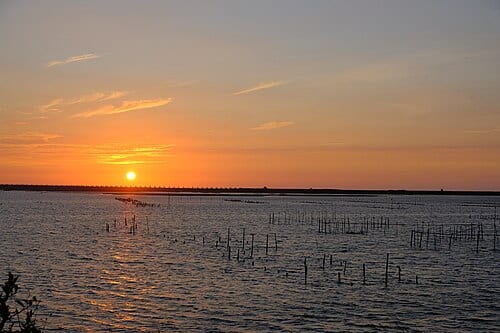
Qigu Lagoon is the largest lagoon remaining in Taiwan, enclosed by four offshore sandbars — Qingshangang, Wangziliao, Dingtoue, and Xinfulun — along the Qigu coast of Tainan, and it lies within the boundary of Taijiang National Park. Gliding through the oyster-farming racks on a bamboo raft while watching waterbirds forage along the sandbars makes it one of the most evocative fishing-village landscapes on Tainan's coast.
The lagoon's water surface area has been shrinking due to sedimentation; official sources most often cite roughly 1,100 hectares today, while some older figures that include the sandbars' land area put it near 1,600 hectares. It is enclosed by four sandbars — Qingshangang, Wangziliao, Dingtoue, and Xinfulun — not the "seven sandbars" sometimes claimed. The lagoon and its sandbars fall within the statutory land boundary of Taijiang National Park, whose planned total area is about 39,310 hectares.
What to see at Qigu Lagoon
Qigu Lagoon is located in Qigu District, Tainan, and is one of the most intact natural lagoon landforms preserved in Taiwan. The lagoon is enclosed by seven sandbars — including Dingtoueda Sandbar and Wangziliao Sandbar — and the mainland, forming a semi-enclosed water body. The outer side of the sandbars faces the Taiwan Strait directly, while the inner waters are calm and shallow, with a muddy sandy bottom that has made it an ideal aquaculture site since ancient times. Oysters (牡蠣), milkfish, and hard clams are among the main products.
Visitors board rubber-hulled boats or traditional bamboo rafts operated by local fishers to enter the lagoon, where they can observe bamboo-pole oyster racks up close. Some operators offer on-the-spot shucking and tasting of fresh oysters. Viewing platforms on the sandbars allow views out over the Taiwan Strait; at low tide the sandbars emerge, and egrets, cormorants, and other waterbirds occasionally roost there, making this an important bird habitat along Taiwan's southwest coast.
Tips for getting the most out of your visit
Practical information
Getting there and time needed
- From central Tainan, the ride by scooter or car takes about 50–60 minutes. Head west along Provincial Highway 17 and turn into the Qigu District roads. Self-driving is recommended as public transportation is inconvenient.
- Rubber boat operators are concentrated near Qigu Fishing Harbor. Departures generally run from around 8 a.m. to 4 p.m. During peak season, asking in advance or queuing for a boat on arrival is advisable.
- Strong winds or rain may lead to cancellations. During typhoon season (June–September), check the weather before heading out.
Nearby connections
- Jiangjun Fishing Harbor (about a 20-minute drive) can be combined to extend the outing with harbor sightseeing and seafood dining.
- Qigu Salt Mountain (Taiwan Salt Museum) is within Qigu District and can be added to the itinerary for an introduction to Taiwan's salt-making history.
Source: compiled facts and Wikipedia entry on Qigu Lagoon.
Frequently Asked Questions
How large is Qigu Lagoon?
Qigu Lagoon's water surface area is roughly 1,100 to 1,600 hectares depending on the survey year, making it Taiwan's largest remaining lagoon, though sedimentation is steadily shrinking it.
How many sandbars enclose Qigu Lagoon?
Qigu Lagoon is enclosed by four offshore sandbars — Qingshangang, Wangziliao, Dingtoue, and Xinfulun — not the "seven sandbars" sometimes mistakenly described.
Which national park manages Qigu Lagoon?
Qigu Lagoon falls within the statutory land boundary of Taijiang National Park, along with the surrounding sandbars and wetlands.
Sources
- 七股潟湖 - 維基百科 — 面積、沙洲數量與名稱
- 「分分合合」-七股潟湖・沙洲|台江國家公園 — 沙洲地形官方說明
- 台江國家公園的範圍及面積?|台江國家公園全球資訊網 — 確認七股潟湖屬國家公園法定陸域範圍