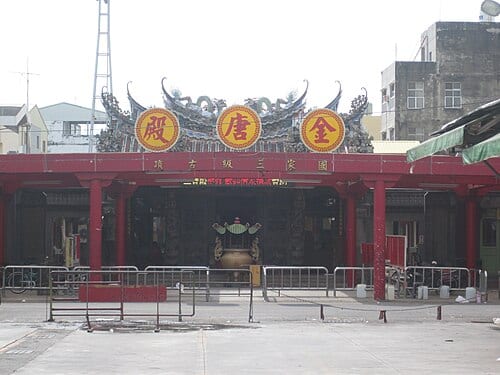
Jiali Jintang Temple is a Qing-dynasty temple monument in Jiali District, Tainan, built in 1698 (the 37th year of the Kangxi reign) and now enshrining the Three Lords — Zhu, Lei, and Yin — popularly called the "Three Elder Lords of Xiaolong." Ye Wang's celebrated Jiaozhi pottery was installed here during an 1855 renovation, but all of it was later replaced by cut-and-paste mosaic (jianzhan) master He Jinlong during a 1928 renovation and no longer survives at the temple today. He Jinlong's surviving mosaic work, spanning the inner and outer walls, roof ridges, and the rear wall of the main hall, is considered one of the most complete collections of jianzhan craftsmanship in Taiwan; the temple was designated a third-grade national historic monument in 1985.
Jintang Temple was founded in 1698 (the 37th year of the Kangxi reign) under the original name Dong'an Temple. Renowned craftsman Ye Wang was commissioned to create Jiaozhi pottery during an 1855 renovation, but all of that work was replaced by Chaoshan cut-and-paste mosaic (jianzhan) master He Jinlong during the temple's fourth major renovation in 1928 — Ye Wang's originals no longer survive. He Jinlong's surviving mosaic work spans the inner and outer walls, roof ridges, the front hall entrance, and the rear wall of the main hall; the temple was designated a third-grade national historic monument in 1985.
What to see at Jiali Jintang Temple
Jintang Temple is located on Zhongshan Road in Jiali District, Tainan. The temple was originally founded during the Kangxi reign of the Qing dynasty and has been repaired and expanded multiple times over the centuries. The cut-and-paste mosaic (jianzhan) work by Chaoshan master He Jinlong, added during the temple's 1928 renovation, is now the temple's most important cultural asset. He Jinlong was one of the most representative jianzhan craftsmen active in Taiwan in the early 20th century, known for vivid color combinations and lifelike figural compositions. His work here, spanning the inner and outer walls, roof ridges, and the rear wall of the main hall, is considered one of the most complete surviving collections of his craftsmanship.
The temple architecture itself has considerable historical value as well, with skilled craftsmanship in the ridge mosaic (jianzhan) and woodcarving ornamentation throughout. The worship route through the temple is clearly laid out, and the temple has provided labeling to help visitors identify He Jinlong's mosaic panels and understand the 1928 renovation that replaced the temple's earlier Ye Wang Jiaozhi pottery (none of which survives today). It is advisable to use the temple's explanatory materials or a guide when visiting in order to appreciate the historical layering of the temple's decorative work. The focus of a visit here is quiet appreciation of static craftsmanship, and the pace is correspondingly unhurried.
Tips for getting the most out of your visit
Practical information
Getting there and time needed
- Located on Zhongshan Road in Jiali District, Tainan. Driving or riding a scooter is the most convenient option. Parking is available in front of and around the temple.
- The temple is generally open year-round for worshippers. Cultural visits are best during daytime hours. Avoiding major ceremony periods is advisable for undisturbed appreciation of the craftsmanship.
Nearby connections
- Nankunshen Daitian Temple and Jingzijiao Tile-Pan Salt Fields in Beimen District are within the nearby area. A northern Tainan itinerary combining temple visits and salt country scenery in one day is possible.
- Jiali District's town center has traditional markets and local food. After visiting Jintang Temple, exploring the culinary scene of Jiali nearby is an easy extension.
Source: Wikipedia entry on Jiali Jintang Temple and Tainan City Bureau of Cultural Affairs historic site data.
Frequently Asked Questions
Can visitors still see Ye Wang's original Jiaozhi pottery at Jiali Jintang Temple?
No — the Jiaozhi pottery Ye Wang made in 1855 was entirely replaced by He Jinlong's mosaic work during the 1928 renovation, and none of the originals survive today.
What craftsmanship is Jiali Jintang Temple best known for today?
It is the cut-and-paste mosaic (jianzhan) work left by master He Jinlong during the 1928 renovation, covering the inner and outer walls, roof ridges, and the rear wall of the main hall.
Which deities does Jiali Jintang Temple enshrine?
It enshrines the Three Lords — Zhu, Lei, and Yin — popularly known as the "Three Elder Lords of Xiaolong."
Sources
- 佳里金唐殿 - 維基百科 — 金唐殿1698年創建、主祀朱雷殷三府千歲;葉王1855年交趾陶已於1928年遭何金龍剪黏全數汰換不復見;1985年列國定古蹟
- 佳里金唐殿創建於清康熙37年主祀朱、雷、殷三王爺 - 台南市政府教育局 — 官方教育資料佐證金唐殿主祀神明與建廟年代(注:該檔案標題年份標註1689疑為誤植,經1662+36年計算確認應為1698年)