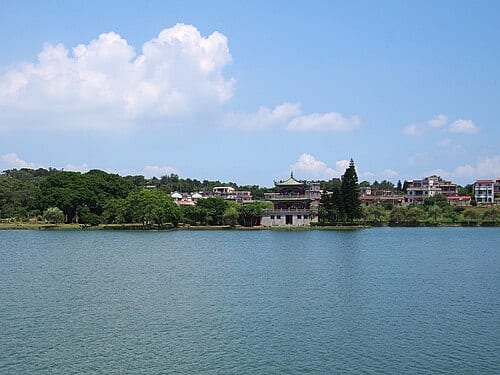
Gugang Lake is a semi-brackish lake at the southern edge of Jincheng Township, Kinmen, where a lakeside rock face bears the "Hanying Yungen" inscription carved in 1653 by the Ming loyalist Prince Lu (Zhu Yihai), and it lies near Zhaishan Tunnel, a wartime waterway excavated between 1961 and 1966.
The "Hanying Yungen" cliff inscription beside Gugang Lake was carved in 1653 (the 7th year of the Yongli era) by Prince Lu, Zhu Yihai (1618–1662), a member of the Southern Ming loyalist court, making it an important historical trace of Southern Ming activity on Kinmen (sources: Ministry of Culture's iCulture platform, National Cultural Heritage Database). Nearby Zhaishan Tunnel was excavated between 1961 and 1966 — a five-year project carried out jointly by military engineers and local Kinmen residents. Its entrance passage runs about 101 meters, and its interior A-shaped waterway is about 357 meters long, built to allow landing craft to pass through (sources: Kinmen National Park Headquarters, Chinese Wikipedia "Zhaishan Tunnel").
Highlights of Gugang Lake
Gugang Lake is on the southern side of Gugang Village, Jincheng Township, and falls within the Kinmen National Park administration area. It is one of the few natural water bodies on the island with a lake surface. The lake is fed by rainfall and is semi-brackish; the vegetation along its shores is predominantly casuarina windbreak forest, with coral trees and other plants adding color — when the coral trees flower in spring the lakeshore becomes particularly vivid. The lakeside trail is level, running about 1 to 2 kilometers in total, suitable for a relaxed walk.
Historic inscriptions preserved on the lakeside rocks include "Hanying Yungen," where the carved text records the feelings of earlier visitors moved by the mountain and water landscape here, adding a layer of cultural depth to Gugang Lake. The entrance to Zhaishang Tunnel is a few minutes' walk from the lake; the tunnel is a wartime waterway blasted through rock in the 1960s that allowed small boats to pass through. Its interior space is impressive and it is one of Kinmen's most notable examples of wartime engineering.
How to make the most of your visit
Practical information
Getting there and timing
- Gugang Lake is in Gugang Village, Jincheng Township, about 10 to 15 minutes by scooter from the Jincheng Township town center. There is a car park suitable for both scooters and cars.
- The trail is open all day with no admission fee. Zhaishang Tunnel charges a separate admission; for opening hours, check the Kinmen National Park Headquarters official information.
Nearby connections
- Zhaishang Tunnel and Gugang Lake are about 5 to 10 minutes apart on foot — combining both is strongly recommended, forming a southern Jincheng Township half-day natural and war-heritage route.
- Heading north from Gugang Lake back into Jincheng Township, the Qiu Lianggong Mother's Memorial Arch and the cultural park can be added to connect with Jincheng's cultural heritage sites for a full-day itinerary.
Sources: Kinmen National Park Headquarters trail and ecology interpretive materials, Jincheng Township Office tourism information.
Frequently Asked Questions
Who carved the "Hanying Yungen" inscription at Gugang Lake?
It was carved by Prince Lu, Zhu Yihai, a Southern Ming loyalist, in 1653, recording the Southern Ming court's presence on Kinmen.
When was Zhaishan Tunnel excavated?
Excavation began in 1961 and finished in 1966, a five-year military project to create a wartime waterway for landing craft.