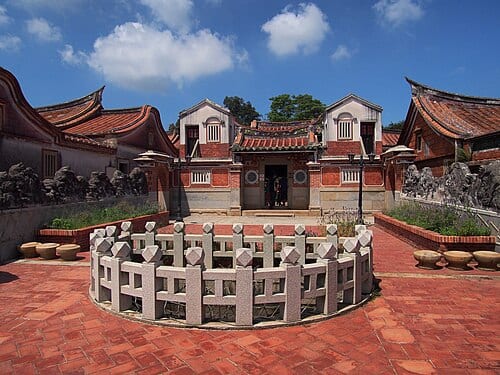
Shanhou Folk Culture Village is a cluster of Minnan buildings in Jinhu Township, Kinmen, funded by the overseas merchants Wang Guozhen and his son Wang Jingxiang, who were based in Japan. Construction began in the second year of the Guangxu reign (1876) and finished in 1900, taking 25 years to complete 16 grand houses along with one ancestral hall and one school, together known as the "Eighteen Houses."
Shanhou Folk Culture Village was funded by Wang Guozhen and his son Wang Jingxiang, overseas merchants based in Japan. Construction ran from 1876 to 1900, a span of 25 years, producing 16 grand houses plus one ancestral hall and one school, together known as the "Eighteen Houses." Wang Guozhen went to Japan in 1868 and founded the "Fuxing" trading firm in Kobe in 1871; Wang Jingxiang later served as chairman of the Overseas Chinese General Chamber of Commerce in Japan and died there in 1923.
Highlights of Shanhou Folk Culture Village
The Shanhou settlement is located in the northeast corner of Jinhu Township, facing the strait. The 18 buildings are arranged in the traditional settlement configuration. The primary building materials were transported from the Fujian coast to Kinmen, including granite stone and timber components. The architectural style is predominantly Minnan da-cuo (grand house) form, with some ancestral halls and communal spaces. The overall layout fully reflects the spatial order of a late-Qing Minnan traditional settlement.
The wood carving, brick carving, and stucco decoration craftsmanship on the buildings is of a high standard. The gable walls, door lintels, and window lattices are all decorated with intricate patterns covering themes including flowers, the Eight Trigrams, and historical narratives. The site is now an important cultural landscape protected by Kinmen National Park, with an exhibition space introducing the history of the settlement's construction and the background of the Wang family.
Tips for Getting the Most Out of Your Visit
Practical Information
Getting There & Hours
- Shanhou Folk Culture Village is in the northeast of Jinhu Township, some distance from Jinhu Town center. Driving or renting a vehicle is most convenient. For bus routes, check the Kinmen County bus official website.
- Opening hours and admission fees are subject to announcements by the Kinmen National Park Headquarters. Allow 1 to 1.5 hours for your visit.
Nearby Connections
- Chen Jinglan Mansion is on the coast of Chenggong Village in Jinhu Township, also within Jinhu Township, and can be combined into a half-day architectural culture route through Jinhu.
- The Taiwushan hiking trail is within Jinhu Township. Those with enough energy can plan it as an extension of the same day.
Sources: Kinmen National Park Headquarters; Wikipedia entry on Shanhou Folk Culture Village.
Frequently Asked Questions
Who funded the construction of Shanhou Folk Culture Village?
It was funded by Wang Guozhen and his son Wang Jingxiang, overseas merchants based in Japan; construction ran from 1876 to 1900, taking 25 years.
What does "Eighteen Houses" refer to?
It refers to the 18 buildings in the Shanhou settlement: 16 grand houses plus one ancestral hall and one school.
What role did Wang Jingxiang hold in Japan?
Wang Jingxiang continued the family business and served as chairman of the Overseas Chinese General Chamber of Commerce in Japan, dying there in 1923.
Sources
- 金門民俗文化村 - 維基百科 — 建造年代、出資者背景、建築棟數