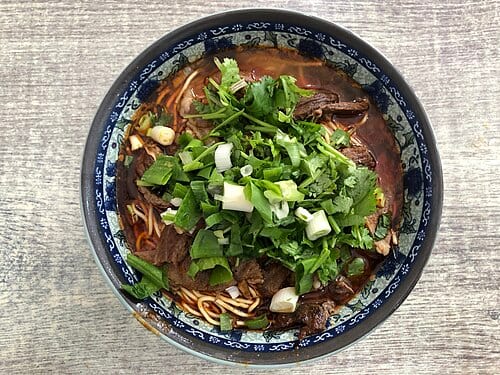
Kinmen Beef is a local beef product from Kinmen yellow cattle whose feed includes kaoliang lees from the Kinmen Winery's distilling process, giving the meat a faint grain fragrance and no gamey smell at all. Inside an old beef restaurant in Gaokeng Village, Jinsha, servers bring out a full table of whole-cow dishes — fresh-poured warm-cut beef noodle soup, braised tendon, offal soup, stir-fried beef, even liver and tongue — a style pioneered by “Gaokeng Eatery,” founded in 1973, and now the signature representation of Kinmen beef cuisine.
The predecessor of Gaokeng Beef Restaurant, “Gaokeng Eatery,” was founded in 1973 by first-generation owner Chen Yashang, starting out with hot beef noodle soup before expanding into whole-cow dishes and ready-to-eat beef jerky. Large-scale lees-fed cattle farming took off after the Kinmen Winery's 1998 corporatization and the subsequent rise in kaoliang sales following the opening of the “Mini Three Links,” which sharply increased lees output; the Kinmen County Government and the Council of Agriculture jointly launched a lees-cattle program, with the winery now supplying about 250 metric tons of lees to farmers daily and Kinmen's cattle population surpassing 6,000 head.
What is Kinmen Beef
Kinmen beef refers to locally raised yellow cattle, a native breed whose core feed is the kaoliang lees produced by the Kinmen Winery. Lees are rich in protein and enzymes; cattle fed on them develop finely marbled meat with a light grain fragrance and no gamey smell whatsoever. The main preparations are the whole-cow feast (various cuts served at the table), fresh-poured warm-cut beef noodle soup, and lees-marinated beef jerky. The fresh-pour warm-cut method is unique to Kinmen — hot broth poured directly over raw beef slices in the bowl cooks them to medium in seconds.
Why does it represent Kinmen? The Kinmen Winery generates large quantities of kaoliang lees as a byproduct. Starting in the 1990s, the Kinmen County Animal Science Experiment Station collaborated with local cattle farmers to use the lees as feed, inadvertently producing the distinctively flavored Kinmen yellow cattle. Gaokeng Beef Restaurant, founded in 1973, pioneered the whole-cow feast format; Liangjin Farm has passed ISO22000 food safety certification, with fresh-pour beef noodle soup as its signature dish. The circular economy from pasture to table — using the winery's byproduct as cattle feed — is what makes Kinmen lees-fed beef irreplaceable.
How to eat it the local way
Local knowledge
Verified facts (sponsored content filtered)
- Certified in the Kinmen County Government's dedicated article "Local Beef Cuisine" — Kinmen yellow cattle are listed as a distinctive livestock product raised on kaoliang lees.
- Gaokeng Beef Restaurant, founded in 1973, pioneered the whole-cow feast and is the landmark old-school beef restaurant in Kinmen.
- Liangjin Farm holds ISO22000 food safety certification; the fresh-pour warm-cut beef noodle soup is a preparation found only in Kinmen.
Visitor tips
- The whole-cow feast is best ordered for four or more people to experience the full range of cuts; two people can opt for single-serving fresh-pour beef noodle soup instead.
- Gaokeng in Jinsha and Liangjin Farm are both some distance from the town center — a rental scooter or private car is recommended, as bus service is infrequent.
- The fresh-pour noodle soup broth is extremely hot; let the beef slices sit for about 30 seconds before lifting them out to avoid burning your mouth.
Data compiled from the Kinmen County Tourism Bureau, Kinmen Winery, and a large volume of public reviews, with sponsored content filtered out.
Frequently Asked Questions
Why does Kinmen beef have a faint grain aroma?
Because Kinmen yellow cattle are fed kaoliang lees left over from the Kinmen Winery's distilling process, giving the meat a light grain fragrance with no gamey smell.
When did lees-fed cattle farming become large-scale in Kinmen?
It expanded after the Kinmen Winery's 1998 corporatization and a subsequent rise in kaoliang sales following the opening of the “Mini Three Links,” prompting the county government and Council of Agriculture to jointly launch a lees-cattle program.
When was Gaokeng Beef Restaurant founded?
Its predecessor, “Gaokeng Eatery,” was founded in 1973 by first-generation owner Chen Yashang.
How many cattle does Kinmen raise today?
With the winery supplying about 250 metric tons of lees to farmers daily under the program, Kinmen's cattle population now exceeds 6,000 head.
Sources
- 高坑牛肉店 - 金門老店 - 金門食尚 - 金門美食讚 — 高坑飲食部1973年陳雅商創立沿革
- 金門畜產試驗所 廢棄酒糟的魔法 - 今周刊 — 金門酒廠1998年企業化改制後酒糟養牛計畫、每日250公噸酒糟供應、金門養牛逾6千頭